
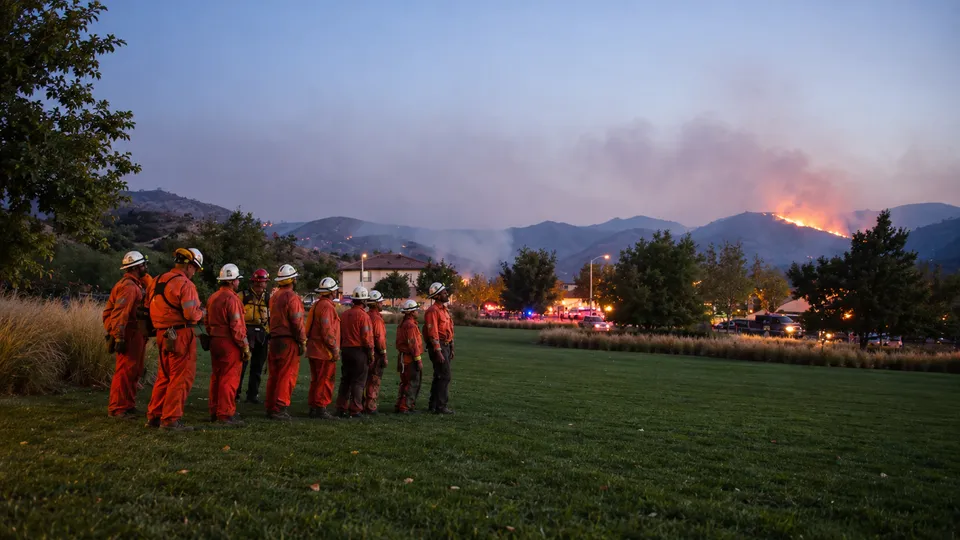
Picture the résumé of a man who has stood on a fire line in Yosemite National Park, cutting brush through 24-hour shifts while a quarter of a million acres of the Stanislaus National Forest turned to black velvet behind him. Now picture that man, upon release from prison, hiding that résumé — stuffing it in a drawer, ashamed that a hiring manager might recognize the letterhead. That is the little bourgeois agony, inverted, that Assembly Bill 2483 was written to end. On Monday Governor Gavin Newsom signed the measure, and with one stroke the state of California admitted that the men and women responsible for nearly half of the emergency hours spent fighting its wildfires might be worth hiring once their sentences are up.
Firefighting, as CalMatters tells it, is grueling work no matter who’s holding the Pulaski: 24-hour days, backbreaking labor, and the heat, always the heat. Incarcerated crews do it for the chance to learn skills and escape the monotony of the yard — and, under a pay law Newsom signed last year, for substantially better wages than other prison jobs, a little upward mobility news from the same signing season in which the state nudged Cal Fire pay upward. But once the gates opened, the résumé vanished into thin air. “Sometimes folks didn’t get any paperwork at all, coming home,” said Assemblymember Sade Elhawary, the Los Angeles Democrat who carried the bill, in an interview with CalMatters. And if a firefighter did walk out with a credential, “it was just kind of like, ‘Here’s the paperwork, good job,’” — a document with little consideration for what employers actually wanted to see. The Golden State Version-of-a-Diploma: suitable for framing, useless for hiring.
AB 2483 attacks the problem with two tools, according to CalMatters. First, it standardizes the credentials incarcerated firefighters receive when they leave prison, so that by 2028 those papers will match the requirements for entry-level jobs at Cal Fire — the state’s own firefighting department, where such positions are a pathway to meaningful work, a six-figure income and a state pension. Second, it gives formerly incarcerated firefighters priority in hiring for those positions. Not a guarantee — a preference, a leg up, a small official acknowledgment that the experience is real.
The man who helped make that distinction stick is Royal Ramey, chief executive of the nonprofit Forestry and Fire Recruitment Program, and Ramey knows Cal Fire from the wrong end of a hand tool. While incarcerated in 2013 he was on the front line of the Rim Fire, that monstrous burn through Stanislaus and Yosemite, working around the clock — sometimes more than 24 hours at a stretch — clearing flammable and hazardous debris until, he said, he was often exhausted. “It changed my life,” he told CalMatters. “At first it was grueling and it sucked, but I embraced it. Once I fell in love with it, I wanted to pursue it as a career.”
He left prison in 2014 carrying a certificate of completion from his firefighting program — and was reluctant to show it to any employer, ashamed a hiring team would recognize he had been in prison. So there he stood, a veteran of one of the great California fires of the century, afraid of his own credentials. Instead he enrolled in the fire program at Victor Valley College in Victorville. “I just wanted to show that I went to a regular academy, you know, nothing that’s associated with being incarcerated,” he said. Clean. Legible. Presentable to polite society. From there he worked for the U.S. Forest Service and then Cal Fire itself, and then founded the nonprofit that would go back to Sacramento and knock.
The knocking had been tried before. Elhawary introduced a similar bill last year and watched it die in committee, CalMatters reports — done in, in part, by opposition from the Cal Fire union, which objected to a hiring quota for formerly incarcerated firefighters the earlier version would have created. This time Ramey was more involved in the negotiations, and this time the quota became a preference with no job guarantee. The union came around. The bill passed. The governor signed.
Ramey’s argument for the preference is that it chips at the stigma applicants already carry through the door — that invisible knock-down they perform on their own résumés before any human resources department gets the chance. “The bill tells incarcerated firefighters that their hard-earned experience counts,” he said. Which is, when you think about it, a remarkable thing to require a law for: that the state which sent a man into a burning forest in an orange jumpsuit should be obliged, afterward, to read his file.