
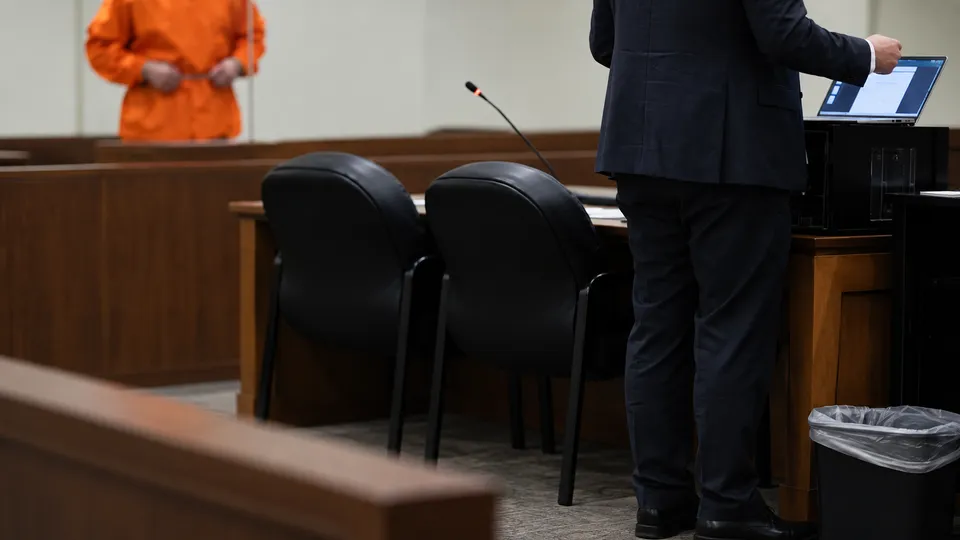
Imagine you run a California county and you have a constitutional obligation to provide a lawyer to poor people accused of crimes. You could employ government lawyers to do it. Or you could hand a private attorney a flat fee — a fixed sum that stays the same no matter how many cases pile up or how little work gets done on each one. The second option has a small design flaw, which is that every hour the lawyer spends investigating or litigating comes directly out of his own effective hourly wage. The incentive, if you write the contract that way, is to plead everything and investigate nothing.
This is not a hypothetical. About two dozen California counties use flat-fee contracts as their primary method of providing public defense, and most of the rest use them for conflict cases — the ones with multiple defendants, where the county public defender’s office takes one defendant and a private firm working on a flat fee takes another. CalMatters investigations found that poor defendants in these systems are routinely convicted without anyone investigating the charges against them, and that lawyers working flat-fee arrangements carry astronomical caseloads and challenge the prosecution’s case less often than other defense attorneys.
Last week Gov. Gavin Newsom signed the Fair Representation Act, sponsored by Assemblymember Nick Schultz of Burbank, which bans flat-fee contracts when a defendant faces the death penalty or life without parole. The law also requires counties to create a separate fund for defense investigators, so that a lawyer no longer has to choose, as Schultz put it, between his take-home pay and hiring someone who might turn up mitigating or exonerating evidence. Josh Schwartz of The Wren Collective, a nonprofit criminal justice reform group, called it the first time California has put “basic guardrails” on its privatized public defense system, adding that flat-fee systems “have long been empirically shown to produce worse outcomes” and that the impact is “especially disturbing” in life-and-death cases.
The law reaches all flat-fee contracts in some way — the other provisions apply across these privatized systems — which means most of California’s counties will have to change how they provide defense. Schultz framed it modestly: “It’s a big first step,” he said, toward making sure the constitutional right to counsel is real rather than, as he put it, “just giving people the appearance of a robust defense.”
The reason California needs guardrails at all is that it has essentially none of its own. The state has a constitutional obligation to ensure effective representation but has handed the whole job to its 58 counties, and it is one of just two states providing no funding and no oversight of basic public defense. Schultz originally wanted to ban flat-fee contracts outright, as several other states have. Rural counties objected, and the bill stalled last year in the Senate Appropriations Committee after then-Chair Anna Caballero — whose district includes counties dependent on these contracts — said her rural areas couldn’t afford it. To get it moving, legislators narrowed the flat-fee ban to the most serious cases. Everything else survived.
A companion law, introduced by Assemblymember Joaquin Arambula of Fresno and signed Sunday, requires counties to report attorney caseloads and other basic information about their public defender systems to the state. The idea, per Schultz, is that once Sacramento can actually see the data, it can write better bills — and eventually grapple with the underlying question, which he stated plainly: “California needs to explore how we would go about funding a public defense infrastructure, the way most other states do.”
Meanwhile, at the fire line
Newsom’s signing pen was busy in other directions too — it has been that kind of bill-signing season in Sacramento. On Sunday night he signed a law intended to narrow the pay gap between Cal Fire firefighters and their better-paid counterparts at city and county departments, a disparity the union says drives turnover.
The mechanism here is a bit of legislative karate. The law doesn’t promise anyone a raise. Instead it requires the next governor to bargain in good faith toward lifting Cal Fire compensation to within 15% of the average at 20 fire departments around the state. Last year Newsom vetoed a blunter version of the bill that called for raises directly, writing that it would “create significant cost pressures for the state and circumvent the collective bargaining process” — officials estimated $373 million to $609 million in the first year. So Assemblymember Heath Flora, a Ripon Republican, brought it back in a form that hands the governor’s office negotiating power over the outcome. This time it passed the Assembly 77-1 and the Senate 40-0. The new law could carry a similar price tag, depending on how the union bargains; its current contract expires June 30, about six months after Newsom leaves office.
The gap is real. A 2025 salary survey found Cal Fire paid about 27% less on average than local departments, for a schedule firefighters regard as harder — roughly 20 more working days a year. A Cal Fire engineer’s total monthly compensation was $21,700 against $26,500 for the same rank at a local department. “This is a big one,” said Cal Fire Local 2881 President Tim Edwards, who credited Newsom with showing appreciation for “the men and women on the front lines of the megafires and the pandemic.” Edwards said closing the gap could take a two- or three-year contract. The workforce in question has grown fast: fewer than 6,000 firefighters as recently as 2019, about 9,500 in the union today.
Two related bills did not survive the week. Newsom vetoed a proposal letting police and firefighters retire earlier on more generous formulas, warning it risked weakening the pension stabilization changes Jerry Brown signed 14 years ago, and on Sunday he vetoed a bill that would have let CHP officers and Cal Fire firefighters divert their last five years of pension contributions into a lump-sum investment account — an idea public safety unions have chased for nearly 30 years, through 10 gubernatorial vetoes. Such accounts, Newsom wrote, can “create long-term fiscal and administrative pressures on departments,” and those questions belong at the bargaining table, not in the Legislature. Which is a tidy summary of the whole week: the only raise he signed into law is the one he gets to leave for someone else to negotiate and pay for.