
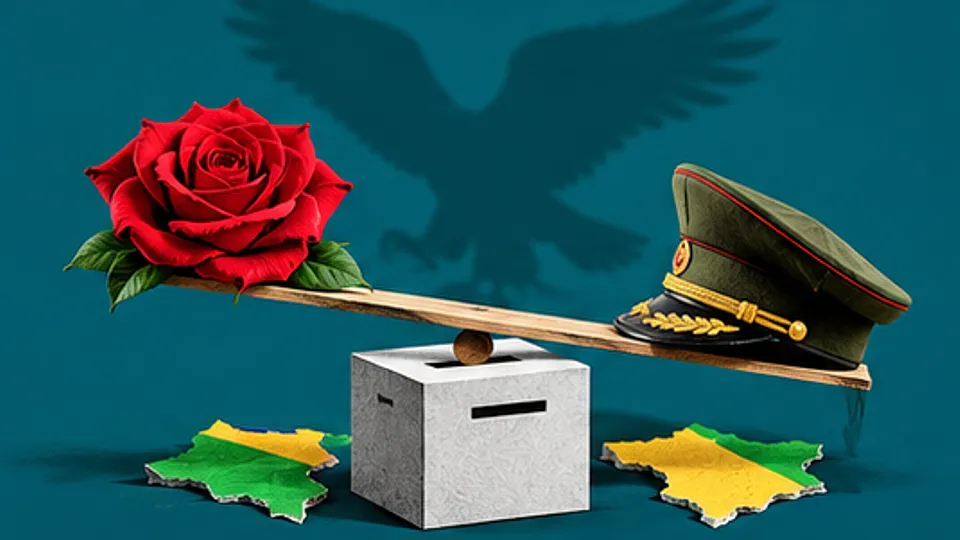
Brasilia, 2016. A backbench congressman named Jair Bolsonaro stands in the Chamber of Deputies to vote for the impeachment of President Dilma Rousseff, and dedicates his ballot to the military officer who tortured her during the dictatorship, when she was a guerrilla fighter. The gesture caused outrage. It also made him famous. Two years later, after three anonymous decades in Congress and a premature exit from the Army for disciplinary reasons, he won the presidency.
Ten years on, history has turned itself inside out. Jair Bolsonaro, 71, is serving a 27-year sentence under humanitarian house arrest, convicted of attempting a coup to overturn his 2022 defeat. And Luiz Inácio Lula da Silva, 80, the man he beat in the streets but not, in the end, at the ballot box, is president and asking Brazil, as it voted on Sunday, October 4, for a fourth and likely last term.
Waiting for him, according to polls that have for weeks shown the two men tied, is Flávio Bolsonaro, 45 — the eldest son, anointed by the father over the objections of his own party. Some 160 million registered voters were eligible to cast ballots on Sunday [FILLED?]. If no candidate clears 50 percent, the top two meet again in a runoff on October 25.
Two Brazils
Al Jazeera described a “deeply polarised” vote, and the numbers explain why. EL PAÍS, surveying the country on the eve of the ballot, found a society “exhausted, apathetic and resigned to its fate” — a single conciliatory nation that has become, effectively, two Brazils. Once again, the paper noted, many voters will be voting against a candidate rather than for a vision of the country.
Voting is compulsory for most adults in the world’s fifth largest country, and turnout is typically among the highest in the Americas, CNN reported — a civic ritual that persists even as enthusiasm for democracy’s offerings evaporates. The pendulum swings, the same old faces remain in power, corruption dominates the news, and life, for many, does not substantially improve.
The son
Flávio Bolsonaro has spent half his life in politics, like his brothers. Sixteen years a Rio de Janeiro city councilman, then the Senate. He is, by general agreement, the least ideological of the clan — an evangelical Christian despite his father’s Catholicism, a man who boasts of having been vaccinated during the pandemic and says his wife and daughters have “re-educated” him. “Flavio Bolsonaro is not the Bolsonaro that most right-wing voters originally wanted to cast a ballot for,” Brian Winter of Americas Society/Council of the Americas told CNN. “He is clearly the most moderate member of the family, and that may give him appeal to swing voters, but it also means that he doesn’t stir enthusiasm in the same way that his father did.”
The father, in fact, imposed him. The Liberal Party establishment wanted a candidate without the Bolsonaro surname, which sits poorly with moderates; the former president overruled them. The son is also under investigation for corruption and money laundering — and not for the first time. Not a single party agreed to ally with him, a measure of his initial weakness. Yet a new poll showed him tied with Lula for weeks before the vote. Four other candidates trail far behind: the centrist psychiatrist Augusto Cury, former Goiás governor Ronaldo Caiado, the Missão party’s Renan Santos, and former Minas Gerais governor Romeu Zema.
God, country, family
How does a family whose patriarch is a convicted coup plotter still command half a nation? The researchers EL PAÍS consulted give an answer older than the Bolsonaros themselves. David Magalhães of the Observatório da Extrema Direita traces a violent, reactionary populism rooted in patriarchy, military authoritarianism and slavery — a radical right that existed long before 2018 and merely entered public debate through the election. Mercia Alves, a political anthropologist at CEBRAP, is blunt: “Bolsonaro didn’t create moral conservatism. He didn’t encourage [big groups] of evangelicals to get into politics, nor did he create the Brazilian far right. What he did do was very effectively rally these elements around a single candidacy.”
The result is a politics of divine mission: abortion, drugs, “gender ideology” placed at the center, elections reframed as battles against evil rather than debates about the economy or security. It has found its most loyal congregation among the poor of the urban peripheries — voters who until 2010 favored Lula’s Workers’ Party, and whose lives, EL PAÍS recounts, are held together less by the state than by the church: the husband who stopped drinking, the mother who learned to read from Scripture, the child taking guitar lessons instead of courted by crime. Pastor by pastor, from Amazonian villages to the wealthy south, the Catholic priests are being displaced. Michelle Bolsonaro, the former first lady with her biblical parables and Instagram videos, preaches a conservative female empowerment to this audience — and aspires to high office herself.
The northern shadow
No foreign government has pressed its thumb on a Brazilian election quite this openly in recent memory. Two days before the vote, the US suspended in-person consular services across Brazil, citing unspecified “security concerns.” Lula’s campaign petitioned the Superior Electoral Court, calling the move “yet another extremely serious development in the interference in Brazilian elections by the US government,” alleging it was “coordinated, by all indications, directly by the brothers Flávio and Eduardo Bolsonaro.” Brazil’s intelligence agency had, in recent days, confirmed US interference on Flávio’s behalf, Common Dreams reported — and Brazil’s attorney general had already opened an investigation after The Guardian revealed the State Department was diverting $1 million from its human rights fund to fight alleged “judicial overreach” by Brazil’s Supreme Court.
“Although Trump has not formally endorsed him, Bolsonaro is undoubtedly Washington’s preferred candidate,” Nick Cleveland-Stout of the Quincy Institute told Common Dreams. The pressure campaign has been long: tariffs of up to 50 percent on Brazilian goods, sanctions on the Supreme Court justice overseeing Jair Bolsonaro’s case, threats of American “military might,” the designation of two Brazilian crime groups as “narcoterrorist” organizations — the same pretext, Common Dreams noted, that Trump invoked for his January invasion of Venezuela to seize Nicolás Maduro. Even three Democratic US senators warned Secretary of State Marco Rubio this week that the administration’s actions “point toward an effort to interfere with, and potentially undermine, Brazil’s general election in October.”
Yet the meddling has a way of ricocheting. Eduardo Bolsonaro claimed credit in Washington for the tariff pressure; Brazilian businesses hurt by the tariffs punished his brother’s campaign for it. “Some have joked that the most effective campaigner for Lula has been Donald Trump,” Winter told CNN. Lula carried the argument to the United Nations: “Brazil is nobody’s backyard.” Dov H. Levin, a political scientist at the University of Hong Kong who studies election interference, cautioned in Folha de S. Paulo: “There are cases of failure, and cases where the reaction provoked by the intervention harms precisely the side it intended to help.”
The continent turning
The stakes stretch past the border. “It’s two competing visions of what the country should look like and what Latin America should look like,” Winter said. A Flávio victory, he argued, would “cement this move to the right” across a region where the right has won 13 of the last 16 presidential elections — Abelardo de la Espriella in Colombia in June, Keiko Fujimori in Peru by a tenth of a percentage point weeks later. Lula, with Mexico’s Claudia Sheinbaum, remains a bastion against the wave. Javier Milei flew in to call Lula a “convict”; Brazil recalled its ambassador to Buenos Aires. Netanyahu endorsed Flávio by video; Flávio met Trump in the Oval Office in May, then Vance and Rubio the next day.
Beneath the geopolitics, the grievances are humbler. Crime tops the list: Flávio promises terrorist designations for criminal factions, new federal prisons and criminal responsibility at 16. The economy, meanwhile, is fine on paper and sour in the stomach. “The economy is OK, but people feel like their salary doesn’t go as far,” Winter told CNN. “They feel like their standard of living has declined, even when sometimes the official statistics tell a different story.” In the poor neighborhoods where religion outbid the state, Brazilians who struggle to feed their children no longer vote with their wallets, EL PAÍS observed. They vote their values. On Sunday, in the world’s fifth largest country, that is precisely what they did.