
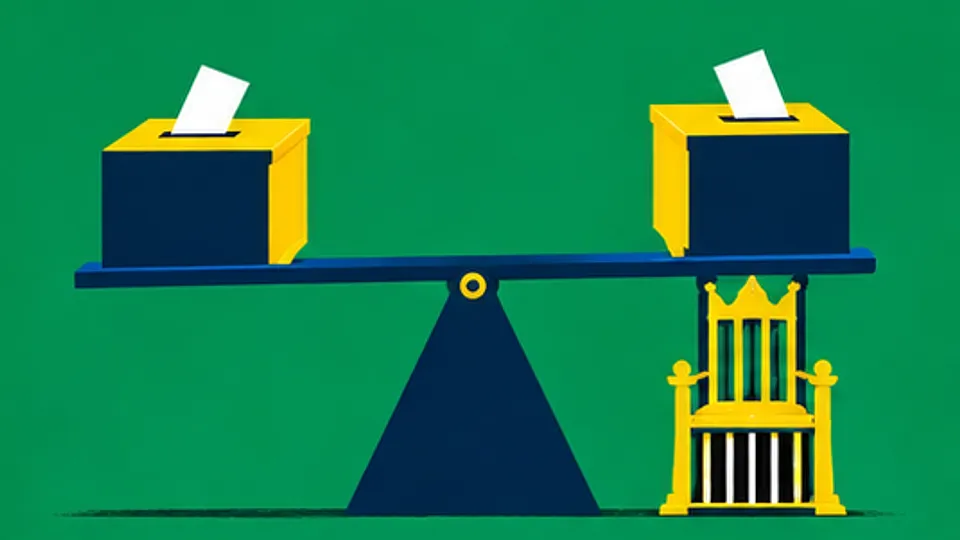
Senator Flavio Bolsonaro, the eldest son of Brazil’s imprisoned former president, goes before voters on Sunday in the first round of a presidential election in which he is statistically tied with President Luiz Inacio Lula da Silva.
A Sept. 24 poll by the public opinion firm Datafolha showed Mr. da Silva with 47 percent in a simulated runoff and the younger Mr. Bolsonaro, 45, with 45 percent, within the margin of error. Other pollsters have found the gap even narrower. Neither candidate is projected to win an outright majority, so the race is expected to go to a runoff.
The family’s patriarch, Jair Bolsonaro, was sentenced to 27 years in prison last year for attempting to overturn his 2022 election defeat. In 2023 a court barred him from public office for eight years for abusing his political power, and he has been banned from social media since July 2025. Even so, his dynasty stands on the verge of returning to power.
Analysts told Al Jazeera that the family’s strength does not rest on a base of true believers; Bolsonaro supporters are estimated at only 15 to 25 percent of the electorate. What fuels it, they said, is “antipetismo,” hostility toward Mr. da Silva’s Workers’ Party, which has won five of the last six presidential elections. “There is a hyperfocus on Lula and the PT, who for over two decades have been branded by many conservatives as the ones solely responsible for rampant corruption,” said Paulo Roberto Souza, a political scientist at the Democracy in Check Institute, an independent research nonprofit.
The elder Mr. Bolsonaro did not invent that sentiment, said Mario Sergio Lima, a Brazil analyst at Medley Advisors, a political advisory firm, but his 2018 victory gave it an identity — he was able to “condense anti-PT sentiment into his own persona.” “It is easy for anyone who is already against the PT to vote for Flavio or anyone who carries the Bolsonaro name,” Mr. Lima said.
The movement remains a family affair. Of the former president’s four sons, Carlos is running for the Senate and the youngest, Jair Renan, for the Chamber of Deputies. A third, Eduardo, moved to the United States in 2025 to lobby President Trump for help with his father’s trial; he lost his congressional seat that December over repeated absences, and in June a Brazilian court ruled his efforts amounted to illegal foreign interference. Former First Lady Michelle Bolsonaro, popular with conservative evangelical Christians, was floated as a presidential candidate before the former president delivered a jailhouse endorsement of Flavio in December.
“It’s a dysfunctional family. They often fight among themselves,” said Fabio Zanini, a columnist for the newspaper Folha de Sao Paulo, who described the clan as a “franchise” that reaches across Brazilian politics. Flavio Bolsonaro has leaned into the inheritance: in early September he rallied in Juiz de Fora, the city where his father survived a near-fatal stabbing during the 2018 campaign, retracing his father’s route to “complete the journey” the elder man could not finish.
He was not always the heir. After the prison sentence, Gov. Tarcisio de Freitas of Sao Paulo, a former Bolsonaro cabinet minister who won Brazil’s richest state in 2022, was rumored as the right’s new standard-bearer. “Cutting ties with the Bolsonaros would have been political suicide for Tarcisio,” Mr. Zanini said. “So someone like him had no alternative but to back Flavio.” Mr. de Freitas chose to seek re-election, and the remaining conservative candidates — Ronaldo Caiado, Renan Santos and Romeu Zema — hold less than 10 percent support combined.
Neither front-runner inspires much affection. A September poll by the firm AtlasIntel and Bloomberg found 51.6 percent of respondents would refuse to vote for Mr. da Silva and 50.6 percent would refuse the younger Mr. Bolsonaro. “Neither of the two main candidates are particularly convincing,” Mr. Zanini said. For many conservatives, he said, Flavio’s chief credential is that “he is seen as the guy who can defeat Lula.”
The campaign took a new blow this month when the Supreme Court unsealed documents showing Mr. Bolsonaro under investigation for alleged corruption, money laundering and the illegal transfer of funds abroad. The case involves his dealings with Daniel Vorcaro, a former banker accused of one of the largest fraud schemes in Brazilian history; Brazilian news outlets have reported that the senator negotiated with Mr. Vorcaro for millions in funding for a film about his father. Mr. Bolsonaro has denied wrongdoing and called the investigation politically motivated.
Mr. Lima said a victory would “definitively cement Bolsonarismo as the undisputed leader of the Brazilian right.” Mr. Zanini argued even defeat could be survivable: “Even if he loses, it will be by a slim margin, and he’d come out of this election strengthened, potentially setting himself up for another run in 2030. It would be a defeat for Bolsonarismo, sure, but it wouldn’t be a death blow.”