
El Dorado, Arkansas, is a town in the pine country near the Louisiana line. The Federal Aviation Administration runs a radio communications site there, the kind of building most travellers would never think about. On a map it sits far from any large airport. On a network diagram it sat right beside all 22 of the centers that guide American aircraft across the sky.
On Friday, November 13, that second geography won. A technician from L3Harris, the FAA’s network service provider, was swapping out a 25-year-old Cisco router at the El Dorado site for a new Juniper Networks machine. Soon afterwards the FAA ordered only the third nationwide ground stop in its history.
A Friday on the floor
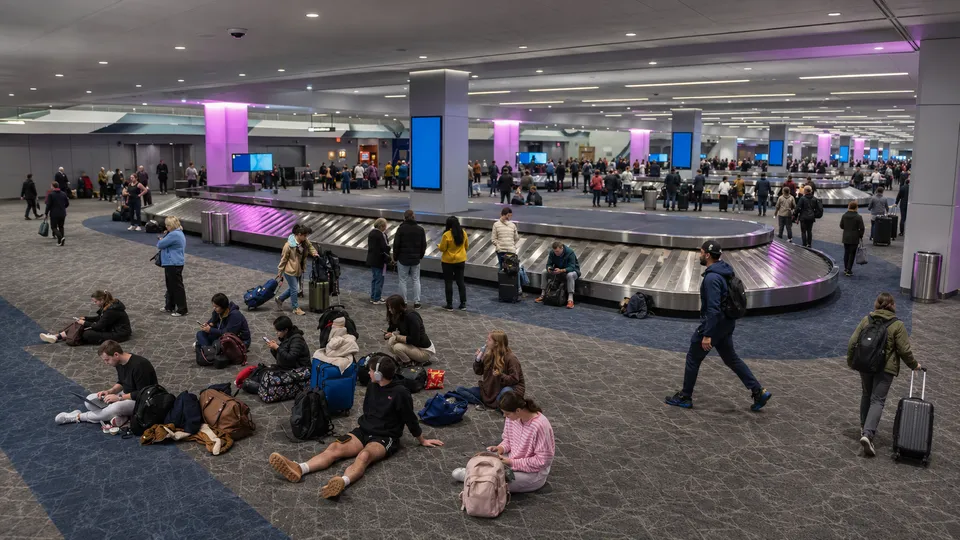
Departures were blocked across the country for more than four hours. More than a million passengers were affected. More than 12,000 flights were cancelled that day, and the count passed 20,000 over the weekend while stranded travellers hunted for hotel rooms, rental cars and buses. Some international flights got out before the wider restart. A photograph from LaGuardia that day shows people sitting on the floor, waiting to get their luggage back.
The cause was not a storm or an attack. It was data. In a question-and-answer post on November 15, the FAA said “data began flooding” its Telecommunications Infrastructure network, the FTI, which carries flight data and voice and video links to air traffic facilities nationwide. The network was receiving 1,000 connection attempts every four to five seconds. That flood caused “instability with aircraft communications and radar feeds” at 17 of the 22 Air Route Traffic Control Centers and at several of the approach control facilities that handle aircraft near airports.
The agency’s first investigation named two places as “the reason for the excessive data flooding the systems”: the radio site at El Dorado and a radar site in Amarillo, Texas, where L3Harris had recently put in a similar router. The work was part of a conversion from old copper wiring to fiber optic lines. According to the Associated Press, as carried by PBS, FAA spokesperson Ian Gregor said the agency stopped installing the Juniper routers and switched off the ones already in service. The national system now runs on the Cisco routers that have been in place for 25 years, while the new units are tested in a laboratory at L3Harris headquarters.
Hewlett Packard Enterprise, which owns Juniper, told ABC News that “the device functioned as it was configured to by the installer. It did not fail or act improperly.” Senate Commerce Committee Democrats wrote that roughly 400 of more than 3,600 planned routers have been installed. Their letter added a line the investigators have not yet answered: “Identifying the device that failed does not establish why it failed.”
Who was in the room
Normally, FAA employees carry out the risk assessments and coordinate with contractors such as L3Harris on maintenance and upgrades. The Professional Aviation Safety Specialists union, which represents the agency’s technicians, said in a statement that none of its members took part in the work that led to the ground stop. CNN reported that the router at El Dorado was replaced by an L3Harris engineer with no direct FAA oversight. According to the union and two sources who spoke to CNN, the FAA technician escorted the contractor into the building and then turned to other work, not knowing what the contractor was doing.
Philip Mann spent 17 years at the FAA. He began as a technician at Denver International Airport and later managed a training program at the FAA Academy in Oklahoma City. He now advises on aviation safety and AI governance at Vector Strategic Consulting. In a long interview with Jeremy Hsu of Ars Technica, he described the rules that used to govern this kind of work.
The first rule is the “blast radius”. A technician asks how far a failure could spread. At Denver, Mann said, it was sometimes one end of one runway. A short-range radar might cover about 50 miles, and the planning assumed that whole circle could go dark for controllers. A router feeding a nationwide network has the widest radius possible, so it calls for the strictest precautions, above all doing the work at night when traffic is light. “Which is when this should have been done,” he said.
The second rule was cruder. Technicians did not break anything on a Friday, and some work was not scheduled after lunch. A failure on Thursday meant people fixed it on a working day. A failure on Friday meant someone gave up a Saturday. Then there was what Mann called the commandment:
“Thou shalt not be on the front page of the newspaper.”
“It seems like all of that was missing here,” he said.
Rules without a guardian
Mann said that in his time an FAA employee was always the contractor’s point of contact. That person cleared them through the fence, arranged their badges and handled the airport authorities. At some facilities only a government employee could physically switch a system back on, even if it took nothing more than flipping a switch, because that act puts the system back into the national airspace. In Mann’s account, Duffy has more or less admitted that the agency mixed up how remote the facility was with how far its service reached, and got the two “completely backward.”
He also pointed to history. In 2009, a Harris technician misconfigured a router that directs air traffic data through the FAA’s telecommunications network. Thousands of travellers were delayed and hundreds of flights grounded nationwide. Mann recalled that the company had identified a couple of dozen areas that might be affected, and the real number turned out to be about six times that. “So they should know better,” he said.
What follows is reflection, not reporting. Big institutions tend to lose their unwritten rules without anyone noticing: the habit of asking how far a failure could reach, the reluctance to start risky work on a Friday afternoon. The written procedures stay in the binder. The person who once stood next to the contractor gets other work. The system keeps running until one ordinary weekday shows that the rules had no one left to enforce them.
Transportation Secretary Sean Duffy has kept blaming L3Harris even though investigators have not settled the cause, and CBS News reported that the contractor struggled during the ground stop to find where the outage was coming from. FAA Administrator Bryan Bedford told reporters investigators were “very close” to the root cause, and said Duffy would announce it at a news conference as soon as Friday, November 20. The agency has already spent about $1 billion of the $12.5 billion set aside to modernize this network, which is still retiring its floppy disks. Until the finding comes out, the country’s air traffic runs on the 25-year-old Cisco routers the new ones were meant to replace.