
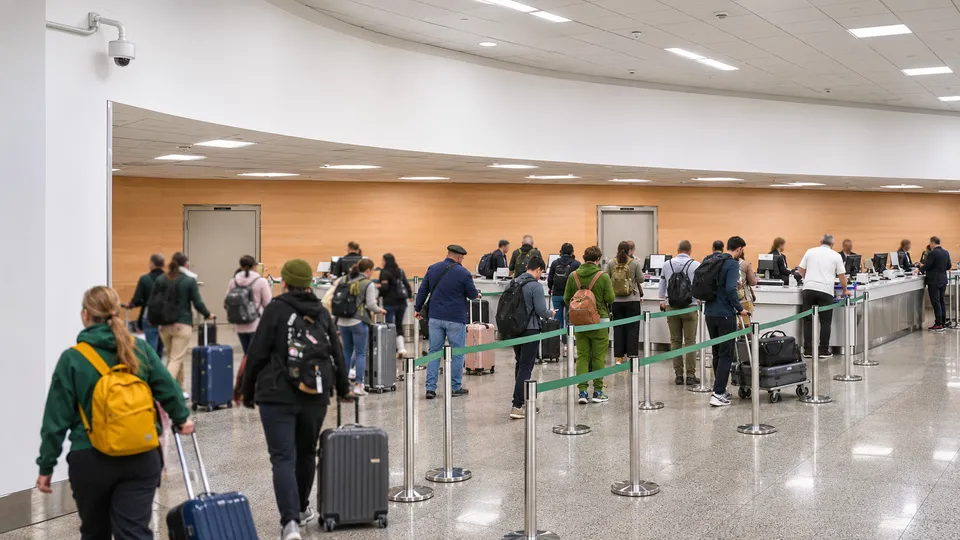
Shortly after 3:30 p.m. on Friday, Nov. 13, a router just installed at a remote radio site in El Dorado, Ark., began flooding the Federal Aviation Administration’s national telecommunications network with data, according to federal officials, and within half an hour the agency had stopped every departure in the United States.
The stop lasted 4 hours and 21 minutes, by Reason’s count, the longest nationwide halt to American air travel since the Sept. 11, 2001, attacks. The cancellations kept coming after it ended. More than 18,500 flights within, into or out of the country had been canceled by the morning of Nov. 16, according to FlightAware data, and the brokerage Bernstein estimated the hit to the four biggest U.S. airlines at $345 million in pretax earnings, Al Jazeera reported. JetBlue had canceled more than a quarter of its Sunday flights by that morning.
The F.A.A. says the flood caused instability at 17 of its 22 en route control centers. The network that failed is not the government’s. It belongs to L3Harris Technologies, the defense contractor that has owned and run it since 2002. The F.A.A. signed a contract to replace it in 2023. That replacement does not exist yet.

The money meant to fix the system has barely moved. Of the $12.5 billion Congress set aside for air traffic control in July 2025, just over $1 billion had been spent by Oct. 31, according to F.A.A. figures. The law earmarks $4.75 billion of it for telecommunications, yet Transportation Secretary Sean Duffy says none of it can pay for the network he needs. He now wants $50 billion more, up from the $30.1 billion the administration requested the day before the outage. In September, the F.A.A.’s administrator told Congress that about $10 billion more would do.
How one router did it
Controllers at the F.A.A.’s Indianapolis center noticed it first, as static and broken transmissions, Yahoo News reported. Bryan Bedford, the F.A.A. administrator, said at a news conference the next day that for about 45 minutes his staff “could not assess the cause of the instability.” At about 3:45 p.m. the agency imposed the ground stop “to remove pressure from the system,” he said, Politico reported.
Engineers traced the traffic to two places. Rebecca Guy, the agency’s acting chief technology officer, said the sites were “pinging our network at a very high rate, a thousand connections over every four to five seconds.” One was El Dorado, where L3Harris had just put in a new router while moving a line from copper to fiber. The other was a radar site in Amarillo, Texas, where equipment had been replaced about three weeks earlier. Once L3Harris blocked traffic from both sites, the network stabilized and air traffic resumed at 8:15 p.m., according to the F.A.A.’s preliminary account.
Mr. Duffy described the moment the El Dorado site came online during an interview on NBC’s Meet the Press on Nov. 15.
what we saw when we turned this facility on was that the router we used was flooding the rest of our network with data.
The routers on the receiving end, he said, “were purchased in 2001. They were obsolete in 2006.” The new unit was made by Juniper Networks, which Hewlett Packard Enterprise now owns, and a company spokesperson said the devices appeared to have worked as designed: “They did not fail.” The F.A.A. has switched off the broadcasting feature that spread the data on all 69 routers of that type, Mr. Duffy said, though other accounts put the number at about 60. Mr. Bedford put the open question as a list: “Was it a faulty installation? Was it a faulty configuration?” Or was it, he asked, “a bad piece of router technology.”
The administration’s own explanations point two ways. President Trump told reporters on Nov. 16 that “what you saw on Friday was very, very old equipment that had a heart attack.” Markwayne Mullin, the homeland security secretary, said on the night of the outage that new equipment was “overwhelming the older system,” according to a reconstruction of the day by GovInfoSecurity. The preliminary findings fit both: a new router overloading equipment bought in 2001. What made the new router do it is still unknown.
The F.A.A. is working with the F.B.I., and officials said on Nov. 14 that they had found no evidence of a cyberattack. Mr. Duffy wrote on X that L3Harris had collected both routers and taken them to its Florida headquarters for testing, with engineers from the F.A.A., Juniper and Cisco involved.
UPDATE: We spoke with the CEO of L3Harris, and the contractor secured the two routers from the remote FAA facilities in Texas and Arkansas. L3Harris is now conducting deep diagnostics testing at their headquarters in Florida. @FAANews, Juniper, and Cisco engineers are assisting…
How much went dark in the control rooms is disputed. Mr. Bedford said “no facilities went dark.” Nick Daniels, president of the National Air Traffic Controllers Association, told Yahoo News, “We know we didn’t have communications with airplanes.” Mr. Duffy also ruled out the agency’s newest tool. The A.I. traffic system the F.A.A. had extended to all 22 centers that week “is not even plugged in,” he said.
A network the F.A.A. does not own
Harris Corporation, which later merged into L3Harris, won the F.A.A. Telecommunications Infrastructure contract, known as F.T.I., in 2002. GovInfoSecurity put the original award at about $3.5 billion. The deal made the network contractor-owned and contractor-operated. It carries voice, radar and data among roughly 5,000 F.A.A. facilities, and much of it still runs over copper circuits that date to the 1960s and that phone carriers no longer support, according to the Government Accountability Office.
The trouble was on record early. The Transportation Department’s inspector general found the program behind schedule in 2006 and reported in 2008 that reliability problems were disrupting air traffic operations, CBS News found in a review of the records. On Nov. 19, 2009, during the network’s first big move to fiber, it failed nationally. The inspector general’s June 17, 2010, letter to the leaders of the House transportation committee gave the cause.
network configuration and procedural errors by the contractor caused the FTI outage
The 2009 failure blocked about 75 percent of the network’s traffic and held up restoration for five hours, the letter said. CBS counted more than 800 delayed flights. The F.A.A. and its contractor acknowledged at the time that “the risk of future outages remains as new services are added to FTI’s fiber optic network.”
On Hacker News, hours after the Nov. 13 stop, a reader posted a link to that report and quoted its tally of the services still waiting to move.
As of December 2009, Harris reported that there are a total of 20,982 services operating on the FTI network. While FAA has transitioned all 1,808 IP services supporting FAA flight plans to the new FTI fiber optic network, additional risks will be introduced when the Agency begins transitioning other FAA services, such as En Route Automation Modernization (ERAM) and NextGen platforms, which also require IP technology to operate.
The parallel has limits. The 2009 failure hit flight-plan data, not the radio and radar feeds that faltered this month, and GovInfoSecurity, reading the inspector general’s findings, traced it to a misconfigured Harris router at the Los Angeles center. But the transition the auditors warned about is the one under way now. The G.A.O. says the F.A.A. plans to replace 5,170 copper lines with fiber and move nearly 30,000 services onto the new links by the end of 2028.
The contract record since then is uneven. Harris won a $291 million job in 2012 to upgrade voice equipment, and the project was terminated in 2018 after $160 million had been spent. A 2024 inspector general audit found 10 improperly authorized extensions of the F.T.I. contract, adding 57 months and $1.5 billion, and warned that the F.A.A. “may be repetitively using these noncompetitive extensions for convenience and administrative ease.” L3Harris has spent $23.9 million on lobbying since 2020, according to Senate records cited by CBS.

The F.A.A. did try to replace the network. In March 2023 it picked Verizon for a $2.4 billion contract, potentially running 15 years, to build F.A.A. Enterprise Network Services, an internet-protocol network meant to replace F.T.I. by 2027. On Aug. 11, the agency gave the lead role to AT&T through an “undefinitized single award” with a $74.3 million first task order, saying a new competition would take at least 22 months, Washington Technology reported. Verizon moved to a supporting role. “I want to get away from L3Harris and get to a new one, but they own the network,” Mr. Duffy said, WXXI News reported.
The outages before this one
By GovInfoSecurity’s count, Nov. 13 was only the third nationwide ground stop ever. The second came on Jan. 11, 2023, when contract workers “unintentionally deleted files” while repairing the database behind the system that sends safety notices to pilots, NPR reported at the time. That stop lasted roughly 90 minutes.

Regional failures have come more often. On April 28, 2025, controllers in Philadelphia handling Newark’s traffic lost radar and radio contact with planes for about 90 seconds, and the inspector general traced it to a single burnt copper wire. On Sept. 19, 2025, two cut fiber cables forced a five-hour stop at Dallas-Fort Worth and Love Field. The F.A.A. blamed outdated infrastructure and faulted Frontier Communications and L3Harris, which it said had not made sure backup systems worked. L3Harris answered that the failing analog circuits had never been replaced for lack of funding.
The age of the equipment is well documented. A 2024 G.A.O. review found 51 of the F.A.A.’s 138 air traffic systems unsustainable and 54 more potentially unsustainable. So is the record of the last overhaul. The NextGen program, begun in 2003, had spent $15 billion of a projected $36 billion by the end of 2024 and delivered 16 percent of its expected benefits, the inspector general wrote in a Sept. 29, 2025, memo.
Where the $12.5 billion went
President Trump signed the One Big Beautiful Bill Act on July 4, 2025. Section 40003 gave the F.A.A. $12.5 billion, about $9 billion for systems and the rest for facilities. The largest lines, as AOPA itemized them, were $4.75 billion for telecommunications, $3 billion for radar and $1.9 billion for a new air route traffic control center. The money is available until Sept. 30, 2029.
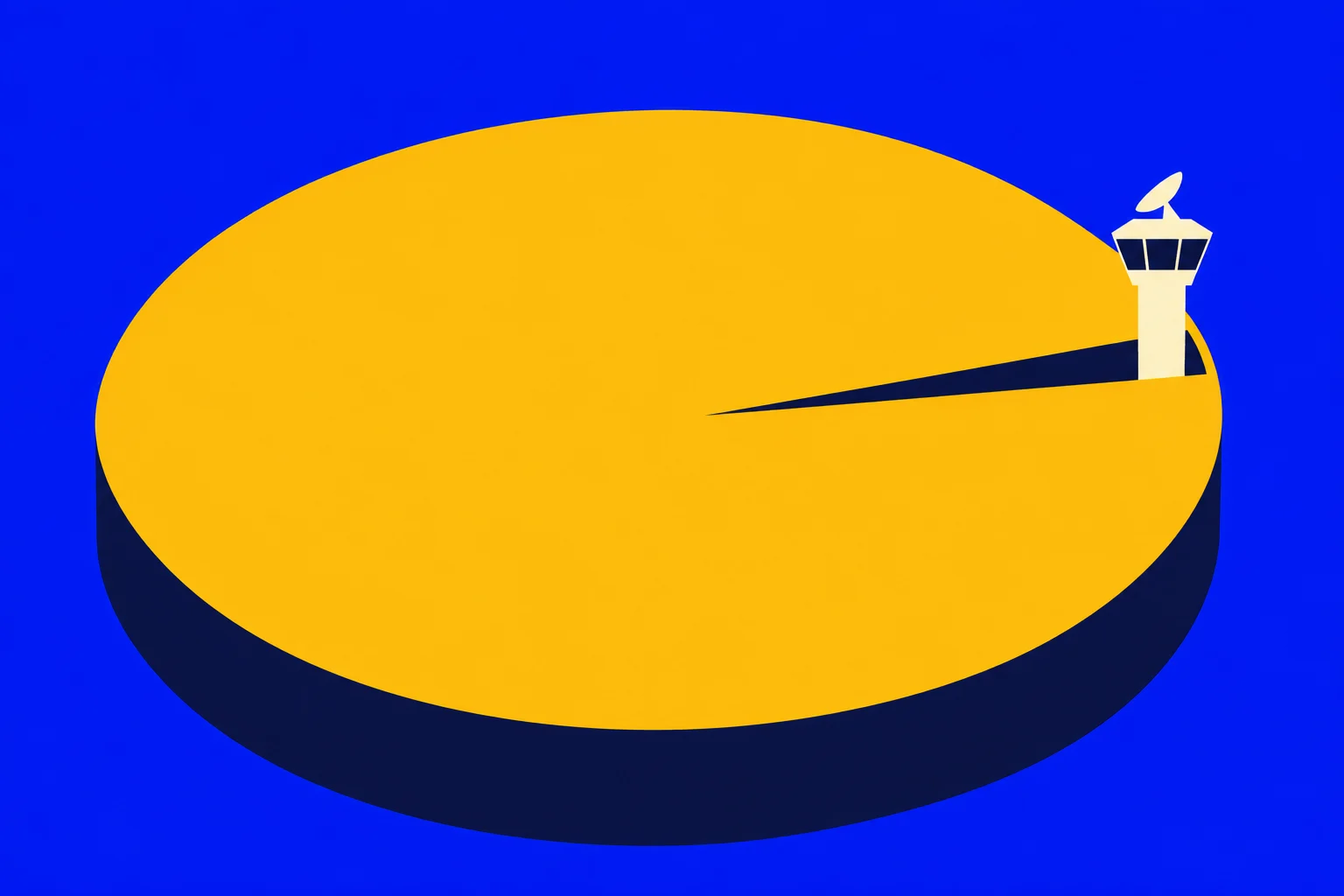
By March, the F.A.A. had obligated $1.8 billion of the systems money, 20 percent, G.A.O. auditors found. By Oct. 31 it had committed $4.3 billion of the full $12.5 billion, about 35 percent, and spent slightly more than $1 billion, about 9 percent, according to F.A.A. data provided to Congress and reviewed by Politico. Representatives Rick Larsen of Washington and André Carson of Indiana, the top Democrats on the House Transportation and Infrastructure Committee and its aviation subcommittee, counted “$8 billion unobligated and $11 billion unspent” in a Nov. 14 statement. “Explain to Congress, again, why they need more money?” they wrote.
The Transportation Department says “every dollar” is accounted for. It points to electronic flight strips at 25 towers, five facilities moved off floppy disks and 469 modernized tower radios, and says about 70 percent of the copper lines have been converted to fiber. The big hardware purchases are only starting. As of Oct. 15, 15 of 612 planned radars had been deployed and none of 435 display systems installed, The Center Square reported, against a December 2028 finish.

Some of the money can’t be spent yet. A budget office document provided by House Democrats shows about $5.29 billion of the reconciliation money designated for fiscal 2028, which begins Oct. 1, 2027, NBC News reported. Democrats call it a freeze imposed on Sept. 28 by Russell Vought, the budget director. The administration called that “an absurd lie” and said funds not yet apportioned stay with the budget office, as they have for decades.
The telecom question
Mr. Duffy’s defense rests on how Congress wrote the law. “They were very specific on how we spend the 12.5, and none of the money goes to this telecom that I have to build,” he said on ABC News, USA Today reported. The statute’s largest line says otherwise: $4.75 billion for “telecommunications infrastructure modernization and systems upgrades.”
The G.A.O.’s accounting explains most of the gap. That $4.75 billion covers telecommunications, voice switches and radios, which the F.A.A. now expects to cost $5.91 billion, and it pays for the copper-to-fiber conversion on the existing L3Harris network. It does not pay for the new AT&T network. The president’s 2027 budget request sought $700 million for that separately. Mr. Duffy’s claim holds if “this telecom” means the new network. As a description of the law, it doesn’t.
On Hacker News, a reader who said he had worked in telecom recoiled at the totals on the day of the outage.
The figures they quoted for the overhaul are absolutely insane - almost $45 billion (I used to work in telecom)
The comparison treats the whole sum as a network bill, and most of it isn’t. The $30.1 billion request sent on Nov. 12 included $10.1 billion for air traffic control, of which $2 billion was for cloud computing and telecom, Roll Call reported. The rest was for towers, terminals and other airport work. The F.A.A. says only that the AT&T contract will become a multibillion-dollar award once its terms are set.
Mr. Bedford drew a second line, between the modernization program and the work that failed.
This is ordinary, course-of-business stuff. This is not part of the Peraton, FAA $12.5 billion modernization effort
Peraton is the integrator the F.A.A. hired on Dec. 5, 2025, to run the overhaul, under a contract with a $1.5 billion ceiling. The G.A.O., though, lists the replacement of all 5,170 copper lines in Phase 1 of that same program, and the agency had replaced 2,560 of them by May. The F.A.A. told Roll Call that “it is important to distinguish routine equipment upgrades from the FAA’s broader modernization effort,” but it has not said which account paid for the El Dorado job. Whichever it was, the work that failed was the conversion the modernization depends on.
From $10 billion to $50 billion
The price has moved fast. In 2025 the department said it needed about $20 billion beyond the $12.5 billion to finish by 2028. On Sept. 15, Mr. Bedford testified that Phase 1 would cost $16 billion and that about $10 billion more would be needed. Later that month Mr. Duffy asked for $30 billion. On Nov. 12, he and Mr. Vought sent Congress the $30.1 billion letter. On the night of Nov. 13 the figure became $50 billion. “What I’m trying to do is get a number that I think the Congress will give me,” Mr. Duffy said the next day, according to ABC News.
Oriana Pawlyk, who covers aviation for Politico, had interviewed Mr. Duffy days earlier about the smaller figure, and she posted about the jump that night.
Earlier this week, Secretary Duffy told me he’d personally begin lobbying Congress for $30 billion for air traffic control funding.
Tonight, after an equipment outage prompted a nationwide groundstop, Duffy says he now wants Congress to fund **$50 billion** for the effort
The G.A.O. reported in September that the F.A.A. could not produce the analysis behind its $10.6 billion Phase 1 estimate, which left out government labor and most operating costs, and that the agency was running 11,389 separate project schedules with no master schedule. “They’re buying speed at the risk of cost uncertainty,” Kevin Walsh, a G.A.O. director, told The Center Square. Of the new requests, he said, “It’s unclear how much support or analysis is behind those numbers.” Marc Scribner, a transportation analyst at the Reason Foundation, was blunter: “They’re going to ask for the highest plausible number and take whatever they can get.”
Representative Rosa DeLauro of Connecticut, the top Democrat on the House Appropriations Committee, is in line to chair it in January. She called the request a “$50 billion ransom without a real plan to deliver,” and wrote in a statement:
Congress has shown its willingness to modernize the FAA’s systems and support its workforce as part of annual bipartisan legislation, but we need a competent partner at the Department of Transportation to carry this out in a sustainable, transparent manner
Republicans who passed last year’s money want the arithmetic too. “I understand we have inflation, but it’s not that dramatic,” Senator John Kennedy of Louisiana told USA Today. Senator Thom Tillis of North Carolina said “people have got to explain to me really even the basis for the $30 billion, let alone the additional $20 billion.” Senator Susan Collins of Maine, the Appropriations Committee chair, said, “I don’t see the justification yet for that much.” Senator Mike Rounds of South Dakota said the department had funds “that have not been contracted.” Senator Roger Wicker of Mississippi went the other way: “I think we need to get him some more money.”
The case against more money
The most direct objection comes from people who want air traffic control taken away from the F.A.A. altogether. Liz Wolfe, an associate editor at Reason, wrote on Nov. 16:
Rather ridiculously, the systemwide meltdown wasn’t caused by the old system; it was caused by the effort to replace it.
Robert Poole, who has long argued at the Reason Foundation for a self-funded air traffic utility, wrote the same day that the stop “should not have happened” and that more than 90 countries get air traffic service from stand-alone providers that are separate from their safety regulators. His model is Nav Canada, which he wrote “replaced paper flight strips with electronic strips in less than two years.” The F.A.A. counts electronic strips at 25 towers as progress.
Even supporters of the money concede it would not have prevented Nov. 13. Chris Sununu, chief executive of Airlines for America, said as much on CNBC while urging Congress to pass it. Michael McCormick, a former F.A.A. official now at Embry-Riddle Aeronautical University, told Newsweek that the agency was underfunded for decades but that “money alone won’t fix the problem.” Eric Soskin, the department’s inspector general under President Joe Biden, told CBS the outage “confirms the importance of pushing ahead with the technology upgrades,” adding a warning: “The transfer needs to be handled carefully.” Scott Kirby, United’s chief executive, said “this moment must be a call to action.”
On Hacker News, a reader made the case for the equipment the administration wants to retire.
I think the problem with a lot of the push to “modernize” is we forget the legacy system has been real-world tested for 40 years now. It’s the new stuff that needs to prove itself in terms of stability.
The record cuts both ways. The old plant fails on its own: a burnt copper wire at Newark, unreplaced analog circuits in Dallas. But the three failures since 2009 that reached the national system, in 2009, 2023 and this month, all came while contractors were changing something. The G.A.O. named that risk in September, warning that uncoordinated schedules could cause “excessive disruptions” to air traffic operations.
Another reader on the same thread asked about the hour.
Anybody familiar with these systems know why they would do an update like this at 3pm on a Friday? This would be extremely unusual in any software job I have ever had.
Controllers raised the same point. Anna Giaritelli, a Washington Examiner reporter, said on CNN that she had spoken with 60 controllers that night and that “none of them are buying what he said,” because such switches are done “midweek, middle of the night, when there is no air traffic going on,” Common Dreams reported. Their doubts were about timing, not an alternative cause, and no controller was named. Mr. Duffy promised at the Nov. 14 briefing to reconsider when work at small sites is done. Mr. Daniels said failures like this often follow skipped safety reviews before maintenance, but said he did not know whether that happened in El Dorado. Whether L3Harris followed the F.A.A.’s change procedures has not been disclosed.

What comes next
Mr. Duffy was scheduled to make his case at the Senate Republicans’ weekly lunch on Tuesday, Nov. 17, and department and F.A.A. staff are briefing congressional aides this week. Senator John Thune of South Dakota, the majority leader, has signaled he will not try to pass the money through a Republican-only reconciliation bill, Politico reported, which means it would need Democratic votes. “The question is: Are we going to partner with the Democrats?” he said. Speaker Mike Johnson has said the House will consider up to $50 billion in a year-end package.
The calendar is short. Government funding runs out after Dec. 11, and several Senate Democrats have said they are willing to risk a shutdown to press Mr. Trump to end the war in Iran. “If they need more, they should come up and justify it,” Senator Chris Van Hollen, a Maryland Democrat, said on CNN. Democrats take control of the House in January, and Mr. Larsen has said committee Democrats are rebuilding their oversight staff with the modernization rollout as a top priority. He and Mr. Carson expect Mr. Bedford at a hearing in early December.
On Hacker News, one reader argued that the speed of the official explanation was itself a reason for doubt.
the fact the transport secretary immediately pointed at specific issue (overloaded routers) without any investigation, combined with the fact that this revelation was intermediately followed by the request for money means that I will not trust what they are saying unless there is an independent investigation about what happened.
The inquiry so far is not independent in any formal sense. The F.A.A. and L3Harris are running it together, and the routers are being tested in the lab of the company whose installation is in question, with the F.B.I. assisting. The official account did change between Friday night, when Mr. Duffy blamed overloaded old switches and routers, and Saturday, when he named a new router installed by a contractor. The two versions are compatible. Neither is a root cause.
The two routers remain at L3Harris’s headquarters in Florida. The F.A.A. has set no date for its findings.