
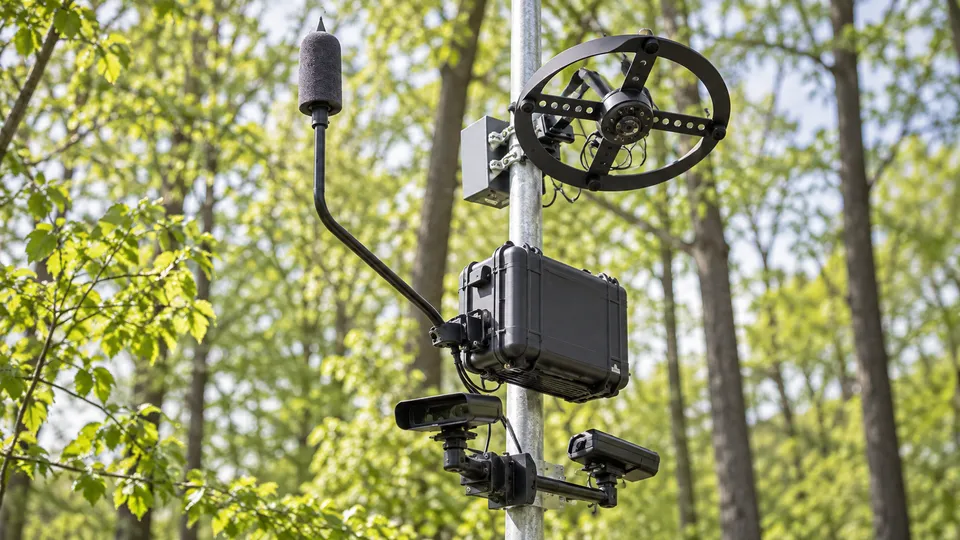
A driver with a modified exhaust rolls down a shoreline street in West Haven, Connecticut. Somewhere above the pavement a microphone registers the spike, a license-plate reader reads the plate, and an email lands in a police inbox to await human review before any citation goes out. This is how the machine age comes to municipal life: not with a robot on the corner, but with a small ear bolted to a pole, listening for the loudest car in town.
The ear is no longer an experiment. In New York City, muffler violations already carry penalties between $800 and $2,625, and acoustic sensors are being paired with existing plate-reader networks in more and more places. The hardware is going up faster than the policy around it — who sets the decibel threshold, who reviews the flag, who owns the data — and the rules are being written while the sensors listen.
Eleven Percent
New York offers the clearest operating picture. Twelve cameras generated 15,994 detected noise events in 2025, according to the city’s annual report, and from those events came 1,691 summonses — a conversion rate of about 11 percent. That low share is, in one sense, reassuring: human reviewers are filtering the flags before anyone is fined. It is also a silence. The city has not published a breakdown of why the other 89 percent of events produced no summons, which makes the system’s accuracy impossible to evaluate independently from the totals alone.
Connecticut is further behind, which is its own kind of honesty. West Haven purchased AXIS Audio Analytics devices to pair with Rekor plate readers already installed along its shoreline streets, but only one device is in place, and it sits there inactive while officials settle the sound threshold and the remaining ordinance details.
The state framework around them is already written: 80 decibels is the statutory trigger, and the penalties climb by degrees — a written warning for a first violation, $100 for a second, $250 for each after that. West Haven has not yet locked in its own parameters. Mayor Dorinda Borer says the system is aimed at aftermarket mufflers and deliberate engine revving, not at someone playing music at a stoplight. A reasonable goal — and an unverified one until the threshold is published and the ordinance specifies it. Wethersfield and East Hartford have both approved similar ordinances; neither system was active as of the latest reporting.
The Debts the Hardware Cannot Pay
Calibration is the first debt. No published false-positive data exists for West Haven’s planned deployment, and New York’s high drop rate, while it suggests meaningful filtering, explains nothing about why events were discarded. From outside city hall, the machine’s judgment is a sealed ledger.
Data retention is the second. West Haven officials say the city owns the data and will not share it with third parties — a start, though declining to share is not the same as setting a limit on how long the records live. Connecticut’s framework confines plate capture to the violating vehicle as far as possible. Skepticism is earned here: plate-reader networks elsewhere in the country have grown far larger than their owners admit, and a single misread ping has already put an innocent woman in a Florida jail for thirteen days.
The third debt is the appeal, and it is the heaviest. Automated flagging with human review is meaningfully better than a machine that tickets on its own, and Connecticut law requires municipalities to let drivers contest citations at a hearing and to spell out available defenses — but West Haven’s ordinance has not yet published how that will actually work. That gap is exactly where a flawed ticket stops being a statistic and becomes a problem for the person holding it. Dallas has already walked this road: AI cameras mounted on garbage trucks photographed properties and assigned them blight ratings, and the deployment drew serious questions about whether the appeals process was adequate before enforcement began. Sensors first, governance later — the pattern repeats itself from city to city.
None of the remedies are exotic. Publish the decibel threshold before the device is switched on. Post annual reports, as New York does, so residents can measure the machine against the claims made for it. Write the appeal process before the first fine is mailed. The microphone can hear a loud car; only the paperwork can hear the driver.