
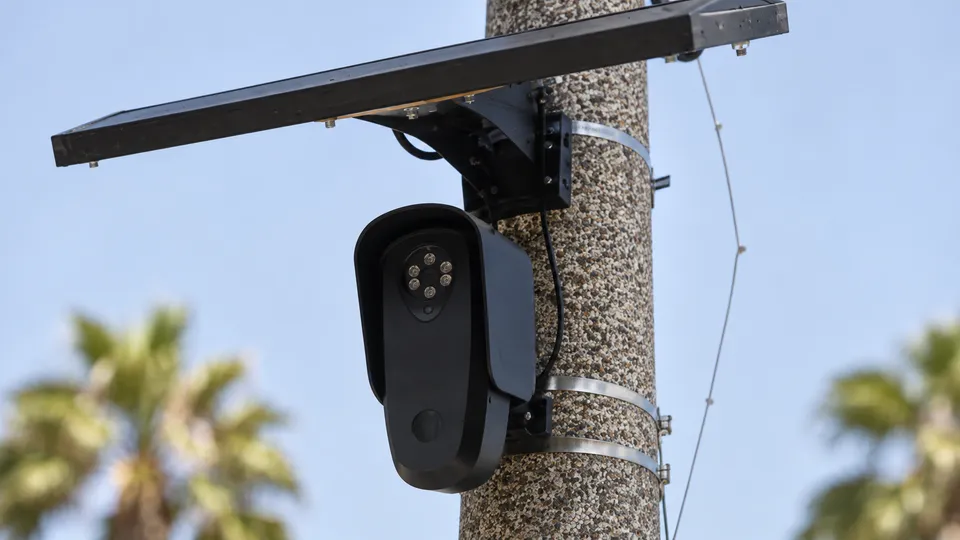
Two in the morning, Palm Beach, Florida, October 2025. A 23-year-old woman named Lindsey Isaacs opens her eyes to find state troopers standing outside her apartment and a tow truck — a tow truck, in the dead of night — hooking up her black Dodge Durango and hauling it away. The troopers, according to her account, had a story for her. A day earlier, a few miles off, there had been a terrible crash on I-4. Three people were dead. Witnesses said a Dodge Durango had done it. And somewhere in the humming, unblinking lattice of cameras that Flock Safety has draped across American roads — automated license plate readers, ALPRs, the great digital net that photographs your car and mine and logs the where and the when — her plate had popped up, near the time, near the place.
That, more or less, was the evidence. One camera. One ping. One data point.
Isaacs described the exchange this week, testifying before members of the U.S. Congress: “They said, ‘We have your plate on a Flock camera, and your car has damage consistent with a collision.’” Her answer, as she recalled it: “Where’s the damage? You’ve got the wrong person.”
She had a point, and it was not a subtle one. A glance — a glance — at the impounded Durango would have shown a vehicle with no crash damage at all, which is an odd condition for a car that supposedly killed three people some 24 hours earlier. And then there was the matter anyone with a working pair of eyes might have noticed: eyewitnesses at the scene had described a maroon Durango. Isaacs drives a black one. Maroon. Black. These are not adjacent shades on a paint chip. Nevertheless, her car went into evidence, into the impound lot, and the machine of accusation rolled on without her in the driver’s seat.
Seven months to notice nothing
What happened next is, if anything, stranger. The Florida Highway Patrol did not arrest her that October night. The agency waited — and on April 17, 2026, roughly seven months after the crash, it issued a warrant for her arrest. Seven months. Seven months in which, one might imagine, an investigator could walk around an impounded Durango, kick the tires, run a hand along the fenders and observe that the alleged instrument of a triple-fatality collision had never, in fact, collided with anything. Instead, according to the available reporting, there was no physical evidence tying Isaacs to the scene beyond that single Flock sighting showing her car had been in the vicinity that day.
So they arrested her on eight felony counts, three of them vehicular homicide, and put her in maximum security jail housing. She spent 13 days behind bars. Of those, 86 consecutive hours — more than three full days — were spent in solitary confinement. Correctional officers, she told the U.S. Senate, explained the isolation by citing “the severity of the charges.” The severity of the charges for a crash she had nothing to do with. The circle closes itself beautifully, doesn’t it? The accusation justifies the punishment, and the accusation came from a camera.
“I was terrified. I was facing the possibility of spending the rest of my life in prison for a crash that I knew I had not been involved in. I did not know if I would ever get out of jail. At my lowest point, I didn’t want to be alive.”
The arrest, by the reporting of it, cost Isaacs her job as well. That is what a data point can do when the human beings attached to it decide not to think.
The photograph that did what police would not
Her release came down to something a seventh-grade science fair would consider basic: pictures. According to reporting from The Center Square, after two weeks in jail, Isaacs was freed only “when her attorney was able to present photos to the judge of her possessed vehicle — which, contrary to the claims of the troopers who possessed it, showed no damage.” The defense took snapshots of the very car the state was holding, showed the court that the state’s central factual claim was false, and the judge granted bond. In May 2026, Florida dropped all charges against her. Around that same time, police arrested a different woman on suspicion of the same fatal collision.
Isaacs now has a civil lawsuit pending against Florida Highway Patrol troopers. What sum compensates a person for 13 days in a maximum security jail, 86 hours of solitary, a lost job, and the experience, by her own testimony, of not wanting to be alive? A jury may get to price it.
The camera does not think, and neither, apparently, does anyone else
Flock’s cameras have become the most recognizable brand in a booming surveillance trade — ALPR networks operated by Flock and competitors such as Axon, reading plates by the millions, feeding databases that police departments query at will — and the backlash has arrived from both ends of the political spectrum, a genuinely bipartisan American grumble. Critics have warned the systems are ripe for abuse, whether by overreaching officers or by hackers prying into the data. The Isaacs case suggests a quieter, dumber danger, which you might call the outsourcing of suspicion: a camera supplies a lead, and the lead hardens into a conclusion, and nobody between the lens and the jail cell performs the elementary act of checking.
That was the message Isaacs carried to Washington. “I came here today because I want you to understand that surveillance technology does not exist in a vacuum,” she told lawmakers. “Information collected by technology can become part of an investigation that affects a real human being. In my case, a Flock camera captured my vehicle a few miles from the scene of a terrible crash. That piece of information became part of an investigation that ultimately led to my arrest on three counts of vehicular homicide and 13 days in jail for a crash I had nothing to do with.”
A real human being. It says something about where the technology has taken us that this is now a point a citizen has to fly to the Capitol to make. The camera saw her car. The camera was, in its narrow mechanical way, correct: the car was there. Everything built on top of that sliver of fact — the damaged vehicle that wasn’t damaged, the maroon Durango that was somehow black, the seven months, the warrant, the solitary cell — was human work, and it was shoddy all the way down.