
Every November the scientists bring the governments a ledger. It records what humanity burned in the year now ending: coal in the power stations, gas in the boilers, oil in the tanks of trucks and cars and aircraft. This year it reached Antalya, on Türkiye’s Mediterranean coast, where the United Nations climate talks, COP31, opened on 9 November. At the bottom stood a number with an unfamiliar sign in front of it. Minus 0.4 percent.
According to the Global Carbon Budget 2026, compiled by an international team led from the University of Exeter, fossil carbon dioxide emissions are projected to reach 38.2 billion tonnes this year, 0.4 percent less than in 2025. A companion study in Nature Climate Change, led by Corinne Le Quéré, a professor of climate change science at the University of East Anglia, sets that dip against the recent record. Between 2019 and 2025, as Scientific American reported, fossil emissions grew by about 0.8 percent a year. The study calls the 2026 fall “short-term.”
The cause is a war.
The price at the pump
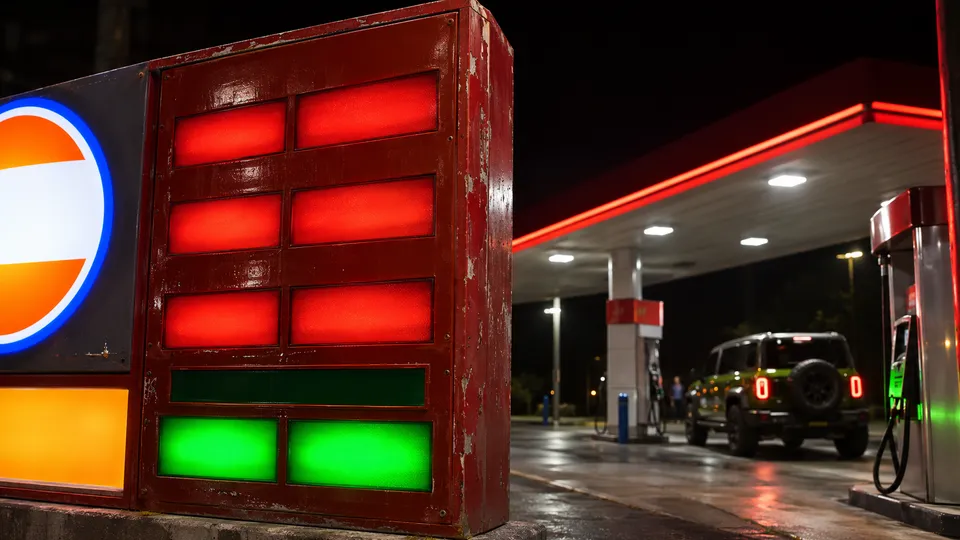
The U.S. war with Iran drove fuel prices so high that people bought less oil. The paper ties the decline to petrol and diesel prices that, depending on the fuel and the period, ran 10 to 50 percent above 2025 levels in the United States, China and the 27 countries of the European Union. Emissions from oil are projected to fall by 1.9 percent. The same shock has kept the oil market pricing trouble in the Strait of Hormuz and sent American oil company profits nearly tripling. Those who sell the fuel did well out of the year. Those who had to buy it paid, and so they used less.

“The high petrol prices following the war in Iran are reducing oil use and keeping emissions low,” Le Quéré said. “But that’s not the whole story: The expansion of renewable energy has progressed a lot in recent years, led by China. And [along with electric vehicles], this is offsetting two thirds of the growing demand for energy.”
What the machines did, and what they did not
This is not 2020, when the pandemic emptied the roads and factories and energy demand fell almost everywhere. In 2026 demand kept rising. As Scott K. Johnson explained in Ars Technica, new electric vehicles and new solar and wind generation covered almost 70 percent of that growth. Yet electric cars explain only about 20 percent of the drop in oil emissions. Most of the drop comes from prices. The machines took the edge off the growth; the war did the rest.
The clean machines matter more each year all the same. Emissions avoided by solar and wind power rose from 0.28 billion tonnes in 2010 to 4.1 billion tonnes in 2025, and are projected to reach 4.6 billion tonnes in 2026, according to the budget’s findings. Half of all the emissions avoided by renewables and electric vehicles are in China, where emissions are projected to fall by 0.9 percent this year after two years of slow growth. Beijing, as rews reported earlier this week, still keeps building coal plants and has never said what its peak will look like.

The researchers broke the problem into its parts: a country’s output, the energy it takes to produce each unit of that output, and the carbon released by each unit of energy. Output can rise while emissions stay flat or fall, if the economy shifts away from heavy industry or the energy system gets cleaner. Between 2019 and 2025, 59 countries cut their emissions while their economies grew. Without the spread of electric vehicles, solar and wind, the team estimates, global emissions would have risen by 1.9 percent a year over that period, not 0.8.
The rebound
History offers little comfort here. Emissions fell by an estimated 5 percent or so during the pandemic, Le Quéré noted, and dipped slightly after the 2008 recession. “However, in both cases, emissions rebounded the year after,” she said.
Feeding the International Monetary Fund’s growth projections through 2028 into their model, the researchers expect fossil emissions to keep rising. Without the oil shock, 2026 would have been a year of growth too. If oil prices fall back to their prewar levels, emissions are expected to climb again, though more renewable energy could offset part of that rebound, Le Quéré said.

The minus sign also covers only part of the ledger. Once deforestation and other land-use change are counted, total carbon dioxide emissions are projected at 43.3 billion tonnes in 2026, up from 42.8 billion tonnes last year. The remaining budget for holding warming to 1.5°C, the budget’s authors say, is now 150 billion tonnes, less than four years of emissions at the current rate. The year itself is on track to be among the hottest ever recorded.
“A decline in fossil CO2 emissions is encouraging, but a reduction driven partly by geopolitical shocks is not a sustainable climate solution,” said Pierre Friedlingstein of the University of Exeter, who led the Global Carbon Budget.
A reflection, then, and only that: rulers who start wars seldom set out to cut the world’s carbon emissions, and a gain that arrives this way lasts no longer than the price spike that brought it. The decline that counts is the one nobody has to be squeezed into.
“We show that to tackle climate change and guarantee that global fossil emissions decrease durably, the expansion of renewable energy and electric vehicles need to accelerate further,” Le Quéré said. The paper ends on a condition: “If further acceleration of clean technology deployment can be supported through time, a sustained peak and decline in global CO2 emissions could be a few years away.”