
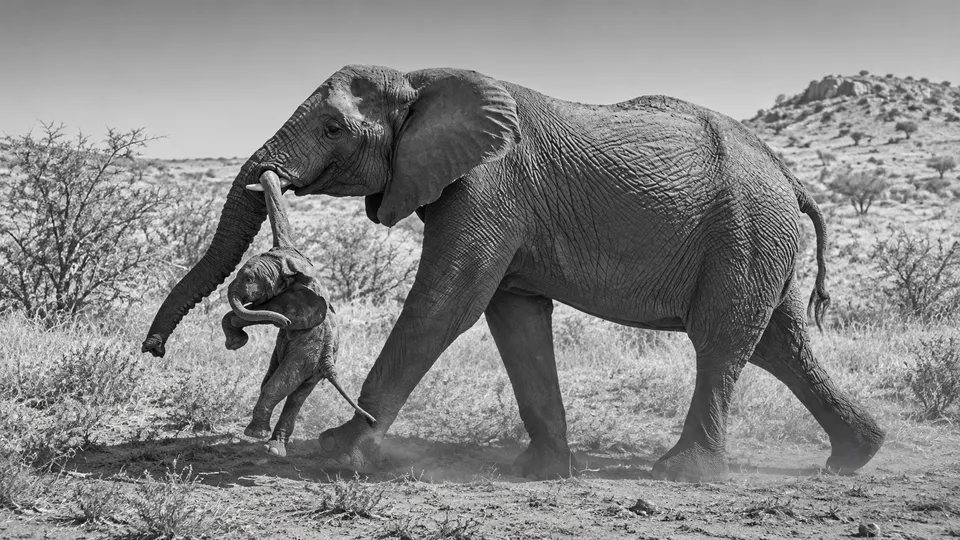
A female elephant carrying the limp body of a calf, its legs wrapped around her trunk, beat 65,403 other entries from 121 countries and territories to win the Natural History Museum’s Wildlife Photographer of the Year 2026, as the museum announced on 13 October. The photographer, Federico Veronesi, was tracking a herd along the dry Huab River in Namibia’s Namib Desert in September 2025 when he spotted an unusual pattern of drag marks in the sand. He followed them to a family group, where a female emerged with the calf’s leg wedged between her tusk and trunk. Jury chair Kathy Moran called the picture, titled The Aftermath, “a gut punch” and “proof that animals have cognition,” according to the museum’s press release.
Veronesi assumed he was looking at a grieving mother. She wasn’t. As Isabelle Gerretsen reported for BBC Future, Christin Winter, conservation programme director at the Namibian non-profit Elephant Human Relations Aid (EHRA), identified the elephant as a 14-year-old female who lost her own calf two years earlier. Since then, Winter says, she has carried the stillborn calves of four other mothers – the first time this specific behaviour has been documented in the area EHRA monitors. She carried this calf for hours, setting it down periodically to feed or drink before picking it up again.
What she was carrying
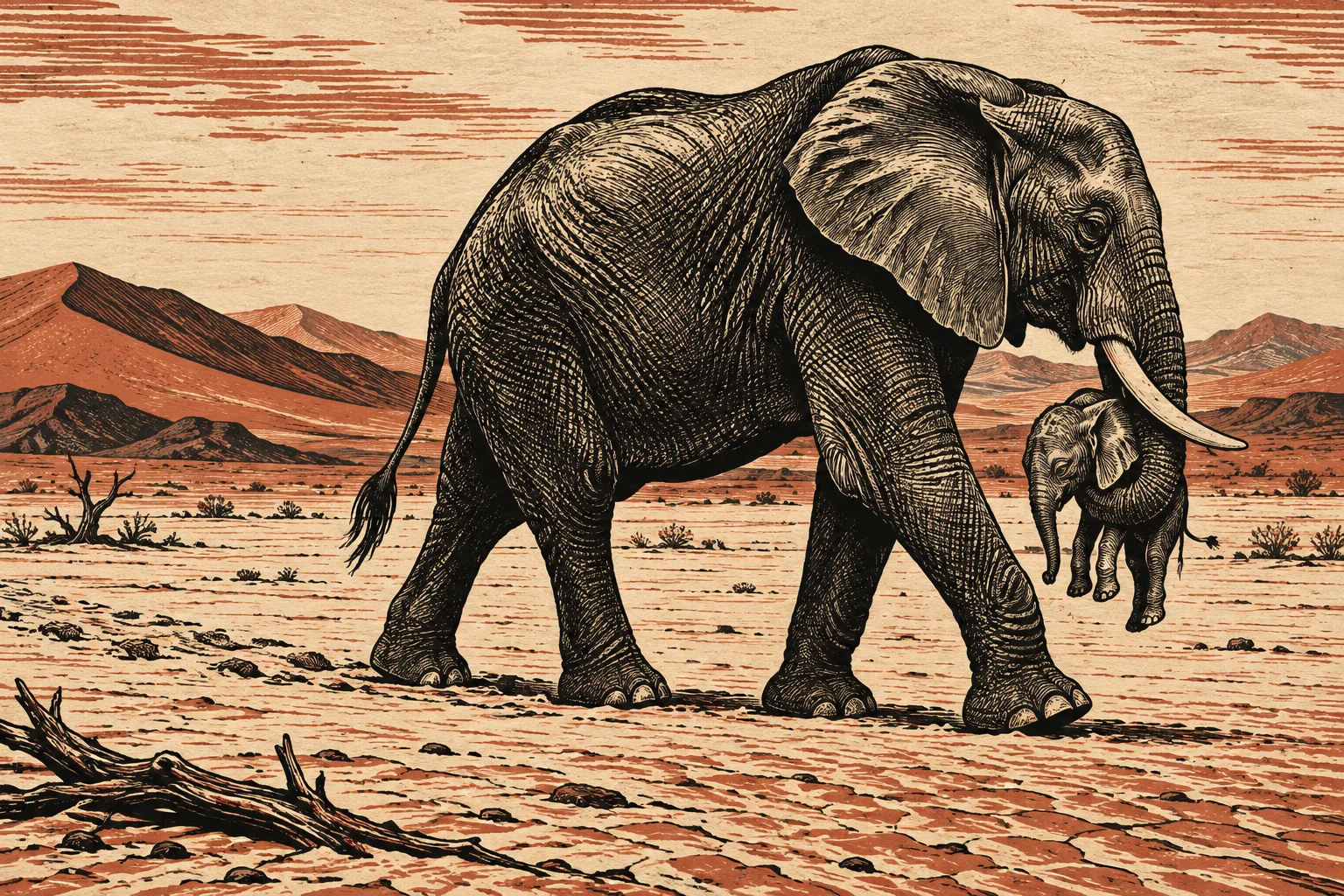
Winter offers two explanations, not mutually exclusive: the carrying could be a form of emotional processing by a female who has not been able to “let go” of her own loss, or an attempt to protect the body from predators. A healthy newborn desert elephant calf weighs 100-120kg (220-265lb), Winter told BBC Future. The stillborn calves EHRA’s team recovers are smaller, 60-65kg (132-143lb) – light enough that one working theory is premature birth, because chronic stress leaves the mothers “not fit enough to carry them full term.”
The chronic stress in that theory is attributed to conflict with humans, mostly over water: elephants push over tanks, pull up pipes and break pumps on farms, and “the tolerance of people towards elephant presence isn’t particularly high,” Winter says. That elephants can carry something like post-traumatic stress disorder from human conflict is not a new idea: it was first proposed in the 1990s by the ecologist Gay Bradshaw after observing orphans of culling operations, and a 2013 study in Frontiers in Zoology, co-authored by the elephant researcher Joyce Poole, found that African elephants translocated as calves after a cull in South Africa’s Pilanesberg National Park still showed impaired social decision-making decades later, compared with an undisturbed population in Kenya’s Amboseli National Park. Elephants have form for unexpected behaviour read as intelligence rather than instinct – Kenyan elephants have been recorded eating specific plants that may ease labour or treat illness – but grief-like carrying is harder to verify than self-medication, because it can’t be tied to a measurable physiological outcome.
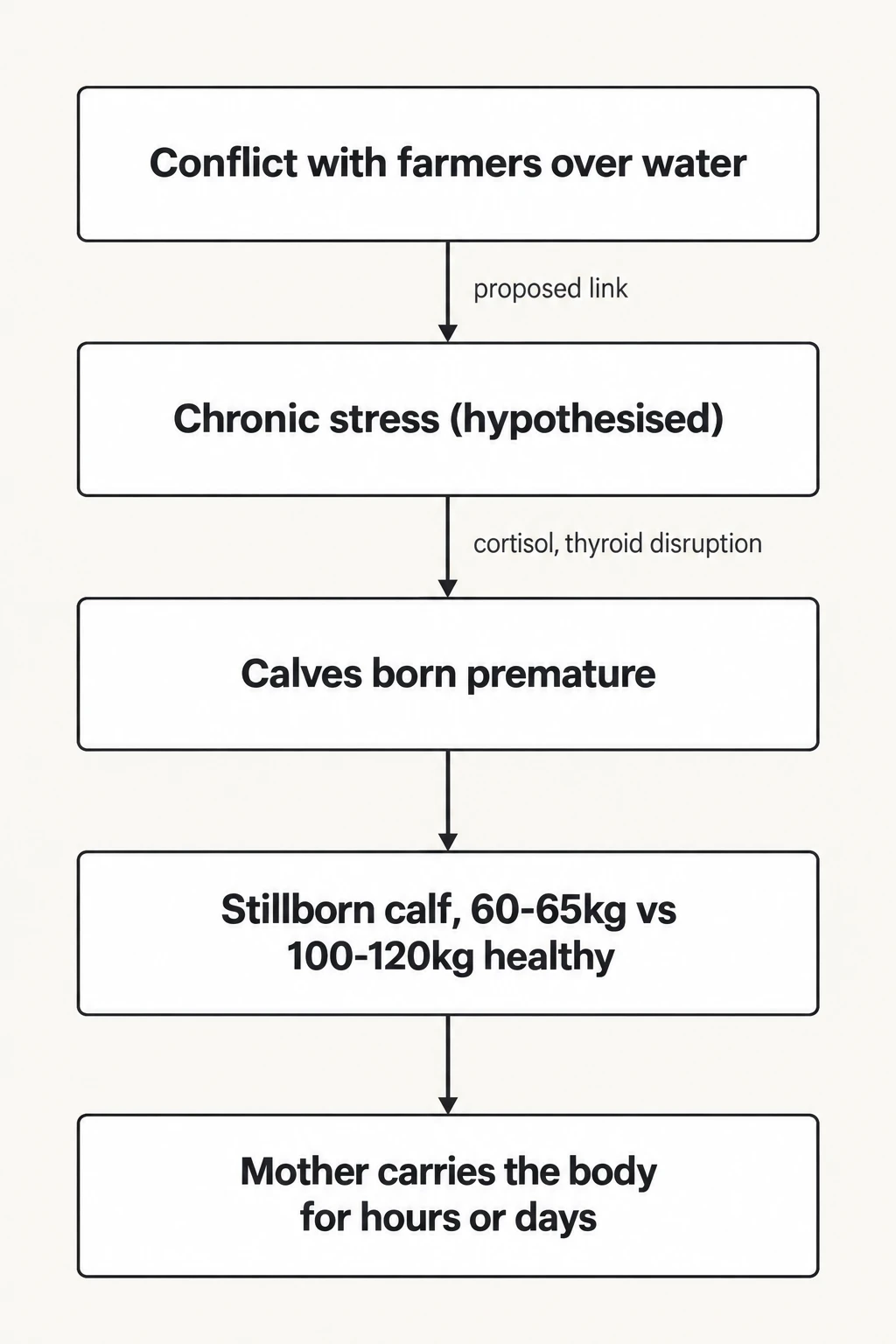
| From | To | How |
|---|---|---|
| Conflict with farmers over water | Chronic stress (hypothesised) | proposed link |
| Chronic stress (hypothesised) | Calves born premature | cortisol, thyroid disruption |
| Calves born premature | Stillborn calf, 60-65kg vs 100-120kg healthy | |
| Stillborn calf, 60-65kg vs 100-120kg healthy | Mother carries the body for hours or days |
Based on Christin Winter (EHRA) and Daniella Chusyd (Indiana University Bloomington), via BBC Future
The mortality numbers
Winter put a figure on how bad the die-off is: of 16 calves born in the Huab and Ugab rivers between 2014 and 2022, only two survived. EHRA’s own website gives a separate, overlapping figure for a shorter window in the same two rivers: nine of 14 calves born between 2014 and 2018 died, for reasons it lists as unknown. The two counts cover different periods and can’t simply be added, but they point the same way: in this population, most calves don’t make it.
How many are left
The two population figures in circulation for Namibia’s desert-adapted elephants don’t match, because they count different areas. Winter told BBC Future that roughly 150 elephants live along five riverbeds in the Namib Desert, migrating for the seedpods of Ana trees and floodplain grass. EHRA’s own site attributes that 150 figure, up from “as low as 52,” to 20 years of work by Namibia’s environment ministry, the NGO IRDNC and the Save the Rhino Trust. A separate EHRA page gives a narrower, more recent count: just 62 elephants resident specifically in the Huab and Ugab rivers – the two rivers where the award-winning photograph was taken – after a 73% decline between 1975 and 2016 (citing a 2016 estimate by the researchers Ramey and Brown) and a further 32% drop in the Ugab river population alone since 2016.
Permits, not just drought
Joyce Poole, founder of the research group ElephantVoices, has called similarly documented cases of elephant grief “harrowing”; in one she has described, a mother didn’t carry her dead calf at all but tried to lift it, then stood guarding the body for two days. Poole connects the trauma directly to policy.
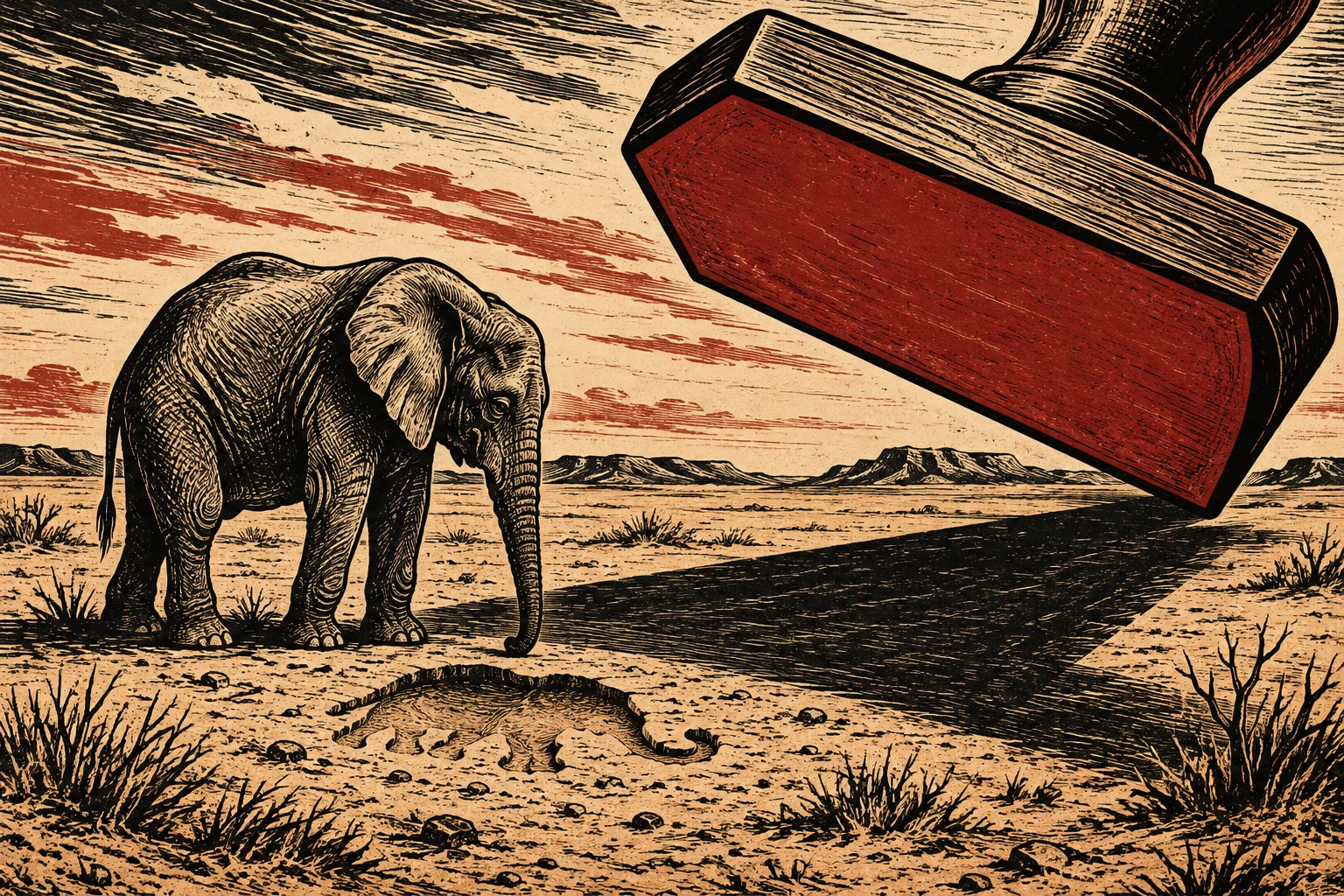
Desert elephants are being pushed to the brink of extinction, not just by climate change but by the trophy hunting permits allowed by the Namibian government. We need to do more to prevent their trauma.
The clearest recent test of that claim is the cull Namibia’s Ministry of Environment, Forestry and Tourism ordered in August 2024: 723 wild animals nationwide, including 83 elephants, 60 buffalo and 30 hippos, culled to supply meat for a drought relief programme after the country had used up 84% of its food reserves, as CNN reported at the time. Of the 83 elephants, 21 were marked for culling in the Kunene and Erongo regions, where EHRA’s monitored desert-adapted population lives. EHRA and the Namibian Chamber of Environment objected on the grounds that killing even a handful from a population already down to 62 animals in two rivers could threaten its survival; the ministry agreed to work with EHRA to avoid culling animals from its long-term monitoring project in the Omatjete and Kalkfeld areas. The ministry’s own update recorded 157 animals already culled by contracted professional hunters at that point, yielding more than 56,800kg of meat for distribution.
EHRA is now working with Daniella Chusyd, an assistant professor at Indiana University Bloomington, on a project running until 2028 that tests the elephants’ dung for heavy metals, PFAS and other “forever chemicals,” and for thyroid and cortisol hormones linked to chronic stress. The project also aims to measure inbreeding in the population and whether surviving calves have different parentage from those that died. None of that will settle whether a 14-year-old female carrying a dead calf for the fourth time is grieving in any sense a human would recognise. It should settle, by 2028, whether the stress that may be driving stillbirths in this population is measurable at all.