
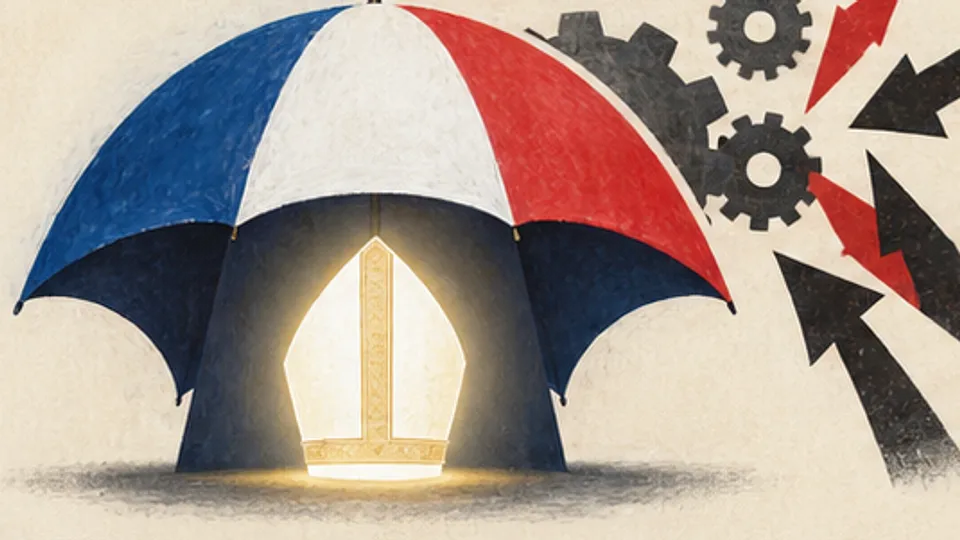
No country has policed the boundary between God and government quite so zealously as France. Its republican creed, laïcité, keeps religion firmly out of the state; its presidents rarely kneel. Yet over four days in late September the eldest daughter of the church gave Pope Leo XIV the sort of welcome usually reserved for rock stars — and the first American pope, born in Chicago and newly practised in French, looked entirely at ease receiving it.
In Paris, around 800,000 people lined the Champs-Élysées, CNN reports, some waving Vatican and French flags, others perched in trees or on companions’ shoulders for a glimpse of the popemobile. In Lourdes, the southern shrine town that draws the sick, some 150,000 attended an open-air Mass, according to Vatican estimates — crowds that dwarf those of the last papal visit, in 2008. At the Stade de France, 80,000 young people packed a prayer vigil that was less hushed than jubilant.
Such numbers matter because France has been drifting from the pews for decades; estimates put weekly Mass attendance at just 5-8% of the population. Yet the French bishops report an unexpected upturn: 8,200 adolescents and 13,200 adults were baptised in 2026, a 20% rise on the year before, and 42% of the adults seeking baptism were aged 18 to 25. “There is a quest for meaning. People need and are in search of meaning and answers to the big existential question,” Rev. Benoît Pouzin, a south-western priest involved in youth ministry, told CNN. Leo saw similar youthful fervour in Spain in June; his predecessor made official visits to neither country.
Choreographing a papal tour of the secular republic takes care, and this one bordered on the provocative. The Paris Mass was celebrated on the Place de la Concorde, where Louis XVI and Marie-Antoinette met the guillotine — the revolution that began the separation of church and state. Later, Emmanuel Macron attended the pope’s Mass in Metz, braving the criticism he drew in 2023 for doing the same during a visit by Pope Francis.
Mr Macron was not the only leader on the pope’s mind. In Paris — where, as we noted last week, he warned against a “paradise of machines” — Leo called for stronger guardrails on artificial intelligence. It was a pointed contrast with President Donald Trump, who dismissed such warnings as a “hoax” during a surprise phone call with Jensen Huang, Nvidia’s chief executive, at a summit in Los Angeles. Aboard the papal plane home, Leo was unmoved: “I don’t think that that is fake news – as some have said – to try and pause.” He found it “interesting”, he added, that Mr Huang had unveiled a tool to stop AI agents running beyond human control: “He’s the same one, however, that says there should be no limits placed and no government regulation.”
The pope devoted his first major theological document to AI earlier this year, warning of its use in warfare, and has established a Vatican commission to study its risks and benefits. “We are trying to continue to promote dialog, study, investigation,” he said, “to find ways to make sure that AI does not get to a point where it could destroy humanity.” Is he in a panic? “No, I’m not, I sleep at night.” But the experts’ concerns, he insists, should be taken seriously.
In Metz, near the German border, he delivered a major speech on European unity, praising Robert Schuman, an EU founder whose cause for sainthood is formally under way, and lamenting that “relations between individuals and states are becoming increasingly uncivilized… The value of keeping one’s word is dismissed; instead, people boast of lies and deceit.” Asked on the plane about the rise of extremist parties in Germany, he said “the combination of these far-right points of view with a certain kind of religion” is not an “authentic expression of Christianity”; the Gospel, he went on, is “not about hatred and division, but… about understanding and compassion.” A critic of America’s war in Iran, Leo wants a stronger European Union and firmer international co-operation.
He also managed a delicate riposte to the Trump White House’s media ban, which shuts out CNN and other outlets. Asked about it by CNN, he said he was “very happy that, here, you are all welcome and good coverage, I think, is very important and that we have it all the way around, for everyone” — solidarity with the press, without a gratuitous quarrel with the president.
The airborne press conferences offered rarer glimpses of the man himself. Quizzed about a miraculous recent victory for his beloved Chicago White Sox, he declined credit — “No comment” — before smiling: “Great things happen in Chicago.” He recalled watching Fulton Sheen, the broadcasting archbishop recently declared blessed, and denied reports that he was still learning French on Duolingo: “It’s fake news!” (He has in the past been spotted using the app to learn German.) Most of his speeches and reflections were delivered in French.
Nor did he spare his hosts. France recently approved legislation granting assisted dying to the incurably ill, a change the Catholic Church strongly opposes; Leo raised the subject several times, most clearly at Lourdes, whose shrine draws many sick and terminally ill pilgrims each year.
The hardest business came near the end. A 2021 report estimated that around 330,000 children had been sexually abused in France by priests or other church figures over 70 years. Leo told crowds the church must admit its own failings and heal “deep wounds”, then sat for two hours with seven survivors of abuse. The Vatican said he thanked them “for their painful testimony” and reaffirmed his commitment “to ensuring that the harm they suffered is not repeated for others.”
The crowds will soon thin, and the popemobile has already left. If France’s faint revival is real, it will be measured not in flag-waving on the Champs-Élysées but in next year’s baptismal registers; on that score, quietly, the omens have improved.