
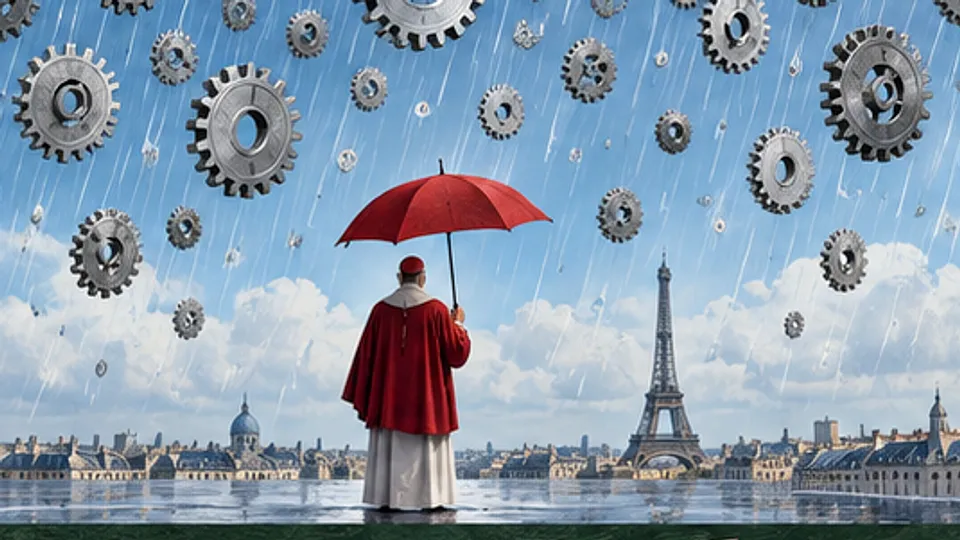
The pope came to France on Friday, and he came with a warning. The machines, he said, could take humanity from the humans.
Pope Leo XIV spoke first at the Élysée Palace, to President Emmanuel Macron and the diplomats and authorities of the republic. It was the opening of a four-day visit, the first official state visit by a pope to France in 18 years. He raised the question of what it means to be human in an age of artificial intelligence, a new nuclear arms race and what he called other threats to life itself.
“If we are to avoid losing our humanity amid a ‘paradise of machines’ invading and conditioning our daily lives, there is an urgent need for education in ethical discernment and the capacity to acknowledge the moral good,” he said.
He described the paradox. Intelligence, he said, is now attributed to computational systems, while people struggle to recognize the inalienable dignity of human persons “whose lives are judged according to the criterion of efficiency and, when deemed no longer productive, are rejected and discarded.”
From the start of his pontificate Leo has called AI one of the greatest challenges facing humanity. His first encyclical, Magnificent Humanity, demanded regulation and told developers to work for the common good rather than profit. On Friday he appealed to developers and the politicians who regulate them to slow down. Later he told reporters that several top AI companies seemed to have taken the appeal to heart, and that the Vatican’s dialogue with them would go on. “Good things are beginning at least,” he said.
Then he went to UNESCO, the U.N. culture and education body, and spoke again. Without truth, he said, language falls to “the logic of violence and to the arbitrary will of the powerful.” Every science risks losing its meaning when pursued without ethics. He did not name names. But he said of those in power: “Instead of respecting the law, those in power invoke it when it serves their interests and disregard it when it restrains them, treating even justice itself as though it were a commodity to be bought and sold.” He had said in April that the world was being ravaged by a handful of tyrants. He did not name names then either.
With wars in Europe and the Middle East, he reaffirmed the Vatican’s opposition to nuclear weapons and called the doctrine of deterrence “mistaken,” saying it only fed a new arms race. “Peace is not a balance of power; rather, it is built day by day through dialogue and justice,” he said. He told the French never to grow resigned to war or to consider it inevitable.
On the flight from Rome, a CNN reporter asked him about the Trump administration’s attempt to bar CNN, MS NOW and Politico from the White House. The pope said reporters were welcome with him. “I am very happy that here, you are all welcome,” he said. Good coverage mattered, he said, and it mattered “that we have it all the way around, for everyone.”
France gave him a hard stage. Secularism is written into its constitution. France put the right to abortion into that constitution in 2024, and its lawmakers have given final approval to a bill letting adults with incurable illnesses receive lethal medication. The French Catholic hierarchy fought both. Leo reminded France of its “deep Christian roots” and called the right to life the “indispensable foundation of every other human right.”
For Macron the visit was a capstone. He is barred from a third term in the May elections, his approval ratings sit near record lows, and Pope Francis refused a proper state visit through all 12 years of his pontificate, refusing even to attend the 2024 inauguration of the rebuilt Notre Dame that Macron had championed. “For a president of the republic as Macron, who is at the end of his mandate, it can be important to be aside the pope and to capture a part of his popularity,” said Charles Mercier, who directs Catholicism studies at Paris EPHE university. Macron, smiling as Leo spoke French, told him: “You are here with us for an extended visit, giving us your time, and that is moving.” He called the visit “a source of hope.”
Church bells tolled across France when the papal charter landed at Orly. Upward of a million people were expected over the four days, and thousands lined the motorcade route waving French and Holy See flags, some waiting hours in the unseasonable heat. Leo, 71, has French blood on his father’s side.
That evening he prayed vespers at the reopened Notre Dame, the service Francis had declined. “To see him, praying with us, it comforts us in our faith and on our path,” said Sister Antonia Faye of Senegal, at her first event with a pope. Then came the youth vigil at the national stadium north of the city — 80,000 young people, fireworks and a theatrical telling of French Catholic history that kept the pope out past 10:30. “Thank you for your courage! Thank you for your presence,” he told them, off the cuff in French. “Thank you for your faith. You are the saints of France!”
On Saturday morning he met newly baptized converts at the Catholic Institute of Paris and said their numbers defied the statisticians. “We must recognize, welcome and protect the small flame that the Holy Spirit has kindled in the darkness of the night, the tiny seed that strives to grow even amid the thorns,” he said. Adult baptisms in France have tripled since 2016, to 13,000 this year. But the broad current runs the other way. France counted 513,000 baptisms in 1980 and 186,000 in 2024. Its priests have fallen from nearly 39,000 to nearly 12,600 over the same span, and church weddings from nearly 217,500 to nearly 40,680. Leo told the bishops not to grow complacent or naively optimistic. Bishop Matthieu Rougé of Nanterre saw it brighter. “Something powerful is happening within the church in France,” he said.
Saturday afternoon he celebrated Mass at the Place de la Concorde, the heart of the secular republic, chosen because nothing else in central Paris could hold the crowd. More than 600,000 had registered. The Vatican estimated 700,000 came. Road closures shut the center of the city as they had for the Olympics in 2024.
The visit runs on. Monday he speaks on European peace at Metz, with Russia’s full-scale invasion of Ukraine in its fifth year. He will go to Lourdes and meet privately with seven victims of clerical sex abuse. A 2021 report estimated 330,000 children were abused in the French church over 70 years and described a systemic cover-up; the bishops’ conference has agreed to compensation, and accusations still surface, including at the school of Notre-Dame de Bétharram near Lourdes. Survivors’ groups wanted more than seven heard. The church said the pope sought depth, not numbers.