
The Gulf of Finland, on a Thursday in late September. Jets from two air forces that spent most of the last century refusing to fly together climbed together over the cold water: Finnish and Swedish Quick Reaction Alert fighters, scrambled to identify a Russian detachment crossing international airspace. What they found, the Finnish air force announced on Friday morning, was a Tu-134 transport escorted by MiG-31 and Su-30 fighters. The military was careful to note the significance of the moment: this was the first joint operational identification mission the two Nordic air forces had ever flown.
Sweden’s prime minister, Ulf Kristersson, marked it with a sentence built like a load-bearing beam. “The Baltic Sea has never been as vulnerable as it is now,” he wrote on X, “but it has also never been better protected than it is right now.” Both countries abandoned decades of military non-alignment and joined NATO in the wake of Russia’s 2022 invasion of Ukraine, and since then their jets have been scrambled with a regularity that would once have seemed unimaginable.
A warning from Copenhagen
The same Thursday, a few hundred kilometres to the southwest, the head of the Danish Defence Intelligence Service sat down at a press conference with an updated assessment of the Russian threat. “There is a low but growing risk that Russia will launch a limited military attack against one or several NATO countries bordering Russia,” Thomas Ahrenkiel told reporters. A full invasion remained “highly unlikely” — his service still thought Russia “would see any interest” in none — “but we cannot rule it out.” What the Danes expect, as reported earlier, is more hybrid war: attacks that once “mainly been aimed at creating fear and weakening public support for aid to Ukraine” now shading into sabotage against defence companies and railway lines carrying military equipment, and, potentially, “destructive cyber attacks that cripple critical societal functions.”
The ghost fleet
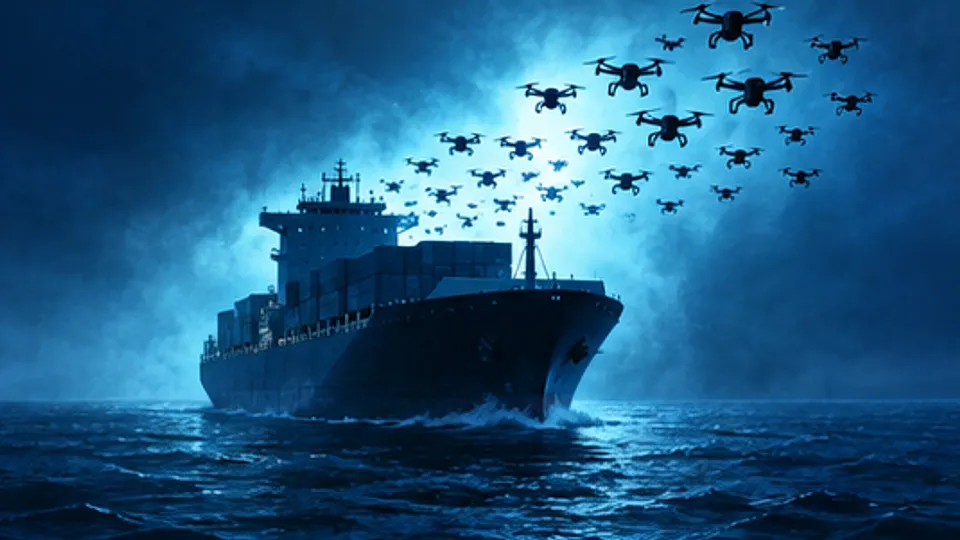
The sky over the Baltic is only one front in this geography of unease. Russian drones have been detected over European Union territory, with incursions into Poland and Bulgaria. And according to a CIA report cited by Euronews, there is a risk that Moscow could launch drone attacks on Spain, France or Italy from containers carried aboard ships of the shadow fleet in the Mediterranean — the ghost fleet, sanctioned and unflagged, that already ferries Russian oil past the blockade of its economy. What would such drones be? According to the latest information from the Ukrainian military, which studies the wreckage that falls on its cities, the answer now goes far beyond the Iranian-made Shahed.
Consider a single night: in the early hours of 27 August, Ukrainian air defences shot down or neutralised 233 Russian targets in one bombardment that had included 258 attack drones, two Oniks anti-ship missiles and several Iskander-M and KN-23 ballistic missiles. Of the drones, the Ukrainian Air Force reckons about a third were jet-powered, the rest a mixture of Shahed-type craft, Gerbera systems, Banderol missiles and decoys. The swarm is no longer a single model but an entire family of machines with different tasks, from flooding radar screens to punching through the defences at more than 500 kilometres per hour. The arithmetic favours the swarm: firing a million-dollar interceptor at a drone worth $25,000-40,000 (€21,000-35,000) is ruinous, and that imbalance is precisely what Moscow is exploiting.
The factory to the east
Most of this fleet is born in one place: the Alabuga Special Economic Zone in Tatarstan, some 1,200 kilometres from the Ukrainian frontier. The complex covers more than 2.8 million square metres, and it is estimated that around 15% of its facilities serve the war, directly or indirectly. Fuselages are moulded there, engines built, electronics assembled. After Ukrainian strikes, Russia has moved much of that chain underground — a Ukrainian open-source analyst estimates some 42,000 square metres of buried space already built, the equivalent of six football pitches of factory floor beneath the steppe.
Output, by every measure, is industrial. Russian media cited by The Economist put daily production of the Geran-2 — Moscow’s designation for the Shahed-136 — above 100 units, with plans to reach 500 a day. The Centre for Strategic and International Studies calculated that in March 2026 Russia produced around 5,500 drones a month; Ukrainian military intelligence put August output at about 3,000 of the jet-powered Geran-4 and Geran-5 plus some 2,800 Geran-2 a month. In March alone, according to a report cited by Euronews, Russia launched 6,462 Shahed-type and related attack and decoy systems — 4,186 of them Geran-2 attack drones, an average of 208 launches a day, rising on some days beyond 900.
The catalogue
The Geran-2 is the old mule of this caravan, in the sky since September 2022: 3.5 metres long, a 2.5-metre wingspan, around 200 kilograms, pushing a four-stroke piston engine of some 50 horsepower at a stately 185 km/h. Depending on the version it flies 1,000 to 2,500 kilometres — the Russian variant trading range for a reinforced 90-kilogram warhead — and carries between 30 and 50 kilograms of conventional explosive mixed with thermobaric material and metal fragmentation, for $20,000-50,000 (€17,000-43,000) a piece. Ukrainian interception rates against it are estimated at 65% to 85%, according to Global Military.
Then came the race for speed. The Geran-3, based on the Shahed-238, bolted a turbojet onto the old fuselage and reached 300-370 km/h; Ukrainian intelligence found dozens of foreign components in its wreckage — many American, some Chinese and European. The Geran-4 was drawn afresh, with integrated fixed wings: cruising at 300-350 km/h with peaks up to 500, at altitudes of 4,000 to 5,000 metres, delivering a 50-kilogram warhead over 450 to 850 kilometres on paper — and, in practice, flying high to save fuel until it covered around 960 kilometres on 28 August 2026, a radius that takes in almost all of Ukraine. It costs $85,000-120,000 (€74,000-105,000). The newest, the Geran-5, reaches up to 600 km/h with a range of about 950 kilometres and a 90-kilogram payload, according to the International Institute for Strategic Studies; German-made transistors were found in its remains. Both are driven by the TF-TJ2000A engine.
The effect is written in the falling percentages. In March 2026 Ukraine intercepted more than 90% of the drones sent against it; by June, with the jet drones deployed on a large scale, the rate had sagged to just over 50%. Kyiv has answered with jet interceptors of its own, among them the Alexa Spatium, which entered service on 21 August 2026 — a chase we have recorded before, in slow motion, wreck by wreck.
The catalogue goes on. The Gerbera began life in July 2024 as a roughly $10,000 decoy — two metres of fibreglass cluttering radar screens beside real Geran-2s — but the versions now built at Alabuga, by what Ukrainian intelligence identifies as the JSC Alabuga Skywalker Technology Co., are being fitted with high-explosive fragmentation warheads from the company Bazalt and KZ-6 charges: the scarecrow learned to carry a knife. And at the front stands the Lancet, the Kalashnikov concern’s short-range loiterer unveiled in June 2019, hunting artillery, radars and armour out to 40 kilometres at 80-110 km/h on the approach and up to 300 km/h in its terminal dive. In August 2025 Russia began swapping its standard charge for a PTM-3 anti-tank mine, raising the explosive load from 1.5 to 1.8 kilograms, according to UNITED24 Media.
A continent reads the radar screens
Europe has taken the hint. In November, NATO military officials said a new American anti-drone system had been deployed to the alliance’s eastern flank; after a violation of Polish airspace, NATO Secretary General Mark Rutte announced the Eastern Sentry programme to deter further incursions. Some European officials describe the crossings as Moscow testing the alliance’s reflexes. The Kremlin dismisses the allegations as “unfounded.” History teaches that empires rarely announce their provocations; they prefer them unsigned, like a writer who publishes under a false name and watches to see what the readers do. The reading, for now, continues over a cold sea.