
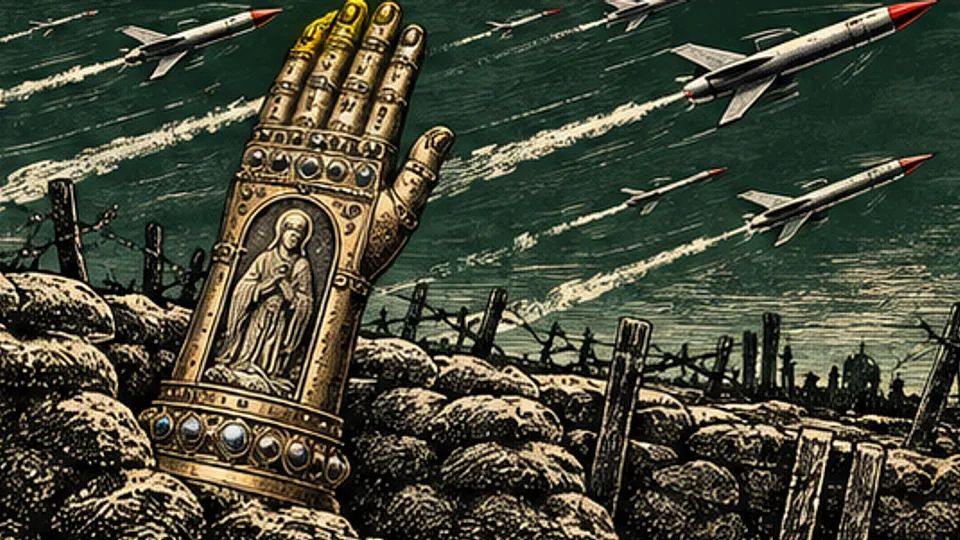
Among the supplies reaching Russian troops dug in for another winter in eastern Ukraine is an item no quartermaster issued: a fragment of the right hand of Dmitry Donskoy, a prince celebrated in Russia for defeating Mongol-led forces at the Battle of Kulikovo in 1380. According to CNN, the relic arrived at the front in early September and has since been circulating among military bases in Russian-occupied territory. The Moscow Patriarchate’s military department said the “saint commander” would invisibly stand “shoulder to shoulder” with Russian soldiers — with the same hand, the church noted, with which he wielded his sword at Kulikovo.
Donskoy’s remains surfaced in August during restoration work at the Kremlin’s Archangel Cathedral, though their location had been known since their burial. President Vladimir Putin called the recovery “absolutely unique” and a “marvelous discovery”; Patriarch Kirill, the pro-Kremlin head of the Russian Orthodox Church, called it “a special sign of God’s providence.” The timing was convenient: the discovery came weeks after unverified reports that the relics of Alexander Nevsky — another warrior-saint whose remains have also been taken to troops this year — had been lost. Metropolitan Vladimir, the Russian-installed Orthodox leader in Donetsk and Mariupol, said the relic would help soldiers and civilians “mobilize both their spiritual and physical strength” and “triumph over the enemy.”
Outside the state-church apparatus, the reception is colder. “The church has practically merged with the state to the point of being indistinguishable,” said Sergei Chapnin, a religious scholar at Fordham University’s Orthodox Christian Studies Center, calling the relic “a mobilizing myth.” The Rev. Alexander Zanemonets, an Orthodox priest and historian who left Russia after the invasion, told CNN the episode “has nothing to do with Christianity” and is “undoubtedly the exploitation of Christianity and the exploitation of the church for ‘patriotic’ purposes” — “a cynical calculation.” Days after Putin announced partial mobilization in September 2022, Kirill told worshippers that a soldier who dies on duty makes a sacrifice that “washes away all the sins.”
The church’s political reach is broader than its congregation. A 2026 telephone survey by the state pollster VCIOM found about two-thirds of Russians identify as Orthodox, down from roughly 80 per cent fifteen years ago, and several priests and scholars told CNN that only about 2 per cent of baptized believers regularly practise — a figure supported by Interior Ministry data on Christmas attendance. Yet a September procession promoted by nationalist groups drew more than 100,000 people in Moscow alone, according to official figures, with a Donskoy fragment carried through the streets. Historian Konstantin Mikhailov called the turnout “a drop in the ocean” in a country of more than 145 million, and described the Kremlin-church arrangement as “mutually reinforcing.” At the front, faith is real and improvised: soldiers spoke of makeshift churches and priests in hospitals. “Like a field kitchen, there should be a priest everywhere,” one former serviceman said, quoting the expression: “We are Russians. God is with us.” A soldier in Donbas offered a different accounting of the relic, which he called “a very unconventional solution to our problems in the 21st century”: “My view is that they are needed more by the mothers of the guys who died in this military operation.”
The weekend’s ledger
The talisman arrived at the trenches during a heavy stretch. At least six people were killed in Russian strikes across Ukraine over the past day, according to local authorities cited by euronews: two women dead and seven injured in Zaporizhzhia Oblast, where 86 damage reports came in; two killed and eight injured in Donetsk, with 1,121 people evacuated from the front lines; one dead and three injured in Kherson; a 69-year-old man killed by a drone in Sumy, where ten more were wounded by a guided aerial bomb. Five people were injured in overnight strikes on Kyiv. Ukraine’s air force said Russia launched 173 attack drones overnight and that 134 had been shot down or neutralised by 7:30 a.m., with strikes recorded at 19 locations. Foreign Minister Andrii Sybiha said a “double strike” hit a logistics facility serving McDonald’s. “Relentless attacks disrupt Ukrainians’ daily lives, damage businesses, threaten jobs, and undermine international investment,” he wrote.
The deadliest single blow of the weekend came on Friday around 8 a.m., when a drone slammed into a Kyiv high-rise, killing a 14-year-old boy, CBC News reported. Among the broken glass and blackened debris on the pavement lay the remnants of a jet engine.
Faster than the interceptors
That engine matters. Russia’s latest drones — the Geran series, the newest the Geran-5, shaped more like a cruise missile than the triangular Iranian-designed Shaheds of 2022 — fly higher and cruise at more than 600 km/h, about three times the speed of the older models. “It’s not easy to intercept. You need to intercept [at] a similar speed or faster,” Volodymyr Khomenko, head of the National Police’s Explosive Ordnance Disposal Department, told CBC. “For faster drones, we need faster interceptors.” Khomenko believes about half the drones now launched at Ukraine are jet-powered, and Ukraine’s Air Force said Russia fired 2,800 of them in August, almost twice July’s figure. The intercept rate tells the rest: about 60 per cent for the jet models, against more than 90 per cent for their predecessors. Newly designed interceptors are still in trials, though President Zelenskyy says production is being accelerated; Ukrainian military intelligence says some of the turbojet engines are sourced from China. Cory Woods, a Canadian flying interceptor drones in Ukraine, told CBC the contest is constant adaptation — and that airfields matter more than aircraft: “There’s no point in hitting the arrow if you let the archer live.”
Manpower from next door
Replenishing the arrows’ handlers has become its own operation. As euronews reports, the Belarusian corner of the internet has filled with adverts offering a “high salary, benefits and Russian citizenship” for signing a Russian army contract — tucked into Telegram channels and Viber chats between posts about selling vegetables. Investigations by DW, TVNET, CityDog and Current Time documented a sharp increase; the rights group Belpol posts screenshots offering a one-off payment of 4.35 million roubles, help with loans, “annulment of criminal convictions” and fast-track passports. Some adverts promise “sorting out problems with the law,” notable because fighting in a foreign war carries up to seven years in prison under Belarus’s mercenary statute; recruiters insist the work is legal “service in the army of the Union State.” Recruits are typically men from small towns with debts, flown or bused through Smolensk or Pskov to sign — after which, euronews notes, there is almost no way back — and are often placed in assault units with particularly high casualty rates. The Lukashenka regime neither acknowledges nor stops the campaign, and the Institute for the Study of War warns Moscow is stretching the Union State’s “equal rights” into “equal obligations,” including military service.
Speaking in Saint Petersburg, Putin denied any wider ambitions. “We are not preparing for any kind of hostilities with Europe,” he told reporters. “There is no real motive to escalate the situation with Europe, no matter what anyone says, no matter who says it, including in the Baltic states.” The three Baltic states, on NATO’s eastern flank, have lately recorded a rapidly growing number of drone incursions.
The fragment of the right hand, meanwhile, continues its tour of the bases. Six and a half centuries ago it held a sword at Kulikovo; this winter it travels among men for whom, in the words of a Donbas commander, the situation “is only getting worse as the time goes on” — a hand offered as protection to an army that intercepts six drones in ten and recruits infantry classified at home as mercenaries.