
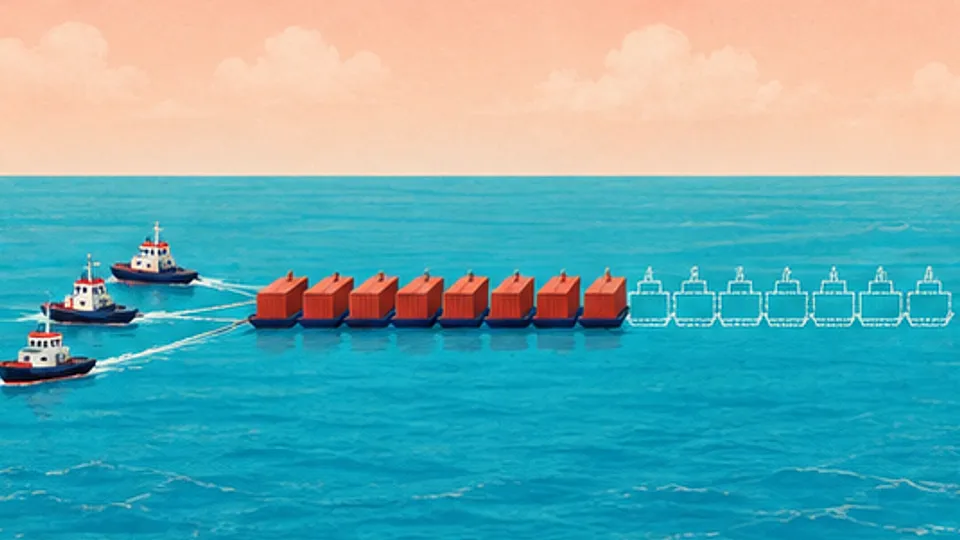
The European Union’s naval mission in the Red Sea fields, at its core, three ships. When the mission was stood up in 2024, its planners indicated the job required at least ten. Between those two numbers a queue has formed: commercial vessels waiting in line for an escort that the escorts cannot always give. “We need more vessels because literally there are commercial ships that are waiting in the queue to receive the escort, and we don’t have enough frigates that can do that,” Kaja Kallas, the bloc’s top diplomat, said Monday after a meeting of EU defense ministers in Brussels, according to Bloomberg.
At that meeting, she said, “two countries were hinting today that they might provide additional vessels.” She did not name them. Coming after months of refusals, the hinting alone counted as movement: an indication, as Bloomberg put it, that EU governments may be coming around on bolstering the mission, known as Operation Aspides.
A mandate the math never matched
Aspides exists to protect commercial shipping from the Iran-backed Houthi militia, and its mandate is limited to exactly that. Italy and Greece supply most of its hulls. France has sent an additional frigate and publicly pressed others to do the same; in a recent interview with Journal du Dimanche, French Defense Minister Catherine Vautrin called on other countries to help reinforce the operation, and Paris has said it would send troops and radar systems, while the UK has offered aircraft in support. Kallas herself implored member states last week to commit more resources. So far the pleading has met a long-standing reluctance to get more involved in anything connected to the Iran war, and EU countries have declined to reinforce the mission even as mounting Houthi attacks have left it unable to fully function.
The attacks themselves have raised the stakes. The Houthis have made advances in Yemen and begun targeting Saudi Arabia’s energy infrastructure, reviving fears of further disruption to fuel supplies already tightened by the war with Iran.
The coalition that has not sailed
Kallas on Monday offered a workaround. In April, France and the UK assembled a “coalition of the willing” that pledged to help protect shipping through the Strait of Hormuz. That mission has never materialized — some countries insist the fighting must first stop, or that Iran must give its permission, conditions Gulf states have criticized as impossible to meet — but the hardware pledged to it still exists on paper. “There are many ships that have also been offered to this coalition of the willing that is not really operational at the moment,” Kallas said. Those committed-but-undeployed vessels, she suggested, could serve Aspides instead. Europe’s exposure to the Hormuz closure, and Brussels’s efforts to manage it, are laid out in an earlier account of a slow-motion energy crisis.
The redirect would carry a diplomatic convenience. Sending ships to the Red Sea may be more palatable to EU members precisely because Aspides already operates there, under an existing mandate aimed at the Houthis — and because keeping vessels in the Red Sea lets Europe avoid direct conflict with Iran.
Underneath the naval arithmetic sits an energy ledger. The Iran war has already lifted Europe’s high energy prices and pushed inflation upward, prompting the European Central Bank to raise borrowing costs twice. Consumer-price gains breached 3% in August, an almost three-year high that, by Bloomberg’s account, is unlikely to recede much in the months ahead. A fresh Houthi campaign against Saudi energy infrastructure threatens a second shock on top of the first; the militia’s widening war has already rippled well beyond Yemen’s shores, as a recent survey of the region’s ledgers described.
Ten ships, the planners said in 2024, and most member states have not been quick to help meet that target. Whether the two unnamed countries convert their hints into hulls remains to be seen. In the meantime the mission sails with what it has, and the queue of merchant ships waits, one escort short, then two.