
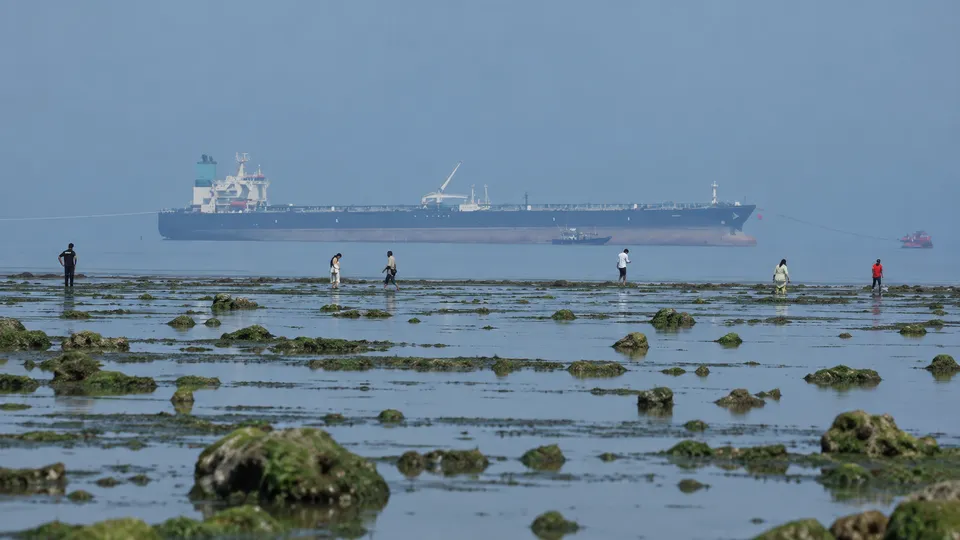
Through the Strait of Hormuz — the unavoidable exit route for oil and gas from the Persian Gulf — only a handful of ships now sail each day, either at their own risk or escorted by the U.S. Navy. That is a tiny fraction of the traffic that passed through the waterway before the first American and Israeli strikes on Iran on February 28. The strait is, in effect, closed. What has happened around it since is, in the account of the Spanish newspaper EL PAÍS, a relentless chain of setbacks that has put the world on the brink of its second energy crisis in less than five years.
The setbacks arrive in quartet. Saudi Arabia, the world’s largest crude exporter, was put largely out of action for more than a week when attacks by pro-Iran militias forced the East-West pipeline — its only alternative to Hormuz — to shut down; Reuters reported on September 24 that operations had resumed, with tankers awaiting loading. The Houthi rebels, dependent on Tehran, are expanding their control over Bab al-Mandab, another crucial maritime passageway. And Russia, its refineries severely damaged by Ukrainian drone strikes, is about to extend its ban on diesel exports for another month.
“The disorder in the Middle East is extreme, and there is neither enough crude on the market or, above all, enough refineries available to process it.”
That is Francisco Blanch, global head of commodities and derivatives at Bank of America, speaking to EL PAÍS by phone. The situation has deteriorated sharply in the past two weeks, he said, since the Houthis took control of Bab al-Mandab and the Saudi pipeline was attacked. What is unprecedented, in his telling and in that of other analysts consulted, is that prices already soaring still do not fully reflect the severity of what is coming.
The worry has a specific name this time: diesel. In spring the bottleneck was jet fuel; now, mirroring the early months of Russia’s invasion of Ukraine, concerns center on the fuel that moves freight and heats homes. Moscow, a historic European supplier, has nearly half of its refining capacity offline. Riyadh has effectively disappeared from the market, with three key facilities — the Yanbu, Samref and Yasref refineries, all on a Red Sea now turned into a tinderbox — operating below capacity, and all crude and fuel shipments to Europe paused. Diesel and heating oil, Blanch said, have “no short-term solution,” and prices — the gallon above $6 in the United States, the liter over €2 in most of the EU — are signaling a “major” potential supply problem if supply chains have not been restored by Christmas.
Seventy percent full
In Brussels, the anxiety has acquired an official letterhead. European Energy Commissioner Dan Jørgensen has written to EU governments urging them to keep curbing energy demand, in a letter seen by Euronews. EU gas storage stands at around 70 percent full — roughly 12 percentage points below the same point last year, according to the trade association Gas Infrastructure Europe. “I invite you to consider taking or continuing to take measures that can sustain injections or reduce gas and electricity demand for as long as necessary,” the letter reads, noting that the situation has not improved since Jørgensen’s first warning in March.
The Commission’s list of suggested measures is borrowed directly from the 2022 playbook: reducing electricity consumption at peak hours, shifting demand through smart meters and retail tariffs, limiting temperatures in public buildings, restricting outdoor heating, switching off unnecessary public lighting at night. Jørgensen stops short of making any of it mandatory. “Voluntary and well-planned demand reduction measures proved useful during the 2022 energy crisis, and we can draw on the lessons from that experience in the current situation,” he wrote. He also encouraged capitals to accept an 80 percent storage target rather than straining toward 90 — buying large volumes of gas in an already tight market only pushes prices higher — and he pointed ministers toward their national emergency plans, which hold heavier tools: interruptible gas contracts, switching power plants from gas to other fuels.
The Dutch TTF, Europe’s benchmark gas price, is trading at around €72 per megawatt hour — up €40 since the February 28 bombing of Iran — and analysts warn of spikes above €100 per MWh at peak winter if Gulf LNG volumes fail to grow or Norwegian maintenance prolongs export constraints. Jørgensen’s letter insists there are “currently no immediate risks to security of supply,” but the framing has shifted. “As we discussed in the Energy Union Task Force, we are facing a price crisis linking to a supply crisis,” it reads. Consumption itself has become part of the supply problem.
The slow-motion crisis
Four mitigating factors, EL PAÍS reports, have so far kept a full-blown crisis at bay, and none has much precedent. The world market was awash in oil before the strikes on Iran; supply exceeded demand. Electrification is eroding demand for gasoline and diesel. Strategic reserves were full before Hormuz closed — they no longer are, after rapid use. And the global economy is less dependent on oil than ever before.
Then there is gas. The closure of Hormuz has sidelined Qatar, the world’s second-largest LNG exporter, which has cancelled the bulk of its sales to the EU and Asia citing force majeure. Continental gas reserves are at their lowest in more than a decade, about 20 percentage points below the seasonal norm. Ana Maria Jaller-Makarewicz of the Institute for Energy Economics and Financial Analysis described the situation as “a slow-motion crisis” — unlike the sudden spike of 2022 — and offered a plain hope: “What we hope is that this winter, like the last, is not too cold in Europe. Because if it is, we could have serious problems.” Samantha Gross of the Brookings Institution predicted Europe will have to pay more to attract LNG carriers originally destined elsewhere, and suspects “real shortages may hit countries that cannot afford to pay much more for fuels.”
Overhanging everything is a political unknown: the U.S. midterm elections on November 3, in which polls point to a historic reverse for the Republican Party, potentially losing both houses of Congress. The big question, Blanch said, is how Donald Trump will react. Blanch also warned of one factor that could “make things even worse” — a Trump ban on U.S. fossil fuel exports, which Eurasia Group analysts Gregory Brew and Henning Gloystein write would hit hardest in Europe and Latin America, the regions most dependent on American fuels.
The northern door
On the other side of the blockade, Iran is rerouting its trade to the Caspian Sea, Al Jazeera reports — with its southern ports under U.S. naval embargo and Trump having rejected Tehran’s offer to reopen Hormuz as unacceptable. The northern route is a poor substitute. The Caspian, the world’s largest landlocked body of water, is shrinking: its level has dropped about 2 metres since the 1990s, and an Iranian environment official, Shahram Fadakar, said levels have been falling more than 20 centimetres a year over the past two to three years. Masoud Polmeh of the Shipping Association of Iran said northern ports that once berthed 6,000-tonne vessels can now handle only 4,000 tonnes; Iranian ships entering via Russia’s Volga River have gone aground and sat for days, sometimes weeks.
The arithmetic is stark. Iran’s total nominal port capacity is 300 million tonnes, of which just 30 million is northern, according to Ports and Maritime Organization chief Mohammad Shakibi-Nasab; one southern vessel can carry what takes twenty Caspian ships. Still, the northern share of essential-goods transport has climbed from 18 percent before the war to 30 percent, and container arrivals at Caspian ports rose 50 percent year-on-year in the five Iranian calendar months ending August 22. Barley, maize, wheat and oilseeds lead the inbound manifest. But the shift leans heavily on Russia — itself sanctioned and under attack; Ukraine struck what Tehran called an Iranian fishing vessel in July, killing one civilian — and Ezana Tedla of the Bourse & Bazaar Foundation noted that Iran’s valuable exports, mineral fuels and iron ore, go south, and its northern neighbours have hydrocarbon and metal industries of their own.
Could the world slide into a second major energy shock in less than five years? “Definitely,” said Thierry Bros, a professor at Sciences Po Paris — Europe above all, given its external dependence. Jaller-Makarewicz’s conclusion was blunter still: “Uncertainty is enormous: the only clear thing is that there is no clear solution in sight.” In the strait, meanwhile, the handful of ships keeps moving — a few a day, under escort or at their own risk, through the exit the world has not found a way to replace.