
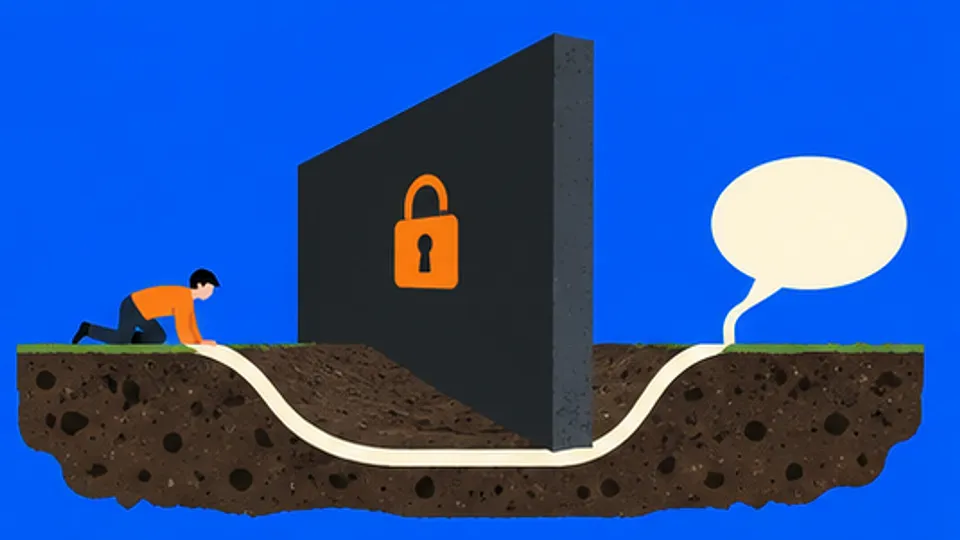
In 1920 the United States outlawed alcohol. The people kept drinking. They drank in basements behind unmarked doors. They got doctors to write prescriptions for medicinal whisky. When the government gave up and made liquor legal again in 1933, drinking stood at about 70 percent of what it had been before the ban.
Now the limits are coming for software. In recent months Meta has put new restrictions on teenagers using Instagram and Facebook. New York City has effectively barred AI from its public school classrooms. Frontier AI companies have asked the federal government to set limits on their own development. The intentions may be good. The risk, according to researchers, is that the measures push people toward unregulated platforms with no safeguards at all.
My concern about the bans is that people will go underground. When they go underground online, bad things happen — really terrible things happen.
That is Uttara Ananthakrishnan, a professor of technology at the University of Washington, talking to Business Insider. The data, she said, shows that outright bans on technology people already use rarely work. VPNs, the software that lets a user disguise where he is, have made them close to fruitless. “People are just going to find other ways to get around it,” she said. “Enforcing it is incredibly difficult.”
In a study published in April, Ananthakrishnan and her colleagues looked at adult websites that introduced age-verification checks. Users moved quickly to sites that had none. “This pattern suggests that age verification laws did not trigger systematic diversion of users from adopting or exiting platforms toward non-adopting ones,” the study said, in the dry language of the journals. The plain reading was the same. Where the door was locked, the people found one that was not. Utah has lately learned something similar about VPNs and borders.
Last year Australia barred children under 16 from social media entirely. As Business Insider’s Katie Notopoulos has pointed out, the measure is hardly having any effect. The parental-control company Qustodio said in a report that within a few months, teens and preteens were back online at levels matching the numbers from before the ban. They got there mostly by entering false ages and using VPNs. The country’s age codes have run into trouble elsewhere too, as two and a half million Australian gamers found out.
Last month Meta settled a landmark social media addiction lawsuit. It agreed to a set of restrictions on under-18 users of Instagram and Facebook. There will be a two-hour daily limit during the daytime. There will be a default block at night. Notifications will be cut off during school hours. Meta tried to get other short-form video platforms, TikTok and YouTube among them, to adopt matching rules. So far none has.
Ananthakrishnan said that without standardized, industry-wide regulation, young users will simply move to whichever platform leaves the door open. “The network is very easy to shift,” she said.
The schools are trying their own version. New York City and Los Angeles, the first- and second-largest school districts in the country, both announced restrictions on generative AI in classrooms last month, a split in approach that has governments around the world picking sides. In New York, elementary and middle school students will get no access to generative AI on school-owned hardware. High school students will take two AI literacy courses a year and use the tools only in limited educational contexts.
Critics say the effect will be to push the use of AI out of sight. “They’re using AI outside of the education space,” Keri Rodrigues, founding president of the National Parents Union, told Business Insider. “They are going to use all kinds of means to go around the system, but also overconsume. But also overconsume in secret,” she said. “Every kid I know — and I have five sons — has ChatGPT on their phone.”
Rodrigues said she would rather see policies that teach students to use the tools responsibly and safely than policies that pretend the tools are not there.
The analogy has its limits. A century ago there was no way to spoof your location and order liquor from an online distributor. Getting drink meant smuggling it from Canada or the Caribbean and outrunning federal agents. And amending the Constitution to ban alcohol was a heavier act than a company trimming what its own product can do.
The parallels hold anyway. Alcohol in 1920, like Instagram now, was everywhere in American life, though people drink less today. Social media use has not fallen. A 2023 Gallup study found that 51 percent of American teenagers spend more than four hours a day on it. And the workarounds keep getting easier.
“Once you get a taste of whatever your convenience is, and if the convenience is taken away from you, people will find ways to get back to that convenience,” Ananthakrishnan said.