
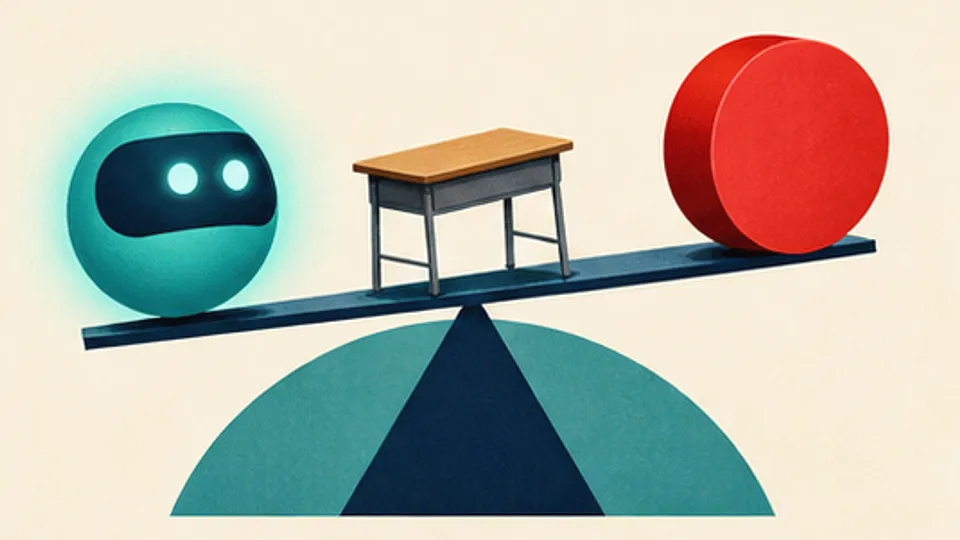
In Estonia the government hands 16-year-olds a chatbot. In New York and Los Angeles, officials have reached for the off switch. Between these poles sits nearly every other education system on Earth, most of them still making up their minds about whether artificial intelligence is a teaching aid, a cheat machine or a threat to learning itself.
Los Angeles pulled the plug first. A couple of weeks before the school year began, the city’s school board banned AI from publicly funded classrooms for the year, affecting some 380,000 pupils. Sandra Martinez Roe, a mother in the city and a member of Schools Beyond Screens, a parent group that campaigns against certain technologies in schools, attended the decisive meeting. “I’m not going to let my children be guinea pigs,” she told EL PAÍS, a Spanish daily. “We went into the meeting prepared, with our demands, some research and a list of experts,” she recalled. “When it ended, they had turned off all the AI tools for all grades and age groups. It was a surprise and a huge victory for us.” The district confirmed the position: “Our policy is to restrict student access to generative AI platforms while the district reviews instructional use and safeguards,” a spokesperson said, adding that the ban will be reviewed at the end of the 2026-2027 school year.
New York has gone further still. Its mayor, Zohran Mamdani, has imposed what city officials describe as “the most expansive student-facing AI moratorium in the nation”, pledging to “prioritize student safety and real, human instruction” and barring the technology for children aged 14 and under. “The tech industry wants us to believe that A.I.-powered early education is not only inevitable, but necessary. We do not see it that way,” Mr Mamdani said. The city has form here: it blocked access to ChatGPT in January 2023, weeks after its launch, over fears of exam cheating, before reversing course that May to “embrace [ChatGPT’s] potential”, in the words of David Banks, then the schools chancellor.
At the other pole sits Estonia, the top-ranked European country and third in the world in the Programme for International Student Assessment (PISA) standings. For a year now it has been supplying 16-year-olds with a tailored version of ChatGPT, built with OpenAI, the chatbot’s maker, that is designed to guide students rather than simply furnish answers. Estonia’s education minister, Kristina Kallas, argues that prohibition merely drives usage underground. “I don’t think banning AI will prevent young people from using it. AI use will just be more clandestine and more hidden from adult view, but they’ll still try to use it,” she said by video call.
The Estonian tool starts from the premise that “general-purpose AI isn’t designed to learn”, as the minister puts it. Her office describes a “Socratic” GPT that helps students “develop their critical thinking skills and [boost] cognitive growth”. The ministry says it has not received a single complaint from Estonian families about the model—though Ms Kallas did receive one from her own son, who had started 11th grade when the tool arrived. “I asked him, ‘How’s it going?’ And he said, ‘It’s really annoying, because [the program] doesn’t give me any answers.’”
Ms Kallas regards the adapted chatbot as merely a first step. “We need to redesign the learning process, recognizing that students are already using AI at home when they’re doing their homework,” she said. “They understand the technology much better than the teachers.”
Even Estonia keeps limits. It does not plan to let pupils under 16 use the tools—a policy it shares, in one form or another, with New York (where the bar is 14 and under), Norway and China. Teachers of younger children are being trained to cope differently. “These are the ages when we need to develop self-directed learners. Teachers know that a 12-year-old is using AI for homework… so we have to design the assignment in such a way that students are forced to think and learn,” Ms Kallas explained.
She calls the stakes “the greatest challenge facing humanity”. “[AI] is a technology that doesn’t force us to think; it makes us dependent on machines. Everything happens very quickly in an education system. And, if we don’t act, all of thinking and memory will be outsourced,” she warns. And she does not think bans answer the problem: “A [blanket ban] is an option, but banning the tools doesn’t make them disappear. The risk is even greater: that learning in schools will become obsolete.”
Somewhere in the middle
Most of the world occupies the murky ground between Estonia and the American bans, without specific policies of either flavour, says Mark West, a researcher at the United Nations Educational, Scientific and Cultural Organization (UNESCO). One exception is the United Arab Emirates, which has made AI a compulsory subject from preschool: four-year-olds learn to compare machines with humans, and 10- to 14-year-olds are taught to design AI systems. “At first glance, they seem like two opposite poles, but that’s not the case,” Mr West said of the UAE and Estonia. “If you look more closely, the UAE and Estonia actually teach students about AI. We believe that’s important and urgent. But relying on AI for learning is an entirely different matter.”
Spain appears to be doing the relying. The PISA report published on September 8th found that in the developed world, students from Malta and Spain use AI the most for studying—while the five OECD countries where they use it least achieve better scores. Spain’s education ministry has set general rules but stresses that education policy belongs to regional governments; a guide issued on September 8th by the National Institute of Educational Technologies and Teacher Training (INTEF) holds that “AI literacy is now a necessary dimension of students’ comprehensive education”. Only Catalonia recommends banning unsupervised AI use in classrooms, for under-14s.
The timing is awkward for the optimists. Teachers are weighing the technology just as Dario Amodei and Sam Altman, two figures central to its rise, propose slowing the pace of model development, while UNESCO counsels both guarding against harm and speeding adoption. “We must ensure that these tools help education and children… and that they’re safe,” Mr West said. Whichever wager a government places, the results will arrive as school results always do: slowly, and marked against everyone else’s.