
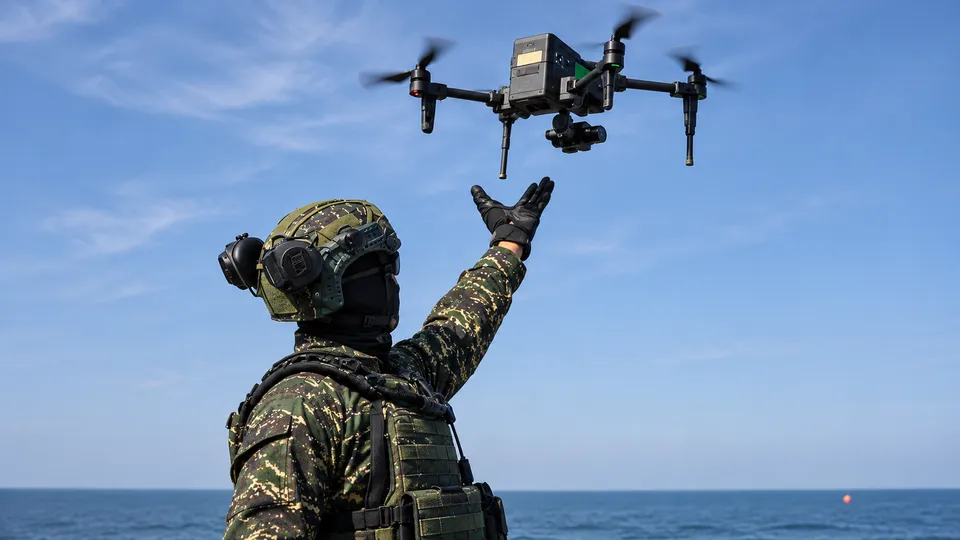
Taiwan shipped 3,500 drones abroad in 2024 and 122,726 in 2025, a 34-fold jump. By June 2026, cumulative exports for the year had reached 191,373 units, according to customs data reported by Business Insider. Export value rose from $4.2 million in 2024 to $89 million in 2025 and $277 million in the first eight months of 2026. Annualized, that implies roughly $415 million for 2026, 4.7 times 2025. None of it means Taiwan has found a durable military customer.
| Export value ($M) | |
|---|---|
| 2024 | 4.2 |
| 2025 | 89 |
| 2026 (Jan–Aug) | 277 |
Source: Taiwan Ministry of Finance customs data, via Business Insider
Most shipments are $800-to-$1,200 units, the range of a first-person-view strike drone, going to Poland and the Czech Republic, transit countries for equipment headed to Ukraine. Cathy Fang, deputy director of the national-security program at the government-funded Research Institute for Democracy, Society and Emerging Technology (DSET), told Business Insider the bulk are likely bound for Kyiv’s front line, where annual demand is an estimated 8 million units — a market Ukrainian procurement officials have described as bottomless for disposable airframes. Taiwan is catching overflow from a war economy: exports hit roughly 136,000 units in the first quarter of 2026, then fell 59 percent to 55,300. “We hope that even if we don’t have the war demand, maybe there will be civilian or government use to sustain it,” Fang said.
Everyone is piling in, with no map
The government-backed alliance TEDIBOA now counts roughly 290 Taiwanese firms making drones or parts, up from a handful before 2022. Stacy Yu, CEO of military supplier Carbon-Based Technology, said that in 2022 and 2023 “things like electric motors, batteries. Everything. Everything was very hard to find, rare and expensive.” A manufacturer can now “find almost anything you need,” she told Business Insider. Her company’s revenue reached $3.2 million in the first nine months of 2026, narrowing a net loss. The rush has also pulled in Hocheng Corp, a ceramics maker whose main product is toilet fixtures, which announced in July that it would make vehicle armor and move into drone composites.
Phoebe Pham, a researcher at the Institute for National Defense and Security Research and former RAND analyst, said Taiwan has no centralized channel connecting manufacturers with military requirements and government buyers, unlike Ukraine’s Brave1 and DOT-Chain marketplaces. Even companies that win government business find the process “murky,” she said; requirements can get distorted down the chain, leaving firms building products that miss what field units want.
Nobody can verify the China-free label
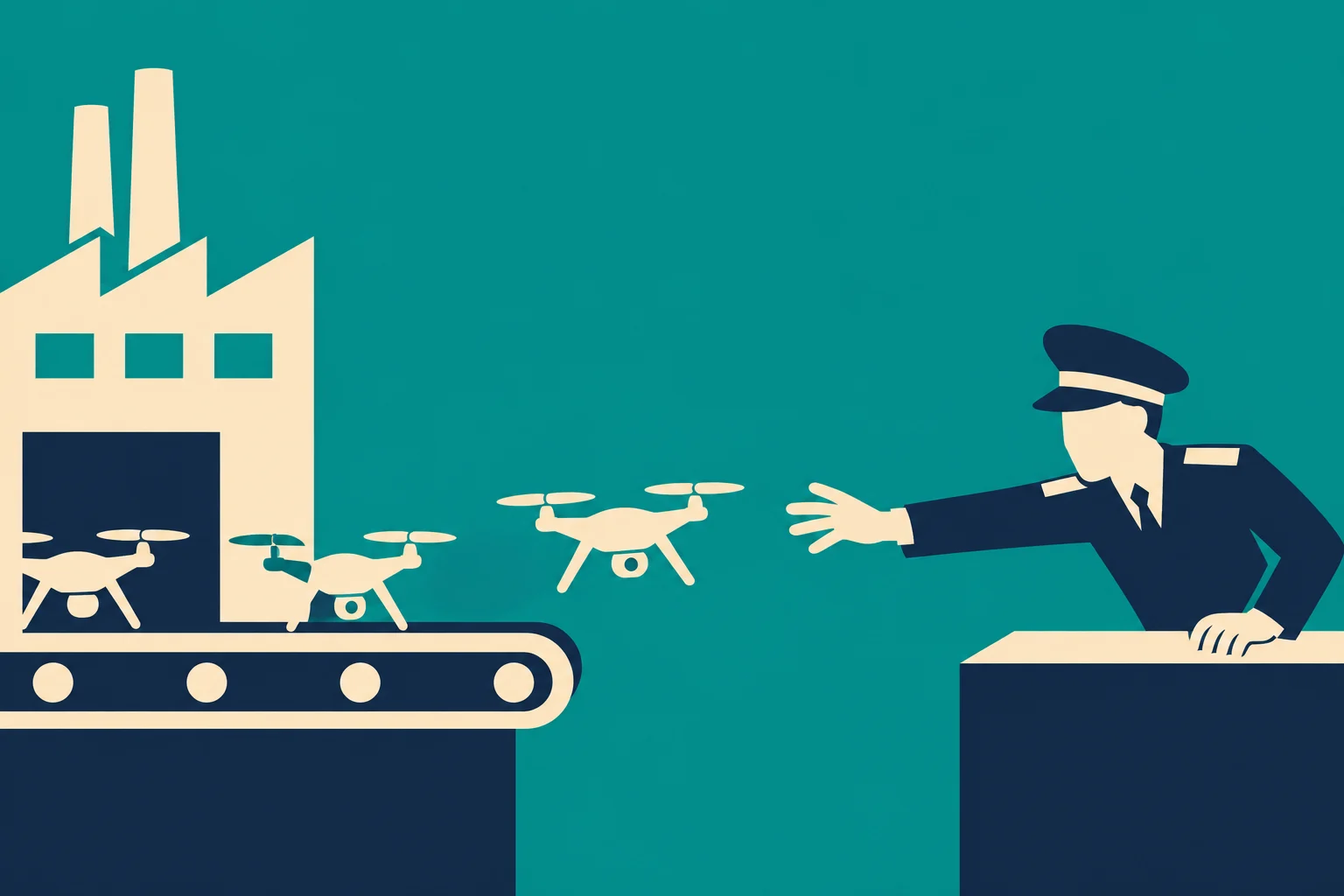
Taiwan’s sales pitch rests on being the non-Chinese alternative to DJI. But it has no uniform standard or certificate confirming a drone sold as China-free actually is, Fang said. DSET frames the hole as a “three chips, two software” gap: flight-controller chips, communications modules, and satellite-positioning and imaging chips, plus AI-enabled flight-control software and autonomous mission and ground-control software, all still largely sourced or licensed abroad even as Taipei brands output “zero red.” One method that has caught violations is reading the chip’s stamp: “If the chip says CHN, then it’s from China. But we don’t have any more strict verification processes for doing that,” Fang said.
In October, prosecutors raided Jiin Ming Industry, a Taoyuan-based military drone supplier, and detained vice chairman and general manager Chien Hao-ting and business director Chen Yang-cheng for two months. They allege the firm put Chinese-made chips and camera lenses into drones delivered under military contracts and submitted false certificates of origin, according to Taipei Times. Chien reportedly admitted the conduct at the detention hearing; Chen denied it, and the allegations haven’t been adjudicated. Jiin Ming said it was cooperating and maintaining its non-China supply-chain commitment, then clarified it had never claimed all products already met that standard. It is at least the third such case in four months: prosecutors charged two Hang Jian Technology employees in August over Chinese flight-controller chips passed off as “red-free,” and a November case detained Align head Tu Ta-sen and his wife over Chinese chips in drones sold to the military and other agencies. The Ministry of Economic Affairs says certification standards will come “as soon as possible,” without fixing a timeline.

Taipei isn’t buying what it’s selling
Taiwan’s military held fewer than 5,000 drones as of Fang’s August 2026 assessment, she wrote in The Diplomat. Taipei had sought $6.6 billion (NT$210 billion) for roughly 211,000 drones and unmanned boats by 2031: 1,446 coastal surveillance drones, 208,200 coastal attack drones and 1,320 suicide boats. Opposition lawmakers blocked that special budget for eight months before the legislature passed its own NT$240 billion ($7.6 billion) version on August 27, 2026, structured as annual appropriations of roughly NT$40 billion, as DroneXL reported. Money isn’t expected to flow until 2027, adding a year to the eight months lost — time Fang says Taiwan needs to test drones, gather field data and train AI models.
The figures around Taiwan aren’t directly comparable, but all dwarf its inventory. China is reportedly on pace to deliver about 1 million drones in 2026 and Ukraine is targeting roughly 7 million units of annual production, both flow figures rather than stockpiles; Japan committed about $1.7 billion to its fiscal 2026 drone budget. Meanwhile, the Pentagon’s Blue UAS list had 323 entries from roughly 45 manufacturers as of October 1, none prominently Taiwanese primes. That matters if Taipei expects US military procurement, rather than Ukraine’s war economy, to become its next reliable customer.
“The Taiwan drone industry exists or is able to be competitive because of the split from non-Chinese drone components,” said Dennis Huang, managing director for international strategy at Taiwan UAV, whose loitering-munition tenders stalled during the budget fight. “If that didn’t exist or no one cared about it, I don’t think the Taiwan drone industry will be competitive at all.” The window is measured in years, before buyers build their own vetted non-Chinese supply chains. The next tests are whether the NT$40 billion first installment clears the legislature’s annual vote in 2027, and whether usable China-free certification exists before another criminal case makes the question moot.