
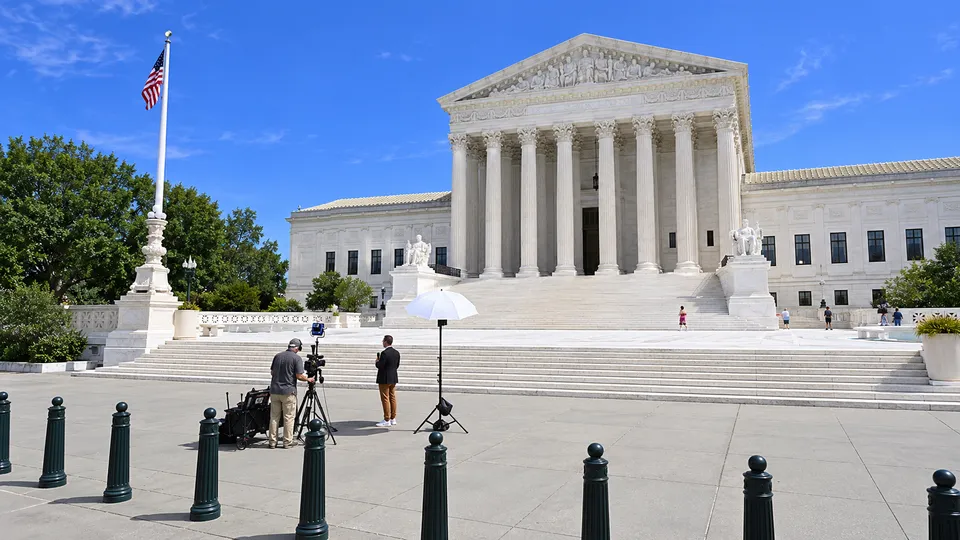
The Supreme Court opens a new, nine-month term on Monday with arguments over whether states and cities can sue fossil fuel companies over climate change, the first of a docket stacked with religion, guns and immigration cases.
Missing from the calendar, for now, are the Trump-driven clashes over tariffs, birthright citizenship and the firing of agency leaders that filled last term. The justices have granted 28 cases, less than half of what they will likely decide by June. “There’s a very good chance that the 35 or so that the court is likely to grant in the remainder of the year will be the ones that are really the highlights,” Masha Hansford, a former assistant to the solicitor general, said at a recent National Constitution Center event. Petitions involving the E. Jean Carroll defamation case, canceled research grants and the ban on transgender troops await an answer.
The opening case comes from Boulder, Colo., which is seeking damages from Suncor Energy and Exxon Mobil over what it calls decades of deception about fossil fuels. The companies argue that emissions cross every border and “cannot be unmixed and traced to their individual sources,” and warn that such suits would amount to a carbon tax that would “bankrupt” the industry. Boulder answers that states may address harms within their own borders: “It merely asks that petitioners bear their fair share of local costs incurred in part because of their tortious conduct.”
A ruling for the companies could also block dozens of similar lawsuits by other states and localities. Justice Samuel Alito is sitting the case out; his most recent financial disclosure lists stock in ConocoPhillips and Phillips 66. A 4-4 split would leave in place a Colorado ruling that lets Boulder’s suit proceed, without setting precedent.
Religion arrives Nov. 3. St. Mary Catholic Parish, a preschool in Littleton, Colo., wants money from Colorado’s universal preschool program, which gives every 4-year-old up to 15 free hours a week, while refusing to admit LGBTQ children or the children of gay parents. The state says funding the school would violate its antidiscrimination law. The justices split 4-4 on a similar Oklahoma case last term, when Justice Amy Coney Barrett was recused; she will take part this time, and the conservative majority has repeatedly granted religious exemptions from generally applicable laws.
Guns come Dec. 2, in challenges to bans on AR-15-style semiautomatic rifles enacted by Connecticut after the 2012 Sandy Hook shooting and by Cook County, Ill., nearly 20 years ago. More than 10 states and the District of Columbia have similar bans. Gun owners’ lawyers say the rifles are in common use, the test set in 2008 in District of Columbia v. Heller; opponents answer that the weapons are unusually dangerous and recur in mass shootings. “We know the outcome, but we don’t know how it’s going to be decided,” Deepak Gupta, an appellate lawyer, said at a Georgetown Law Center event, predicting the bans will fall.
Two immigration cases test the administration’s harder line. The court will hear arguments in December on deporting migrants to third countries when their own countries refuse them; the justices have twice lifted lower-court orders blocking the policy. A second case concerns detention without bond hearings for people in the country illegally. Immigration and Customs Enforcement held more than 65,000 people this summer, up from just under 38,000 at the end of the Biden administration.
On Dec. 7 the court weighs Washington state laws that let youth shelters treat a runaway teenager for gender dysphoria without telling parents. Waiting for review: an effort to overturn the court’s 1980 precedent barring the Ten Commandments from public school classrooms, pressed by new laws in Texas, Arkansas, Louisiana and Alabama, and a dispute over whether states may regulate Kalshi, a $40 billion prediction market.
Over all of it looms the emergency docket. “Now we have twice as many full court rulings on emergency applications as we have on the merits docket,” Stephen Vladeck, a Georgetown University law professor, said. Those orders come with thin briefing, no arguments and little explanation, and lower-court judges in both camps say they are left guessing.
Mr. Trump, for his part, told Time magazine last week that he regretted nominating Justices Neil Gorsuch, Brett Kavanaugh and Ms. Barrett. “I gave them the position of a lifetime,” he said, “and they vote against me often.” Justice Alito, asked on CBS about presidential attacks on the court, called the criticism “very harsh” but “bipartisan.” Of Mr. Trump, he said, “he has his own way of saying things.”
Next month’s midterms could intrude: the court last month rejected the administration’s proposal to give the Postal Service a role in screening mail ballots, and it has juggled redistricting fights. Mr. Vladeck suspects the term’s defining cases have not yet been filed. “The real story of the upcoming term hasn’t been written yet,” he said.