
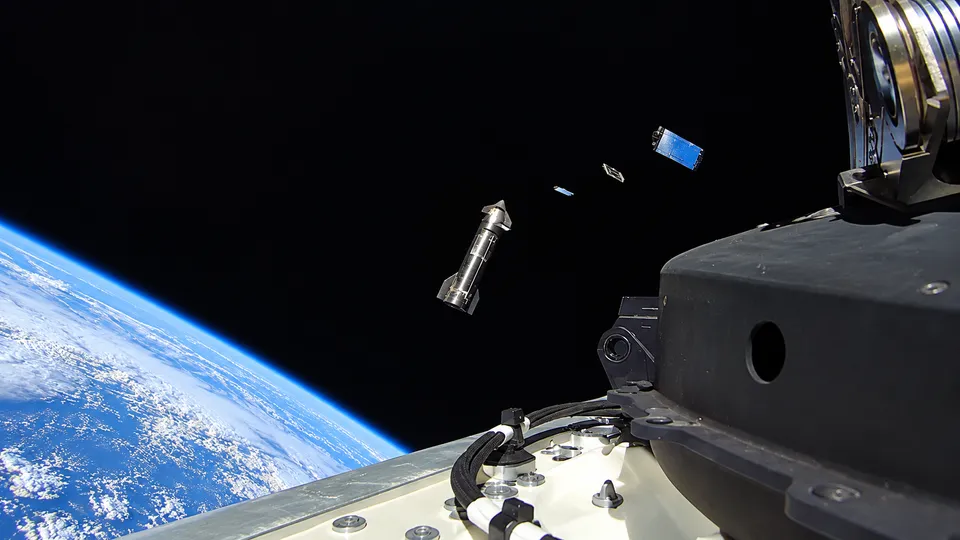
Here is a coordination problem. Imagine you operate a highway with no traffic laws, no licence plates and no requirement to signal. Most of the vehicles are yours. The rest belong to other people, some of whom simply change lanes whenever they like without mentioning it to anyone. You can see the potholes coming, because potholes don’t move. You can’t see the other drivers’ plans, because they keep those to themselves.
That is roughly the complaint Michael Nicolls brought to the International Astronautical Congress in Turkey on Tuesday. Nicolls is SpaceX’s vice president for Starlink and also, as Stephen Clark reported for Ars Technica, president of Elon Musk’s AI company xAI. He went through several cases where satellites belonging to other operators maneuvered without telling anyone and ended up very close to Starlink satellites, which travel at 5 miles per second. His explanation: “Either they were not publishing their ephemeris to us, or they were not considering the ephemeris of others when they were maneuvering, and these led to conjunctions of tens of meters to hundreds of meters.” His verdict on that was, more or less, way too close.
An ephemeris is just a satellite’s location and where it is headed. Nicolls did not suggest the close approaches were hostile, so this was not spying or attempts to ram anything. It was people moving their satellites and not telling anyone.
“Once you can track this debris, and if you can track it well, these are like obstacles on a road,” Nicolls said. “What you can’t avoid is other operators who maneuver without telling you where they’re going to go. We have many examples of this on Starlink, unfortunately.”
The biggest driver pays for the road
The economics are what make this interesting to me. Starlink now has more than 11,000 satellites, which is about two-thirds of the active spacecraft in low-Earth orbit. No global treaty or regulation requires operators to broadcast their positions or maneuvers, or to coordinate at all. So whatever norms exist have to come from governments and companies. When one company owns two-thirds of the fleet, it bears about two-thirds of the risk. That means it also has every reason to supply the public good itself and then lobby everyone else to join in.
That is what SpaceX does. It publishes ephemeris data for Starlink. It has also built camera-based tracking into the satellites, a system it calls Stargaze, which Nicolls said now tracks about 90 percent of the maneuvering satellites that cross Starlink orbits. SpaceX describes a free coordination platform open to all operators, which screens uploaded trajectories against each other and against the Stargaze catalog. It has also moved the whole active constellation below 500 kilometers, and its new V3 satellites, the first batch of which went up on Starship on September 28, will fly at about 350 kilometers.
All of that is the cost of being the biggest. The ongoing cost is dodging. Nicolls said Starlink satellites perform about 1,000 collision avoidance maneuvers a day, to avoid both working satellites and debris. Multiply that by the roughly 182 days in half a year and you get around 182,000. That is about the right scale: SpaceX’s most recent semiannual filing to the FCC, covering December 2025 through May 2026, counted 207,152 avoidance maneuvers, and Space.com calculated that this works out to almost one dodge a week for every satellite. According to Nicolls, Starlink satellites now commonly spot an approaching object and move out of its way on their own. When there isn’t time to steer clear, they do “ducking maneuvers”, turning the satellite at the moment of closest approach to reduce the chance of being hit. That is an impressive bit of engineering, and also a strange thing to need.
Here is the figure that sums up the problem. Nicolls said that over the past few months Starlink satellites have steered around about 650 active satellites from other operators. Only half of those, so roughly 325, belong to operators that share ephemeris with SpaceX. For the other 325 or so, SpaceX is guessing.
Who isn’t calling back
“In particular, it’s been very challenging to share data with international operators,” Nicolls said. SpaceX does share data closely with the Chinese space station and some other Chinese operators, “but there are many that we do not, and we have no information about where those satellites are or where they’re going.” A chart in his presentation put most of the problem on Chinese and Russian satellites, though some operators in the United States, Europe and Japan don’t share either.
Why keep it secret? Some operators may think that knowing where your satellite is, while nobody else does, gives you a competitive or strategic edge. In a narrow sense that’s probably true. Secrecy costs you nothing as long as someone else is doing the dodging, and the biggest operator has made dodging its routine. Nicolls’s argument is that this can’t hold forever: “the law of large numbers says that if it can happen, it will happen.” On any given day the chance of a collision is extremely small. But one collision could produce thousands more pieces of debris, which could cause further collisions, and those would affect everyone’s satellites, including the secretive operators’.
The amount of traffic is about to grow a lot. SpaceX has floated a constellation called Starmind of up to a million satellites, to put AI computing in orbit. Two Chinese megaconstellations are being deployed at full scale. Amazon is at an earlier stage. And Washington just cleared another big Starlink expansion.
Ars put the question to Rajeev Badyal, who runs Amazon Leo, Starlink’s main broadband rival. His answer was more cooperative than you might expect from a competitor. “Every launch we do, we actually coordinate with SpaceX,” he said, describing regular meetings to exchange data. “So, for us, sharing ephemeris or sharing the information necessary for space safety is a non-issue.” Amazon has 396 satellites in orbit. Its first-generation constellation is planned at 3,232, the FCC approved a 4,504-satellite second generation in February, and Amazon has applied for 5,105 more for direct-to-device service. So Amazon is still a small fraction of Starlink’s size, and when you’re the smaller driver on a road someone else mostly controls, cooperating is the cheap option.
On China, Badyal said it was something he “can’t comment on at the moment,” and then gave a fair summary of the whole problem: “At some point, we will have to coordinate, or it’ll end up being a negative thing for everybody, especially if they get to scale.”
At current rates, “at some point” is about a thousand dodges a day from now, and the number is going up.