
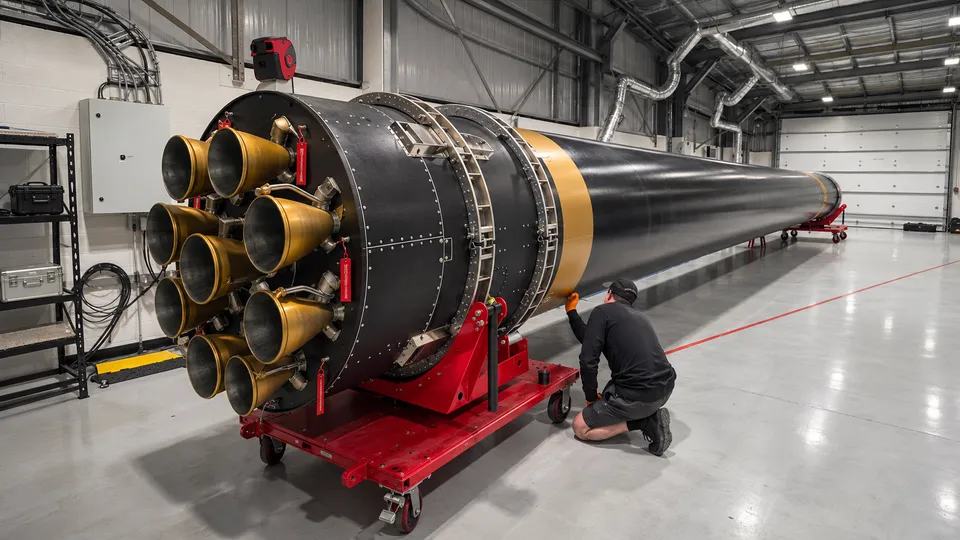
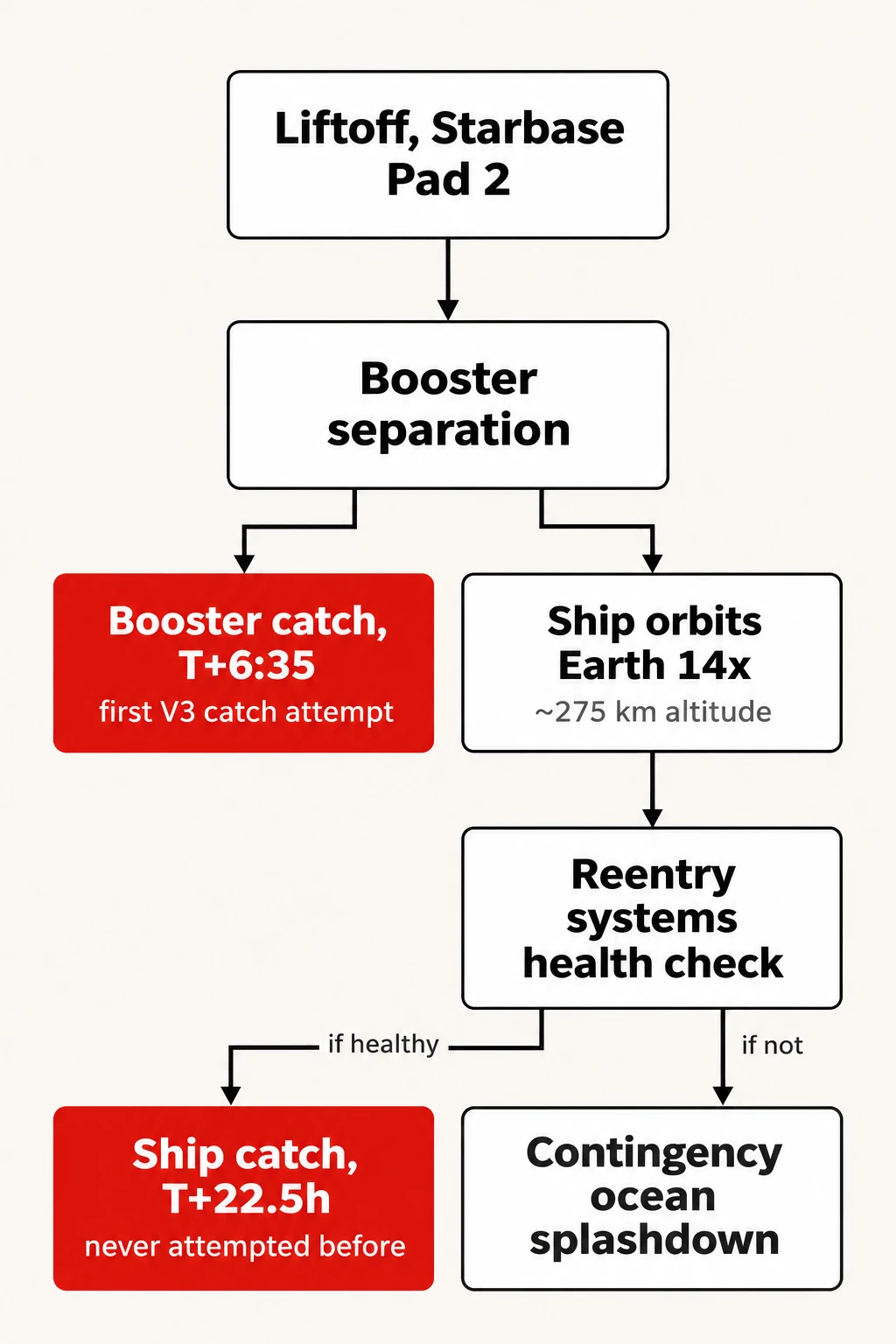
No orbital rocket has ever been fully recovered. SpaceX’s own Falcon 9 reuses its first stage but drops an expendable second stage and payload fairing into the ocean on every flight, and no other operational launcher does better. SpaceX tried to close that gap this weekend at Starbase, Texas. Booster 22, the first Block 3 Super Heavy to attempt a tower catch, came back to the launch site’s mechanical arms about six minutes 35 seconds after Friday’s liftoff; whether the catch succeeded was not yet confirmed as of this writing. Ship 42, the upper stage, is due to attempt its own catch roughly 22.5 hours later, after 14 orbits of Earth at about 275 kilometers, deploying 26 Starlink V3 satellites along the way.
The catch mechanism is the same both times: a pair of arms on the launch tower close around catch pins on the vehicle as it hovers at the end of a landing burn, a maneuver SpaceX has pulled off three times before, on flights 5, 7 and 8, with two of those boosters flying again. This attempt is harder on two counts. It is the first catch try for the larger V3 booster design, and the first catch of any kind at Starbase’s second tower, Pad 2. The ship catch, never attempted before this weekend, is harder still: the ship flies a longer, faster reentry, and its ground track back to Starbase crosses populated parts of northern Mexico and South Texas, which is why the flight plan keeps an ocean splashdown as a fallback if the ship’s reentry and landing systems don’t check out healthy after 14 orbits.
| From | To | How |
|---|---|---|
| Liftoff, Starbase Pad 2 | Booster separation | |
| Booster separation | Booster catch, T+6:35 (first V3 catch attempt) | |
| Booster separation | Ship orbits Earth 14x (~275 km altitude) | |
| Ship orbits Earth 14x (~275 km altitude) | Reentry systems health check | |
| Reentry systems health check | Ship catch, T+22.5h (never attempted before) | if healthy |
| Reentry systems health check | Contingency ocean splashdown | if not |
Based on SpaceX flight plan, via Space.com
The point of the exercise is cost, not spectacle. Falcon 9 recovers only its first stage, which is most of a rocket’s structure and all of its engines, but the second stage and fairing are built from scratch every flight. Full Starship reuse would, if it holds up across repeated flights, apply that saving to both halves. How much that actually saves is still a projection, not a measurement: Starship has not yet flown a paying customer, and the 26 satellites on this flight belong to SpaceX itself. Musk told investors on SpaceX’s October earnings call that Flight 15 would attempt exactly this double catch, and the FAA has separately been weighing a license for up to 456 Starship flights a year out of Starbase — a cadence that only makes sense if both halves start coming home routinely.
The rest of the industry isn’t waiting on a catch
SpaceX’s pivot away from Falcon 9 is forcing the capacity question onto everyone else. The Pentagon’s Office of Strategic Capital — created in 2022 to pull private capital into technology the Department of Defense judges critical — has issued three $150 million conditional loans to launch and space-infrastructure firms in three weeks, as Air & Space Forces Magazine reported: to Stoke Space on October 26 for a second launch pad at Cape Canaveral, to Rocket Lab this week for recovery vessels and factory upgrades on its Neutron rocket, and to the radar-tracking firm LeoLabs. None of the three loans is final; each still has to clear financial, legal and technical due diligence, as GeekWire noted of the Stoke commitment.

Rocket Lab is pricing the shortage in before its own rocket has flown. On November 9 the company raised the price of a dedicated Neutron launch from $55 million to $70 million — a 27% increase — for a vehicle whose debut has slipped to 2027, as Space.com reported. “We saw a pent-up launch market on the horizon, and rather than provide early discounted launches, we set out to deliver a rocket into an environment with extreme demand at full price or higher,” the company said. Rocket Lab’s third-quarter results show why it can get away with that: record quarterly revenue of $268 million, up 73% year on year, against a net loss of $79.7 million that widened from $18 million a year earlier, and an overall backlog of $3.6 billion across 117 launches, up 52% since the second quarter’s $2.36 billion. Eight Neutron contracts worth more than $515 million were signed in the third quarter alone, pushing Neutron’s own backlog to 16 missions with open slots not available before the 2030s. CEO Peter Beck called Neutron “the backbone of next-generation constellation deployment and government missions in the medium-lift launch class.” At $70 million, a Neutron flight now costs nearly as much as a Falcon 9.
New rockets, new customers
Three medium-lift contenders signed launch deals or disclosed specifications this month, each betting on the same shortage. Stoke Space and Planet Labs announced a multi-launch agreement, terms undisclosed, covering both of Stoke’s reusable Nova variants, as Stoke Space announced: the smaller Nova Pathfinder, targeting a first orbital flight in 2027, and the larger Nova Block 2, designed to carry more than 15 metric tons to low Earth orbit fully reusably from a Cape Canaveral pad — the one SLC-14 used to send John Glenn into orbit in 1962 — that the Pentagon loan is meant to help build, targeted for 2029. Stoke has separately raised $1 billion to fund the Nova program.
Firefly Aerospace signed a deal with the Japanese radar-imaging company Synspective for up to 10 launches on its Alpha rocket through 2030, carrying two satellites per flight — up to 20 total — to build out Synspective’s StriX constellation, launching from Wallops Island, Virginia, and Vandenberg, California. The deal helped push Firefly’s own backlog to a record $1.7 billion in the third quarter. Firefly’s Miranda and Vira engines, still unflown on the company’s own Eclipse rocket — co-developed with Northrop Grumman, past 175 hot-fire tests on Miranda, with CEO Jason Kim declining on this week’s earnings call to commit to a 2027 launch — are the same engines AST SpaceMobile has licensed to build its own rocket, Blacklift.
AST SpaceMobile, the direct-to-phone satellite broadband company, unveiled Blacklift on November 12: a reusable, three-stage, 20-metric-ton rocket using seven Firefly Miranda engines on the first stage and three Vira engines across the upper two stages, meant to fly twice a month from Wallops’ former Antares pad carrying five of AST’s Bluebird satellites at a time, targeting operations in late 2028. CEO Abel Avellan said AST had already secured the engines because engine development is, in his telling, 80% of a rocket’s development cycle, and framed the project bluntly: “We want this because we have so much demand of our satellites and, as you have seen it, we cannot get enough launches on time.” AST hasn’t said how it will pay for Blacklift’s development, nor has it built an orbital rocket before.
| Rocket | Payload to LEO | Reusability | Status |
|---|---|---|---|
| Neutron (Rocket Lab) | 13 metric tons | Reusable first stage | Debut slipped to 2027; price raised to $70 million |
| Nova Block 2 (Stoke Space) | More than 15 metric tons | Fully reusable | Cape Canaveral pad targeted 2029 |
| Blacklift (AST SpaceMobile) | 20 metric tons (5 satellites) | Reusable first stage | Targeting operations late 2028; financing undisclosed |
Source: Company statements compiled from Rocket Lab, Stoke Space and AST SpaceMobile
A small, old rocket hits triple digits
While the new entrants line up launch deals for rockets that haven’t flown, Rocket Lab’s Electron reached its 100th mission on November 14, deploying a synthetic-aperture radar satellite for the Japanese operator iQPS into a 575-kilometer orbit from Mahia, New Zealand, as Rocket Lab detailed. Electron first flew in 2017; Rocket Lab says no other commercially developed rocket has reached 100 launches faster. It remains the first carbon-composite orbital launch vehicle and flies the Rutherford engine, the first 3D-printed orbital rocket engine and the first to use electric motors instead of gas turbines to drive its turbopumps.
Europe’s bottleneck is a supply chain, not a rocket
Italy’s Avio faces a different constraint on its Vega C rocket: not demand, but solid rocket motor production shared with Ariane 6. At Vega C’s baseline cadence of four flights a year, a single Ariane 64 launch consumes the equivalent of an entire year’s worth of Vega C boosters, as European Spaceflight’s analysis laid out. Avio wants to raise Vega C’s cadence to six flights a year and eventually nine. CEO Giulio Ranzo has said the company is “working on to increase, as a first step, the cadence of Vega to six per year, and potentially a second step to nine per year.” Getting past six requires new production facilities at Colleferro and a funding decision at the European Space Agency’s 2028 Ministerial Council — which is also the meeting that will have to settle whether Ariane 6’s own growing demand for the same solid motors leaves Vega C, and its planned successor Vega E, enough supply to be worth the investment.