
Empires seldom announce that they have changed. They keep their old name for a while, out of habit or because the old name still sells, until someone on the inside says the new truth out loud. At SpaceX that person was Kiko Dontchev, the company’s vice president of launch. He said it last week at the UP.Summit conference in Florida, as Eric Berger reported for Ars Technica.
“In the last couple years, when I talk about SpaceX, yes, we are a rocket company, but fundamentally we are an infrastructure company at this point. We’re building infrastructure on the ground and low Earth orbit, soon on the Moon, and obviously eventually Mars.”
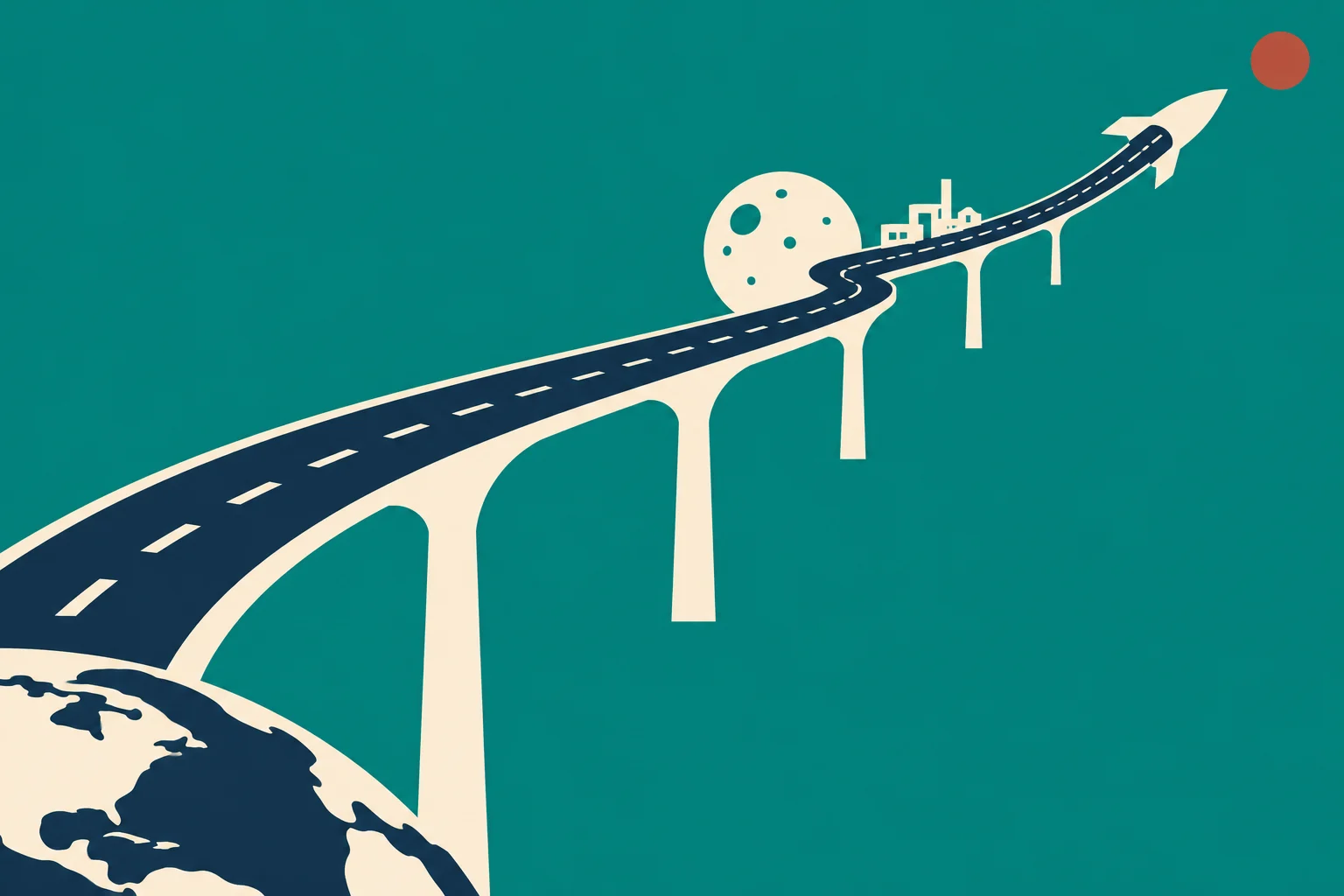
Look at the order of that list. It runs from the ground to orbit, then the Moon, then Mars: a list of territories, each further out than the last. The rocket comes into the sentence only as an apology (“yes, we are a rocket company”) before the real subject arrives. In this new account the rocket is the road. The thing being built is whatever sits at the end of it.
The old name
For most of its life SpaceX meant rockets, and each one came out newer, bigger and more reusable than the one before. Starlink began to change that over the past decade. In the last 18 months the change has sped up as the company turned toward data and artificial intelligence. Falcon 9 has dominated global launch for ten years and is still the world’s preeminent launch vehicle. Even so, Dontchev made clear that it is firmly on the road to retirement.
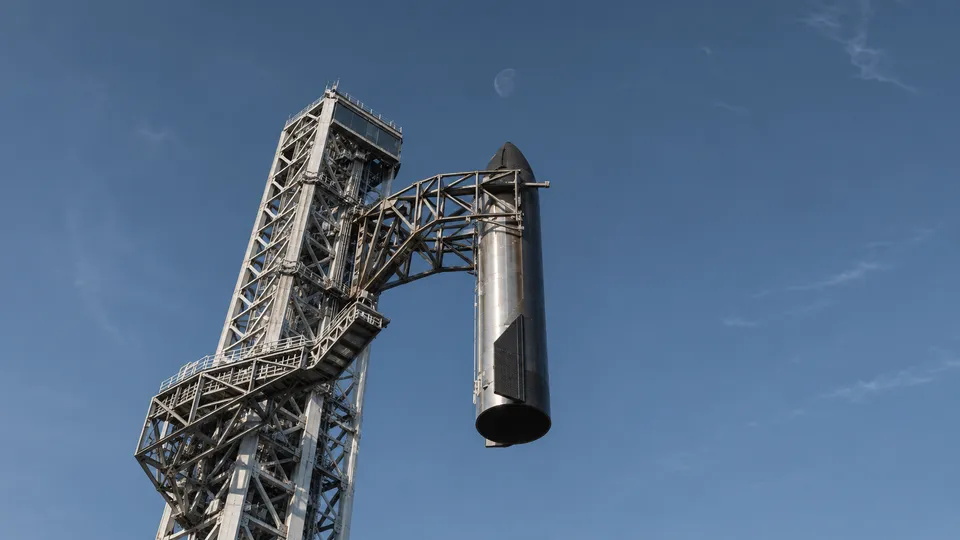
That road has been visible for months. On 25 August, Dontchev wrote on X that a mission that morning from pad 40 was the last planned Falcon 9 Starlink launch from Florida, and that Starlink missions from Florida would fly on Starship from then on. He said the West Coast team would keep launching Starlink regularly from Vandenberg. He also counted roughly 260 Starlink missions flown by Falcon from the Cape in seven years. The rocket still works for other customers. Space.com, covering a recent classified USSF-432 launch for the US Space Force from California, noted that SpaceX plans to retire both Falcon 9 and Falcon Heavy shortly after Starship is up and running. That is the fully reusable giant the company has promised to catch in both halves.
No date for the last Falcon 9 flight came out of Florida. A machine that carried a decade of launches will go into retirement in stages, one coast at a time and one customer at a time, without a ceremony.
The machine that thinks
The new identity has a second root. On 2 February, CNN reported, SpaceX acquired xAI, the artificial-intelligence company founded by Elon Musk, who also founded SpaceX. According to documents viewed by CNBC, the deal valued SpaceX at $1 trillion and xAI at $250 billion, a combined $1.25 trillion, which made it the largest merger on record. Musk said the main reason was data centres in space. The infrastructure behind this idea already has a price on Earth: SpaceX’s borrowing for Nvidia chips has pushed the cost of insuring against its default to a record.
Dontchev described what happened inside the company. SpaceX engineers were already using xAI’s tools before the acquisition, he said, but only in recent months have employees really started to work out how artificial intelligence can speed up what they do.
“What’s happened at SpaceX is we’ve really gone through a huge acceleration of adoption. Even just a year ago, we weren’t adopting it that quickly, but really starting this year, we started to adopt it extremely rapidly. And the acceleration we have seen in our ability to do engineering is unlike anything I’ve ever seen at the company in my 16 years.”

According to Dontchev, tasks that used to take employees hours or days now take seconds or minutes. He said the change reaches beyond the engineers. The search for foreign object debris, known in the trade as FOD, has been largely automated with Grok, the AI assistant made by xAI. FOD is the stray fragment left inside an aerospace part, and it can do catastrophic damage to engines and other spacecraft components.
A small thing in a large machine
The detail deserves a moment of reflection. It is a modest claim next to talk of the Moon and Mars. In rocketry the smallest object in the building can still destroy the largest one, and the job of guarding against it has now been handed, in large part, to the same family of software the company bought for $250 billion. That is faith of a practical kind. A company does not give a task like that to a tool it doubts.
Still, every measure of the acceleration given at the summit was Dontchev’s own: seconds instead of days, a speed-up he called unprecedented in his 16 years. Nothing published so far lets an outsider check those numbers. Starship will have to show them, along with everything else an infrastructure company has promised to build out past the edge of the atmosphere. For now, the one fixed point is that the rocket that made SpaceX is being retired.