
Quantinuum held a single logical qubit in memory at an error rate of 5×10⁻⁶ per round of error correction, across 20 rounds of continuous correction, according to a preprint the company posted October 16 (arXiv:2610.24077). Restated as a single number, that is 99.9995% fidelity, or about five failures per million rounds. The headline isn’t the absolute number so much as the trend behind it: each time the company added more hardware qubits to the same logical qubit, the error rate fell by a factor of roughly 12. Most published error-correction demonstrations manage a factor closer to 2.
The reason that distinction matters, as John Timmer explained in Ars Technica, comes down to how a logical qubit works. It’s built from several hardware qubits linked together: some hold the data, others, called ancillas, get measured repeatedly to produce ‘syndrome data’ that tells the control software whether an error occurred, where, and of what type. A code’s ‘distance’ is roughly how many simultaneous errors the logical qubit can absorb before it fails; a higher distance needs more hardware qubits, and should, below some threshold error rate for the raw hardware, produce a lower logical failure rate. Above that threshold, adding qubits just adds more ways to fail. The point where adding qubits starts to help rather than hurt is ‘breakeven’; several groups, including Quantinuum itself in a September demonstration, have already shown hardware past it. What separates one breakeven demonstration from another is the scaling factor, Λ: how much the error rate improves with each step up in distance. A Λ near 2 means reaching the error rates a useful multi-step algorithm needs would require thousands of hardware qubits per logical qubit. A Λ of 12 cuts that requirement by roughly an order of magnitude at every step.
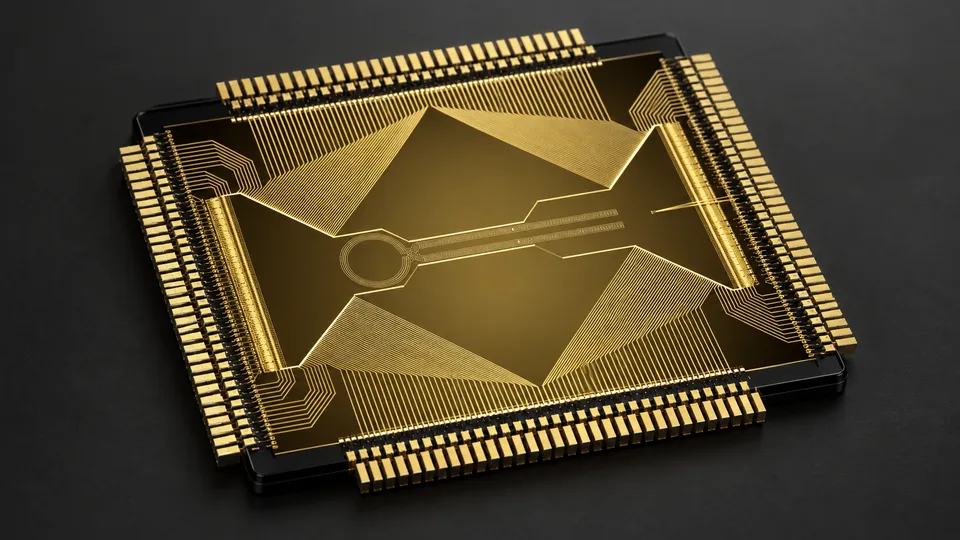
Helios, the machine behind the result, is a 98-physical-qubit trapped-ion processor that Quantinuum put into commercial service on November 5, 2025, built from barium-137 ions trapped above an electrode chip 15.3 millimetres long, according to the company’s product data sheet. The ions sit in a storage ring and get rotated by electric fields into one of two linear zones where lasers read and manipulate them; because any ion can be shuttled next to any other, Helios can wire up essentially any error-correction code’s geometry rather than being locked into a fixed grid, the way superconducting-qubit chips are. Two-qubit gate error on the raw, unencoded hardware runs about 8×10⁻⁴ per the data sheet, close to the 10⁻³ baseline the new paper uses. Trapped ions also skip the dilution refrigerators that superconducting qubits need to stay within hundredths of a degree of absolute zero — the subject of an earlier look at the field’s cooling bottleneck; Helios runs near room temperature, with lasers doing the cooling of the ions’ motion rather than the surrounding electronics.
A sizable share of the errors in earlier Quantinuum hardware came from ‘leakage’: a qubit meant to occupy one of two energy states used for computation instead drifts into a third, nearby state the control software isn’t watching. The company added a laser scheme that finds leaked qubits and pumps them back into the computational states, running concurrently with the laser cooling the ions need between operations anyway; it says this cuts leakage-driven errors by a factor of 6.5. A second, software-only fix swaps any data qubit found to have leaked for one of the ancilla measurement qubits, which gets reset and put back into service rather than carrying the error forward.
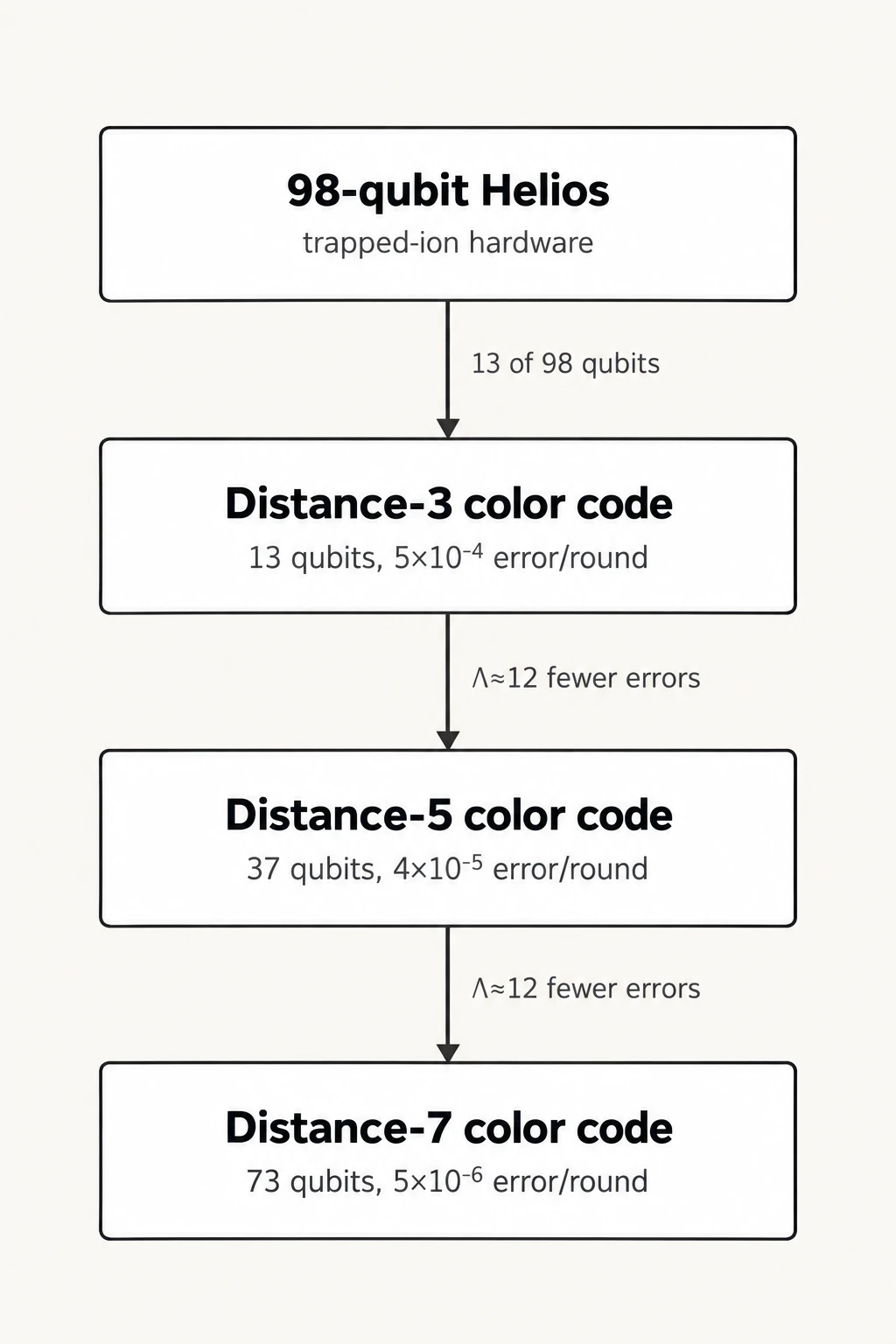
For the memory test, the team built a triangular ‘color code’ at three sizes: distance 3 using 13 physical qubits, distance 5 using 37, and distance 7 using 73 — the largest Helios’s 98 qubits can host at once. Each size ran 20 rounds of syndrome extraction before the logical qubit’s state was checked, because the hardware is now reliable enough that a single round doesn’t produce enough errors to measure accurately. Decoding the syndrome data fast enough to keep up with 20 rounds in sequence took three separate real-time decoders: a conventional algorithm, a convolutional neural network, and a transformer model, all reported to keep pace with the syndrome-extraction rate.
| From | To | How |
|---|---|---|
| 98-qubit Helios (trapped-ion hardware) | Distance-3 color code (13 qubits, 5×10⁻⁴ error/round) | 13 of 98 qubits |
| Distance-3 color code (13 qubits, 5×10⁻⁴ error/round) | Distance-5 color code (37 qubits, 4×10⁻⁵ error/round) | Λ≈12 fewer errors |
| Distance-5 color code (37 qubits, 4×10⁻⁵ error/round) | Distance-7 color code (73 qubits, 5×10⁻⁶ error/round) | Λ≈12 fewer errors |
Based on Quantinuum
The logical error rate per round came out at about 5×10⁻⁴ at distance 3, 4×10⁻⁵ at distance 5, and 5×10⁻⁶ at distance 7 — each step down by a factor the preprint’s authors fit as Λ=12. The team also checked whether syndrome data from one round carried statistical information into non-adjacent rounds, which would signal a hidden, systemic error source; it found correlations only between immediately neighboring rounds, meaning the failures look statistically well-behaved rather than driven by some uncorrected drift.
Holding a qubit still is one test; operating on it is another. For two-qubit logical gates — randomized sequences of two-qubit Clifford gates — the raw, unencoded hardware failed about once per 1,000 operations. Encoding the same gate in a distance-3 color code barely moved that number; distance 5 brought it down to about 7×10⁻⁵, a suppression the authors fit at Λ=9, with a wide uncertainty band of +8/−4 given how few logical failures the run produced. Helios can’t yet hold two distance-7 logical qubits at once to extend the gate comparison that far: its 98 qubits are enough for one distance-7 memory, or two smaller logical qubits, not both at the larger size simultaneously.
How that compares with the other kind of qubit
Quantinuum says the distance-7 memory result is ten times better than its own September record, which used a different code, called Helix, needing only 10 physical qubits per logical qubit rather than color code’s 37 at distance 5. The company also says it is roughly 100 times better than the best published figure from a superconducting machine: Google Quantum AI’s color-code memory demonstration on its Willow processor, published in Nature (arXiv:2412.14256), which measured a suppression factor of Λ=1.56 going from distance 3 to distance 5. The two Λ figures come from different hardware, different codes, and different review processes: Google’s went through Nature’s peer review; Quantinuum’s is a preprint posted five days before the company’s press release and had not been peer-reviewed as of publication. The eightfold gap between Λ=12 and Λ=1.56 is Quantinuum’s selling point, and it rests on comparing a reviewed result against an unreviewed one.

Quantinuum’s own account of the result converts Λ=12 into a hardware budget: reaching the error rate a useful fault-tolerant computation needs would take roughly 30,000 physical qubits on its ion-trap architecture, against an estimated 900,000 on a superconducting machine scaling the way Google’s does. Both figures are projections built by extrapolating the measured Λ outward, not qubit counts anyone has built; the actual machine behind this result has 98.
Robin Blume-Kohout, who co-directs Sandia National Laboratories’ Quantum Performance Lab and had no part in the work, called it a logical qubit ‘nearly 100x better than its component physical qubits,’ according to Quantinuum’s press release.
These findings go a long way to retire one of the field’s central technical risks.
Quantinuum’s chief executive, Rajeeb Hazra, used the same release to restate the company’s target of a universal fault-tolerant machine, called Apollo, by 2029.
We’ve crossed the threshold necessary for exponential improvements in accuracy, reinforcing our path to Apollo and how we can help users unlock commercial value from quantum at scale.
What the preprint doesn’t show is a full algorithm run on an error-corrected logical qubit, more than one distance-7 logical qubit held at once, or a replication by anyone outside Quantinuum. The 2029 Apollo date is the company’s own target, without a track record yet against which to check it. The number worth watching next is whether Λ holds at 12, rises, or falls once Quantinuum or a competitor pushes a color code past distance 7 — that is the test of whether this scaling is a property of trapped-ion hardware or an artifact of measuring just three points.