
Quantum computing has a marketing department and it has a plumbing problem, and the gap between the two is where most of the interesting facts live. In a Q&A published by Kobe University and carried by Phys.org, Professor Takuji Miki of the Graduate School of Science, Technology and Innovation walked through both. The marketing version you already know: a classical bit is a 0 or a 1, a quantum bit can sit in a superposition of both, and for certain calculations — simulating the chemistry of a new drug, say, or factoring very large numbers — that lets a quantum machine do in a short time what a supercomputer would need an enormous number of calculations to match. The emphasis matters: quantum computers are not faster computers. They are fast at a narrow list of problems. It happens to be a list with some very important items on it.
Why the sudden spotlight? Miki’s answer is essentially that demand found the technology before the technology was ready: AI and self-driving cars have exploded the world’s appetite for computation, and there’s an energy angle too — if a quantum machine can do in a short burst what takes a supercomputer long, power-hungry sessions, total energy use could fall.
Now the plumbing. The qubit zoo contains superconducting qubits (Google’s flavor), trapped-ion qubits, neutral-atom qubits, and Miki’s own specialty, silicon spin qubits, whose selling point is manufacturing: silicon is already the material of the semiconductor industry, so these qubits can be built with existing chip technology and packed densely onto a single chip. Density matters because of the field’s central embarrassment — errors. Quantum calculations are so error-prone that a technique called quantum error correction is required, and error correction works by throwing qubits at the problem in enormous quantities. Miki’s benchmark for a practical machine: on the order of 1 million qubits.
For calibration, the superconducting quantum computer announced last year by RIKEN and Fujitsu — one of the largest available to outside users — has 256. So the industry needs roughly a four-thousand-fold scale-up, or and Miki expects machines with 1,000 or even 10,000 qubits within the next decade or so. His timeline for the million-qubit, genuinely practical machine: between 2035 and 2040 at the current pace, though some corporations are aiming for around 2030. He also cautions that nobody knows which qubit type wins — “there’s still no clear winner” — and the plausible futures include several types coexisting with different strengths.
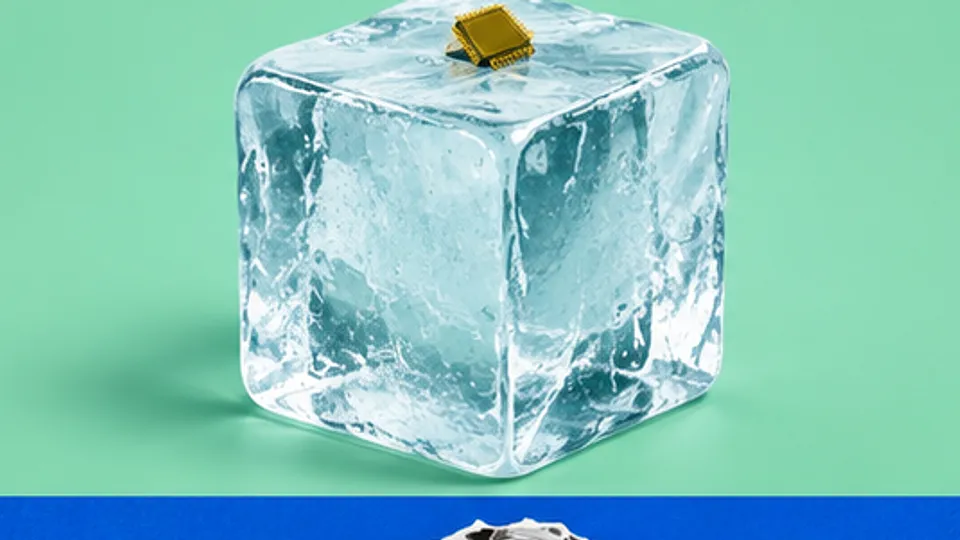
Here’s where the engineering gets almost comic. Qubits only behave properly near absolute zero — minus 273.15 degrees Celsius — because the thermal noise of our room-temperature world drowns quantum phenomena. So you put them in a cryogenic refrigerator. Fine. But every additional qubit needs control wiring, and every wire is a tiny straw carrying heat from the warm outside into the cold box. Miki’s group’s solution: move the control circuit inside the refrigerator too. Which creates two new problems. First, ordinary semiconductor circuits are not designed to function at temperatures close to absolute zero, and there is no accurate operational model for how they behave down there, so his group spends its days making estimates and running experiments. Second, the control circuit consumes power, power becomes heat, heat degrades the qubits — so the circuit inside the fridge must be extraordinarily frugal with energy. The machine of the future currently depends on designing electronics that barely function where they’re asked to work, and then asking them not to warm anything up.
And then there is the application that explains why governments are writing checks. Prime factorization is hard for conventional computers, and a great deal of modern encryption is built directly on that difficulty — encryption said to be strong enough that supercomputers would need years to break it. A practical quantum computer could break it. Some of that encryption protects military systems, which is one reason countries worldwide are pouring resources into the field, and why the defensive counter-move is already an industry of its own: “post-quantum cryptography,” designed to resist quantum attacks, and quantum key distribution, which uses quantum physics itself to secure communications. Miki takes the ethics seriously enough that he makes his students write reports on these concerns in class.
As for what the machines would actually be good for, once they exist: drug discovery and new materials top the list, plus AI and financial simulations, and — Miki’s more speculative hope — finding a catalyst for artificial photosynthesis, artificially reproducing the trick plants use to turn sunlight into chemical energy. One thing he does not expect is a quantum computer on your desk. The machines will live in data centers, which is perhaps just as well. Your home is at room temperature, and room temperature is the enemy.