
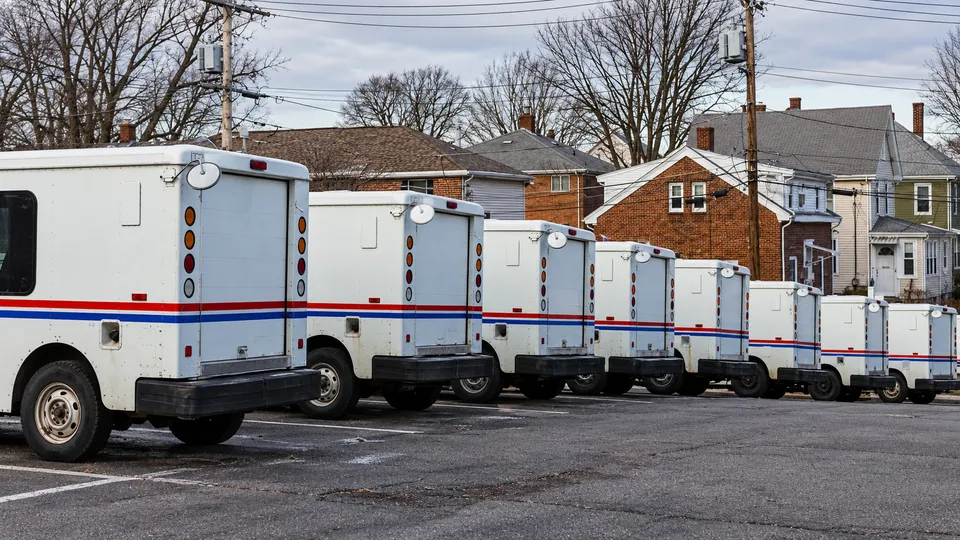
The Postal Service has begun testing forward-facing cameras inside mail trucks that continuously scan roads, signs and sidewalks in the name of “community safety,” an agency letter to the union disclosed this week shows.
The pilot, first reported by 404 Media on Wednesday, places cameras made by Nextbase, a dashcam company, on 100 vehicles in the Washington area. It began on Sept. 21 and is expected to last several months, the letter said.
“The purpose of this pilot is to leverage the Postal Service’s unique ability to collect this valuable data due to the scale and frequency with which our fleet of postal vehicles travel the streets of every community across the country,” the agency’s labor relations office wrote to Brian Renfroe, the president of the National Association of Letter Carriers. An Ohio branch of the union, Branch 238, posted the letter on Facebook.
The cameras face forward, start recording once a truck shifts into drive away from its postal facility, capture no audio and do not block the driver’s view, the letter said. Nextbase markets its cameras to ordinary drivers, fleet operators and ride-share drivers, and its models record at up to 4K resolution and can capture license plates, but the pilot cameras do not run license plate reader software. Postal trucks already carry 360-degree cameras that film the outside of the vehicle.
A Postal Service spokesman said in an email to 404 Media that the agency “is conducting a limited pilot to assess whether vehicle-mounted cameras can help identify roadway conditions and support community safety,” that the pilot “includes privacy safeguards and requires no additional action from employees,” and that the findings “will inform any future decisions.”
The Postal Service is not the only government body turning its fleet into a sensor network. Dallas has put A.I.-powered cameras from a company called City Detect on garbage trucks to scan properties and assign them blight scores, Gizmodo reported, and about 1,800 owners of lower-scoring properties had received “courtesy notices” as of early September. City Detect works with at least 16 other cities.
The pilot comes as license plate cameras draw mounting opposition. Readers sold by Flock Safety and Axon log the time and place of every passing car for police to search — often, privacy advocates say, without a warrant or any suspicion of a crime — and one Florida woman’s 13 days in jail showed what a bad camera hit can do. Some cities have cut ties with Flock. Elsewhere, protesters have pulled the cameras down themselves.
The Postal Service and Nextbase did not answer Gizmodo’s requests for comment. The pilot’s findings are expected to shape whether the cameras spread beyond Washington.