
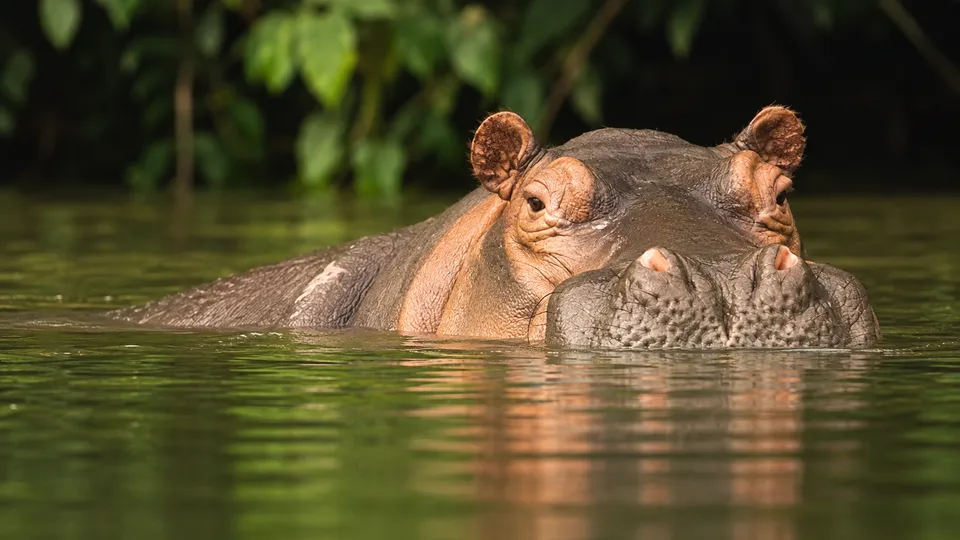
When police killed Pablo Escobar in 1993, the Colombian state inherited his estate, and the estate came with animals. The small, portable species were relocated to zoos around the country without much ceremony. The hippopotamuses stayed. Like debts and grudges, they are the part of the inheritance that compounds. This year the compounding reached Puerto Nare, where 23 children now walk to school with their eyes on the murky water of the Nare River, watching for a three-ton animal that two local boys, Luis and Diego, have named Selmo. Their mother tells them not to get attached: a judge has given the authorities 60 days to take him away.
The boys first saw Selmo on July 27. Luis came home from school with the news. “A what?” his mother said. “A hippopotamus, mom. Tell Diego he has to take care in case he runs into him.” Everyone in the municipality has a Selmo story now, El País reports — that his feces scare off the fish, that he eats the banana crops, that his footprints span three palms, that he would capsize a canoe.
For Nancy Tabares Arbelaez this is not novelty; it is recurrence. At age five, riding her bike in Doradal — 35 miles from Puerto Nare, next door to the Hacienda Nápoles, the estate where Escobar built an illegal zoo of more than 80 imported species over 40 years ago — she came face to face with a yawning hippo and pedaled for her life. That one is now near her children, and she and her neighbors went to the law.
Puerto Nare sits between Antioquia and Boyacá, on the river that shares its name, where life runs entirely through the water: fishing, laundry, swimming children, the route to the doctor, to school, to the cemetery. Juber Martínez, a lawyer and former local representative, pointed neighbors toward a fast constitutional mechanism protecting minors, and in early September a judge ordered Corantioquia, the regional environmental authority, to remove the hippo within 60 days. Martínez wants faster. “Two months seems to us a very long time for the execution of the measure when the children are at real risk as they cross onto the hippopotamus’ side [of the river] twice a day,” he says. “There is already proof that the best option is a lethal one. It is useless to reconsider options that have already been ruled out by scientists.”
Selmo is one of roughly 200 hippos now loose in Colombia — an invasive population with no natural predators and, unlike in Africa, no dry season to check its breeding. They reproduce about 4 percent faster than in their native countries and already occupy 770 square miles, an area larger than Bogotá; one recently turned up in Barrancabermeja, more than 185 miles from the Hacienda Nápoles. Selmo himself carries wounds on his right side and left ear, possible evidence of a fight with another male — and experts suspect that where one displaced hippo goes, a clan may follow. Without intervention, the Environment Ministry warns, the herd will pass 500 by 2030 and could reach 1,000 by 2050, spread across some 5,000 square miles, about seven Bogotás. “The management of these specimens has been a hot potato for one government after another,” says Germán Jiménez, a biologist at Javeriana University. “While no one acts, the problem grows.”
The reason no one acts is not mystery but arithmetic. Being the government that shoots dozens of photogenic megafauna is bad politics. Animal rights activists have defended the hippos for years; about 8,000 people in Antioquia benefit directly or indirectly from hippo tourism, by Jiménez’s estimate; and a quiet trade profits from selling calves and tusks. Science leans the other way. “The approval of euthanasia is very necessary to conserve our ecosystems,” says Nataly Castelblanco, a biologist with Biodiversos Colombia. Every option — reserves, castration, culls — has been studied for decades, and every one has produced friction rather than hippos removed.
The policy record reads like a relay race in which each runner hands off the same potato and runs the other way. In April, near the end of Gustavo Petro’s term, environment minister Irene Vélez approved a plan to cull hippos that endanger communities and castrate the rest. The new government of Abelardo de la Espriella — a presidency better known abroad for handing Washington a guerrilla commander called the Spider — dropped it. In a July interview with EL PAÍS, the new minister, Fabio Arjona, not only rejected killing the hippos but floated a Jurassic Park-style sanctuary financed by Indian billionaire Anant Ambani, who had committed远航 to receiving 80 specimens in India. Two months later Arjona was less decisive, promising dialogue spaces and a monitoring app. Neither the environmental authorities nor the locals interviewed have details of the sanctuary, let alone a budget.
“What else do you want us to talk about?” asks local Juan Aguirre. “We need them to solve it, not to mull it over more. It’s a tricky problem.” Near his house is a giant slide gouged by hippos climbing out to feed; each animal eats about 70 kilos of grass a day and returns some 50 kilos of feces to the river, and their three-ton commutes displace native manatees, capybaras and otters. “How are we going to create a sanctuary for a species that is not only not endemic, but is affecting our flora and fauna?” Castelblanco asks. “We would be the first country to do something this crazy for an invasive species when that money could be invested in protecting our diversity.”
The bill lands, as bills do, on people with the least room for it. Fisherman Marcelino Salazar gave up fishing for fear of meeting a hippo and is looking for another way to eat. Álvaro Sacra Molina Pérez, from Las Angelitas, 40 minutes upriver by boat, still fishes with around 15 hippos nearby. “We fishermen are like thieves. We know that if they catch us they will kill us, but we keep at it. Being illiterate, what else am I going to do?” he says, setting out on eight days of mending a net a hippo shredded in seconds. Vanessa Arango, secretary of the community action board, has little patience for the distant admirers. “This might seem very nice from a distance,” she says. “They come and go in their car... But I go in a canoe. And I assure you that the hippos don’t look so beautiful up close.”
The judge’s 60 days are running. The children cross twice a day. Somewhere upstream, a wounded hippo is, by the logic of clans, a preview. Drug empires are dismantled in an afternoon; their souvenirs take half a century, and counting.