
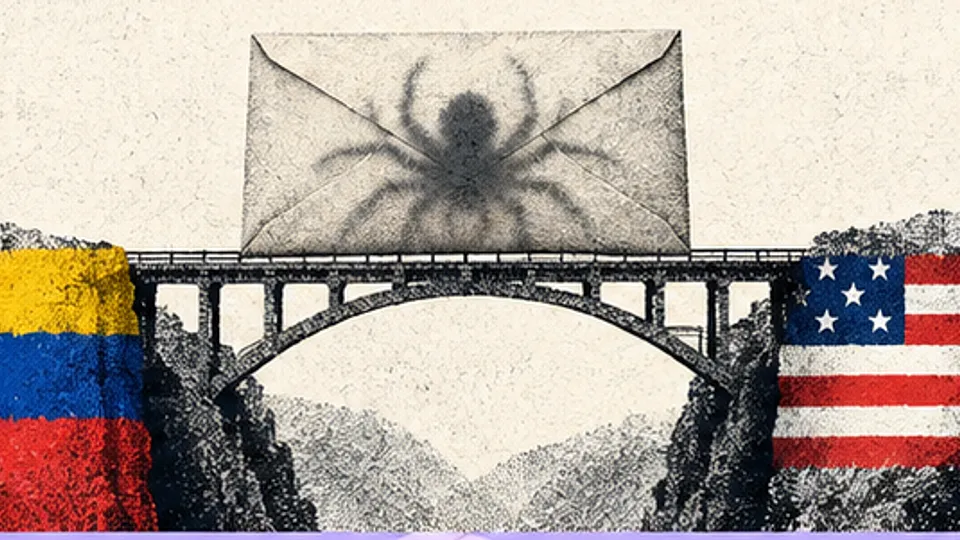
The alias, in Spanish, means spider. On the 25th, the government of Colombia announced — through a post on X by the president himself — that the spider had been handed to American judicial authorities, the Chosun Ilbo reported, and that the president had done it personally. The word personally would recur. It was the point.
The man is Jeovani Andrés Rojas, known as ‘Araña’. He was arrested in February of last year at a hotel in Bogotá, the capital, where he was taking part in activities connected to the peace negotiations that the left-wing government of his predecessor, Gustavo Petro, was then conducting with illegal armed groups. On the 25th he was sent to the United States under formal extradition proceedings.
Rojas led the Comandos de la Frontera — the Border Commandos — a unit of the National Coordination Board of the Bolivarian Army, or CNEB, an organization formed by dissidents who broke from the FARC, once Colombia’s largest guerrilla army. American authorities believe that since 2017 he has been involved in drug trafficking and criminal conspiracy in Colombia and Ecuador. According to Reuters, he is the first senior commander of an illegal armed group extradited since the new government took office. The president, Abelardo de la Espriella, wrote on X:
As president, I personally extradited ‘Araña’. The Supreme Court approved the extradition and I signed it without delay.
He went on: the measure, he said, meant more than handing over a single criminal. It was a message of his government’s firm resolve — to strike the organizations behind drug trafficking and to deepen cooperation with allies against crime that crosses borders. Since taking office last month, he said, his government has carried out 94 extraditions. Ninety-four. The number is meant to be remembered.
He said he would also tear out the money at the root. Drug trafficking, he said, has for decades financed the organizations that sowed violence, terror and pain across Colombian territory; the government would strike every link of crime — the illegal coca crops, the drug laboratories, the trafficking routes, the money networks, the bosses.
Then the promise, in the language of a man laying down a border: Colombia, he said, will never again be a refuge for drug traffickers pursued by the world’s judicial authorities. The state will hunt them down and arrest them, and where the law provides, send them on through extradition.
Espriella is a well-known lawyer who, before his election, had no political career to speak of. He ran on the security crisis that had worsened under Petro, and voters unnerved by the spread of criminal organizations gave him their support. Where the previous government negotiated with armed groups toward disarmament, Espriella proposed something else: the state would retake the initiative of force and control of territory, subdue the organizations militarily, and build peace afterwards. In that order.
Since his inauguration he has discarded the peace talks and launched large-scale military operations, and he reports the progress of what he calls the war on crime directly to the public, on social media, several times a day. The extradition of the spider was one more dispatch from that war — announced, signed and delivered by the president himself.
“Colombia’s security cannot be entrusted to anyone else,” he said that day. “It must be defended with will and determination, within the boundaries of the law.”