
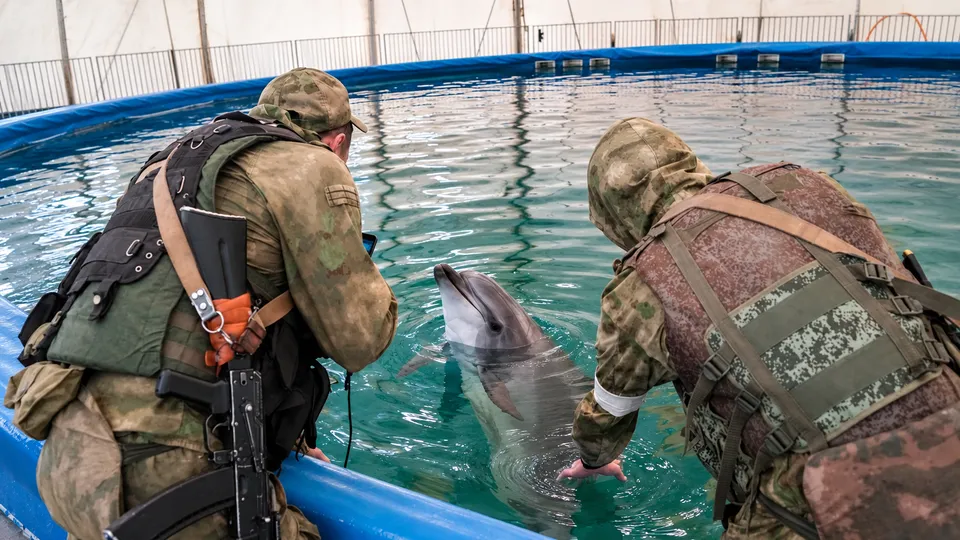
Before the war, the dead dolphins of the Black Sea died the way people killed them. Fishers and poachers working the coast would find the animals suffocated in their nets. To free them they cut off the fins and dropped the bodies back into the water. The carcasses drifted ashore with the marks of the mesh still on their skin, as Mansur Mirovalev reports for Al Jazeera from Kyiv.
Then, in 2022, Russia launched its full-scale invasion, and fishing and poaching along the coast fell away sharply. The nets went quiet. The dolphins kept dying anyway, and now they wash up with their fins intact, looking starved.
The arithmetic of Tuzly
Ivan Rusev is head researcher at the Tuzly Lagoons national park in southern Ukraine, 280 square kilometres (108 square miles) of salty lagoons that migratory birds use as a stopover. He says the fighting kills “hundreds times more” bottlenose dolphins, short-beaked dolphins and harbour porpoises than the nets ever did. By his count, about 50,000 died in 2022 alone. In 2026 the total passed 120,000, which he puts at roughly one in four of the sea’s cetaceans.
The number has climbed through the year in public view. In June, park scientists reported finding 56 dead dolphins on the park’s own stretch of coast, according to United24 Media. By July, Rusev’s estimate stood at about 100,000, Euromaidan Press reported. These are one researcher’s estimates, built mostly from what the water gives up, and they should be read that way. They are also the only ledger anyone is keeping.
A dolphin finds its way, its prey and its companions by sound. In Rusev’s account, explosions, cruise missile launches and military sonar scramble that echolocation, so the animals can no longer navigate, communicate or hunt. “If a dolphin can’t fish, it loses weight fast,” he said. A starving animal burns its blubber, and the blubber holds what the sea has absorbed for years: wastewater, farm runoff, microplastics, antibiotics. The pollutants enter the blood, the immune system weakens, and many of the animals die of morbillivirus respiratory infections.
The shell does not need to hit the animal. Hearing the war is enough.
A narrow band of life
This is an unusual sea. Some scholars believe it was a freshwater lake until about 8,000 years ago, when the Bosporus opened. Below 50 to 100 metres its water holds no oxygen and supports no life. Everything that lives here lives in that upper layer, and that layer has been taking in the war for more than four years.
In 2023 the Kakhovka dam on the Dnipro was destroyed, and most of its 18 cubic kilometres (4.3 cubic miles) of water poured out, carrying fertiliser runoff, heavy metals and machine oil. Mullet and bluefish have become scarce, despite fishing bans and restrictions, and naval mines have been spotted as far away as Istanbul. “With dolphins at the top of the food chain, everything from zooplankton to fish reaches them,” Rusev said.
The wrecks
Since 2022, Ukrainian sea and air drones have sunk two submarines and three dozen Russian warships, the Black Sea Fleet’s flagship, the cruiser Moskva, among them. Each went down with toxic fuel and chemicals aboard. Drone operators who go after the tankers of Russia’s “shadow fleet” are told to aim for the engines. The spills happen regardless. In September 2026 the Russian-flagged cargo ship OMSKIY-107 washed up on Alacalı Beach in Istanbul after a drone strike. This autumn the attacks on shipping spread to the waters off Bulgaria and Romania. Oil coats the seaweed and poisons molluscs and fish, sturgeon especially.
An army can tell a pilot where to hit a ship. Nobody can tell the oil where to go.
Across the water
Environmentalists in Bulgaria, Romania and Turkiye also report more dolphin deaths, though they often cannot say what caused them. Dimitar Popov of Green Balkans, Bulgaria’s oldest conservation group, says most stranded carcasses are too decomposed to show whether nets were involved. He agrees that sonar does “definitely affect cetaceans.”
Russian environmental monitors offered “parasites” and “virus infections” as the cause and did not elaborate. Given the morbillivirus, the virus explanation is not strictly false. It just leaves out what weakened the animals in the first place.
Odesa, August
In August, Tetiana Smolchenko, 33, and her eight-year-old son Oleh came across an emaciated, decaying dolphin in Odesa. Her husband serves in the military. A Russian drone has damaged her apartment building twice. “I nearly threw up,” she said. Watching these animals die, she said, “is no less horrifying” than the deaths of people. “We both wept.”
Flamingoes, boars and the long wait
The birds are suffering too. Explosions and drones startle the flocks that migrate between Northern Europe and the Middle East, and Rusev says birds that cannot feed enough will not reach their destinations, which will affect some populations “for years.” Flamingoes only recently started nesting in the park. Now they abandon their eggs, and the seagulls eat them.
Some animals are doing better. Hunting has almost stopped, and boars, roe deer, foxes, jackals, hares and badgers have increased.
Insects and small mammals should recover within years. Dolphins will take decades. “We estimate that it would take 30 to 50 years to renew the population of cetaceans,” Rusev said.