
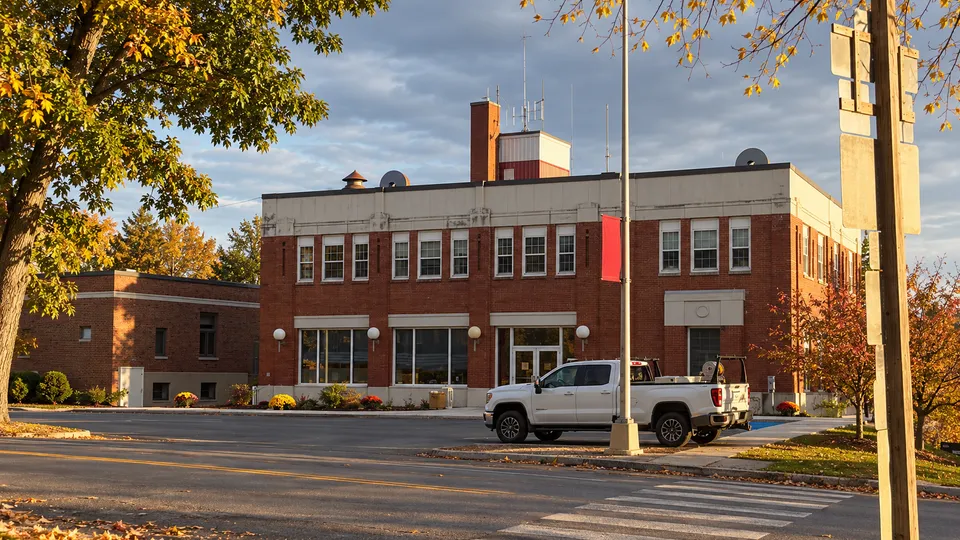
In the far north of Maine there is a county so singular that no one in the state bothers with its full name. It is simply “the County” — Aroostook, roughly the combined size of Connecticut and Rhode Island, home to some 66,000 people, a place of sweeping potato fields rather than the pine trees and lobster boats of downstate. It is among the poorest counties in New England. And this November, improbably, it is the stage for one of the largest political dramas in the country: both candidates for the United States Senate were born here, raised here, and formed here, about 70 miles apart.
Susan Collins, 73, the Republican senator seeking re-election, comes from Caribou. Troy Jackson, 58, the Democratic former president of the Maine Senate, comes from Allagash, a hamlet of roughly 200 souls on the Canadian border. Both have invoked these roots so constantly, the Boston Globe reports, that the County itself has at times seemed like a third character in the campaign.
Caribou, the House of Collins
The Collins family came to Caribou in 1844 and built a lumber mill on a stream. S.W. Collins Co. is still there — a hardware store, two expansive sheds of lumber and building supplies, an annex for kitchen and bath renovation, and four other locations in the County. Generations of Collinses welcomed generations of County residents through the doors, and with success, the family taught its children, came a duty to serve.
Collins’s father, Don, was a World War II hero who served as mayor of Caribou and sat in the state Legislature for two decades, as his father and grandfather had before him; when he died in 2018, Troy Jackson attended the funeral. Her mother, Patricia, was the first woman elected mayor of Caribou. “They really don’t flaunt their success in town,” said Roger Felix, commander of the local VFW post where Don Collins was a longtime member. “One of the ways I describe Susan is, she’s kind of like that aunt that you got.” Her brother Sam runs the business now, from an office above the dammed stream — Collins Pond — surrounded by photographs and leather-bound ledgers of transactions dating to the 1860s. His sister grew up knowing that capability carries “an expectation that you serve the community in some way that you can,” he said, whether the community is local, the state, “or in Susan’s case, on a broader scale.”
Allagash, the Logger’s Son
Seventy miles up the road, a different inheritance. The Jacksons, and the Kellys and Haffords beside them, logged the deep woods in one of Maine’s poorest regions — punishing work, widely shared. Beth Paradis babysat the young Troy Jackson and remembers a quiet, bookish boy whose family struggled like most in Allagash. “I think that shaped him a lot,” she told the Globe. “He saw his mother struggle and he watched her.” His father, a logger, gave him an early political education by taking him to a picket line. Later, Jackson made his name leading Maine loggers to block the border crossing where Canadian workers came to do the same work for less money.
“Logging was just a hard way to make a living,” said Hilton Hafford, an Allagash logger and old friend who took part in that gambit, speaking at Two Rivers Lunch, the Allagash diner. Hafford stayed in the trade while his friend rose through Augusta with a combative advocacy for workers back home. “He’s not the type of person to sit back and let things go as it is,” Hafford said. Jackson still keeps his family home on the banks of the St. John River. His lilting brogue, unusual in the rest of Maine, is common in Allagash, where the same Scots-Irish families have lived for centuries.
Workers and Management
The candidates have turned the County into an argument about itself. A Collins television ad in heavy rotation declares she is “a County girl”; her signs read “Our Senator.” Jackson replies that in the world of the County, he represents the workers and Collins represents “management” — a barb her brother Sam finds off-base. “The perception that we’re up in an ivory tower somewhere… we’re working the business, so I find it uninformed that he perceives it that way,” he said.
For decades, said Shannon Hill, a member of the Mi’kmaq Nation based in Presque Isle, it was common to see lawns bearing signs for Collins — their senator in Washington — and Jackson — their senator in Augusta — proudly side by side. “But not this year.” Hill, a registered Democrat, is backing Collins as a steady force in a chaotic time. “He’s a County boy. She’s a County girl,” she said. “Everyone thinks Maine ends in Bangor, but they’ve always made sure to take care of where they came from.”
The terrain matters. The County flipped from backing Democrats for president to Donald Trump in 2016, yet has always given Collins her widest margins in the state — even as Jackson, whose Senate district covered northern Aroostook, kept winning re-election as the ground shifted. “I do think Senator Collins has built a reputation here, and I think it has largely sustained her over the years,” said Mike Carpenter of Houlton, who served with Jackson in the Legislature. “I’m just going to say my sense of it is that people are tired of that.” The stakes run wider than one seat: Maine has already watched Trump’s trade war sink a salmon farm in a paper town, and the County feels the fight in its bones — a median household income of about $36,000, far below state and national averages, rising fuel costs, tariff quarrels with neighbouring Canada, and shrinking rural health care.
The County keeps its old rhythms all the same. Schools still close for weeks each fall for the “harvest break,” decades after children stopped being sent to the potato fields. Locals measure their ties in centuries, not years — and their grudges too. “If Troy’s great-grandfather said something to my great-grandfather 200 years ago, then we’d all be mad about it forever,” Hafford said. In Allagash, prominence itself carries a local tax: “Some people probably wouldn’t vote for Troy because he’s Troy and he’s from here, and you know, that’s just the way it is in small towns. Sometimes people can’t handle it.” Collins, whose Maine residence is not in the County, remains a constant presence — back twice a year, without fail, for teeth cleanings, said family dentist Bruce Freme. “Susan was never late.”
Whatever happens in November, Felix said, something has already been won. “The one good thing out of it is the fact that Northern Maine is now in the national world. We’re not just a dot on the map on the Weather Channel. No matter which way it goes, the unique thing with Aroostook County is… we’re going to rally behind that person and make sure that things get done.”