
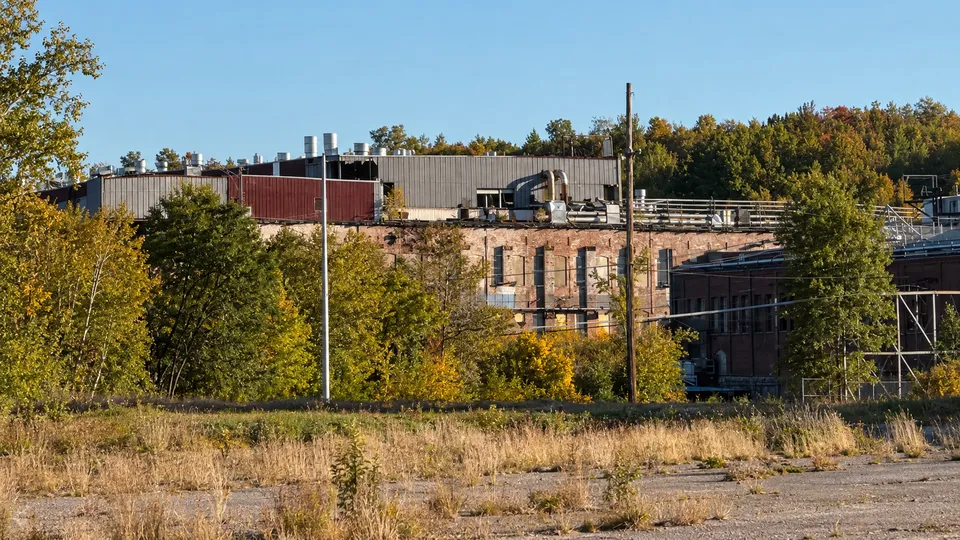
There is a town in Maine where the tariffs were supposed to work like magic. Millinocket, population 4,100, grew up around a paper mill on the Penobscot River and has spent the years since Great Northern Paper closed in 2008 learning what it means when the reason for your town’s existence gets fenced off and left to rust. If the Trump administration’s theory is correct — that taxing imports makes factory towns bloom again — then this is the test garden. CBC News went to see what had grown.
What had grown, until last month, was a plan for fish. Norwegian investors were backing a $300 million US aquaculture venture, Great Northern Salmon, that would repurpose the mill’s giant lagoons and employ 50 people. “It was a marriage made in heaven,” said Gail Fanjoy, president of the local chamber of commerce. “Out of the gate, they were going to employ 50 people. That’s a home run.”
The project was about 80 percent complete when the company announced it was pausing indefinitely. The reason, it said plainly, was the uncertainty around the Trump administration’s tariffs — much of the salmon farming equipment was to be imported from Canada. “The Norwegian investors just said, ‘We’re done, we just can’t deal with this,’” Fanjoy told CBC News. A lifelong Millinocket resident, she is unpersuaded by the promise that trade policy will revive such towns: “Paper companies all up and down the Penobscot River and the state of Maine closed, went bankrupt, and a tariff is not going to bring them back.”
This is not a small-town tragedy in a state where trade is somebody else’s business. Maine does $6 billion US in annual two-way commerce with Canada — a lot of money in a state with fewer people than Manitoba. And it happens to be holding, on November 3th, one of the most consequential Senate races in America. If Democrats are to win the Senate in the midterms, they will almost certainly need Maine’s seat, which raises the question of whether voters will punish the incumbent, Susan Collins, as a proxy for their feelings about the president.
Collins is a genuine political phenomenon: a Republican who has held her seat for 30 years in a state that has not voted for a Republican presidential candidate since 1988. In 2020, polls said she would lose; she won by nine points, the only Senate Republican in the country to carry a Biden state. She was one of seven Republican senators who voted to convict Trump after January 6th. Last week she backed a resolution calling for an end to the war with Iran. She claims the credit for the White House lifting its tariffs on cement and road salt — two things Maine imports from Canada.
Caught by CBC at a parade in Carmel, population 2,900, and asked whether the tariffs threaten her re-election, the 72-year-old parried: “Many of our products, whether it’s blueberries or potatoes or timber or lobster, are harvested here but processed in Canada.” Then: “Canada’s our friend, our neighbour, our biggest trading partner.” She urged the administration “to get back to the table.”
Maine voters are harder to sort than Washington strategists would like. Chris Morang shook Collins’s hand at the same parade, praised her for keeping hospitals and the lobster industry going — and then sided with the president. “I think Canada has taken advantage of the United States a lot,” he said. “I think at this point we’re just getting what we deserve.”
Her opponent finds her gestures thin. Troy Jackson, the Democratic candidate, grew up half an hour from the Canadian border — as did Collins — and worked as a logger and union activist after a late-1990s border blockade against companies importing cheaper Canadian loggers. If elected, he would be the only sitting U.S. senator without a four-year college degree. “I speak funny, I know that. I didn’t go to the right schools and all that,” he told a town hall in Belfast, to whoops and cheers. “But what I think people have come to understand is that I am 100 per cent dug in on getting shit done.”
On tariffs he is blunter: “Everything costs more for people, and you can tell it’s a big deal because Susan Collins was writing concerned letters to Donald Trump. She got us rock salt back, but we can’t eat that.”
Jackson only became the nominee in July, after the original candidate, Graham Platner, stepped down when a former partner accused him of sexual assault. Collins, for her part, comes from a prosperous lumber-yard family; a Democratic Party analysis of her financial disclosures puts her net worth as high as $9.6 million US.
The slyest thought belongs to Jim Melcher, a political scientist at the University of Maine Farmington, who suggests the trade war may actually help Collins — both candidates oppose it, and she can sell her seniority and her record of defying Trump — except that she is also a sixth-term incumbent running on the electorate’s patience. “The perception of the economy and the national Republicans, I think, isn’t helpful to her either,” he said.
Washington, for the record, spent the weekend doing trade diplomacy somewhere else entirely: Al Jazeera reports that after last week’s Trump-Xi summit, the United States and China published a list of goods recommended for tariff cuts, having agreed to work towards lowering duties on $60 billion worth of trade. The Pacific gets a summit and a list. Maine’s border, where the blueberries go north to come back south, gets a parade and a senator saying Canada’s our friend to whoever is close enough to hear it.
Tariffs are sold as a way of making things again. In Millinocket they have so far made exactly one thing: a vacancy, 80 percent finished, where 50 jobs were going to be.