
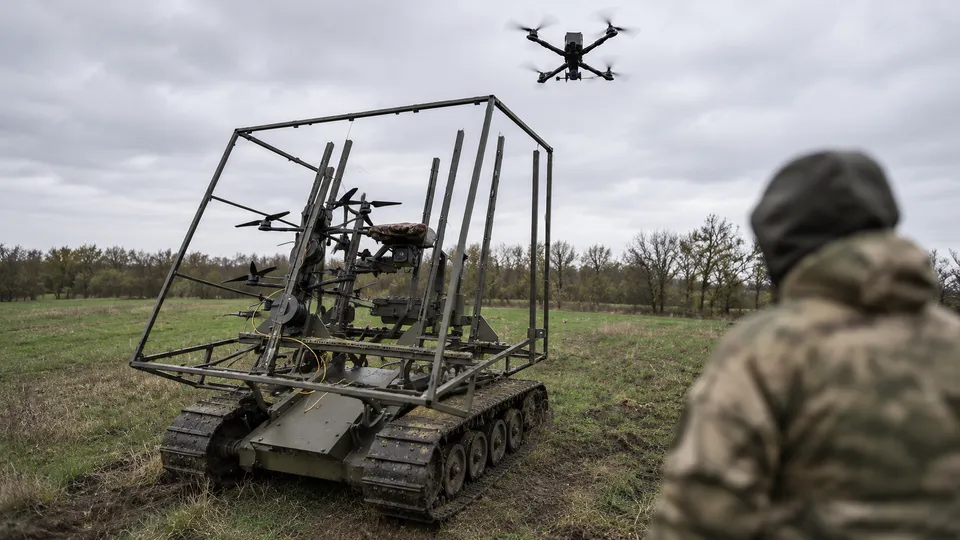
A soldier at the front has always depended on someone else’s journey. Somebody has to bring the water, the shells and the bread, and somebody has to carry him back out when he falls. On the Ukrainian front that journey has been cut into pieces. No single vehicle makes the whole trip any more. The load goes from a robot to a drone to a smaller drone to a pair of hands, the way runners pass a baton.
Oleksandr Yabchanka, head of robotic systems for the Da Vinci Wolves Battalion, described the method to Sinéad Baker, reporting for Business Insider. Over the past year, he said, units have increasingly adopted a “multi-stage logistics and evacuation system” built on uncrewed machines. A mission no longer belongs to one platform. “Different means may be employed at various stages,” he said, “for instance, a ground-based robotic system followed by an aerial drone.”
Bread in ever smaller parcels
The units have described these handoffs themselves. This month the 91st Separate Anti-Tank Battalion said a robot had brought ammunition to soldiers, who loaded it onto heavy attack drones and sent it against Russian targets. The machine that hauled the explosive was not the one that dropped it.
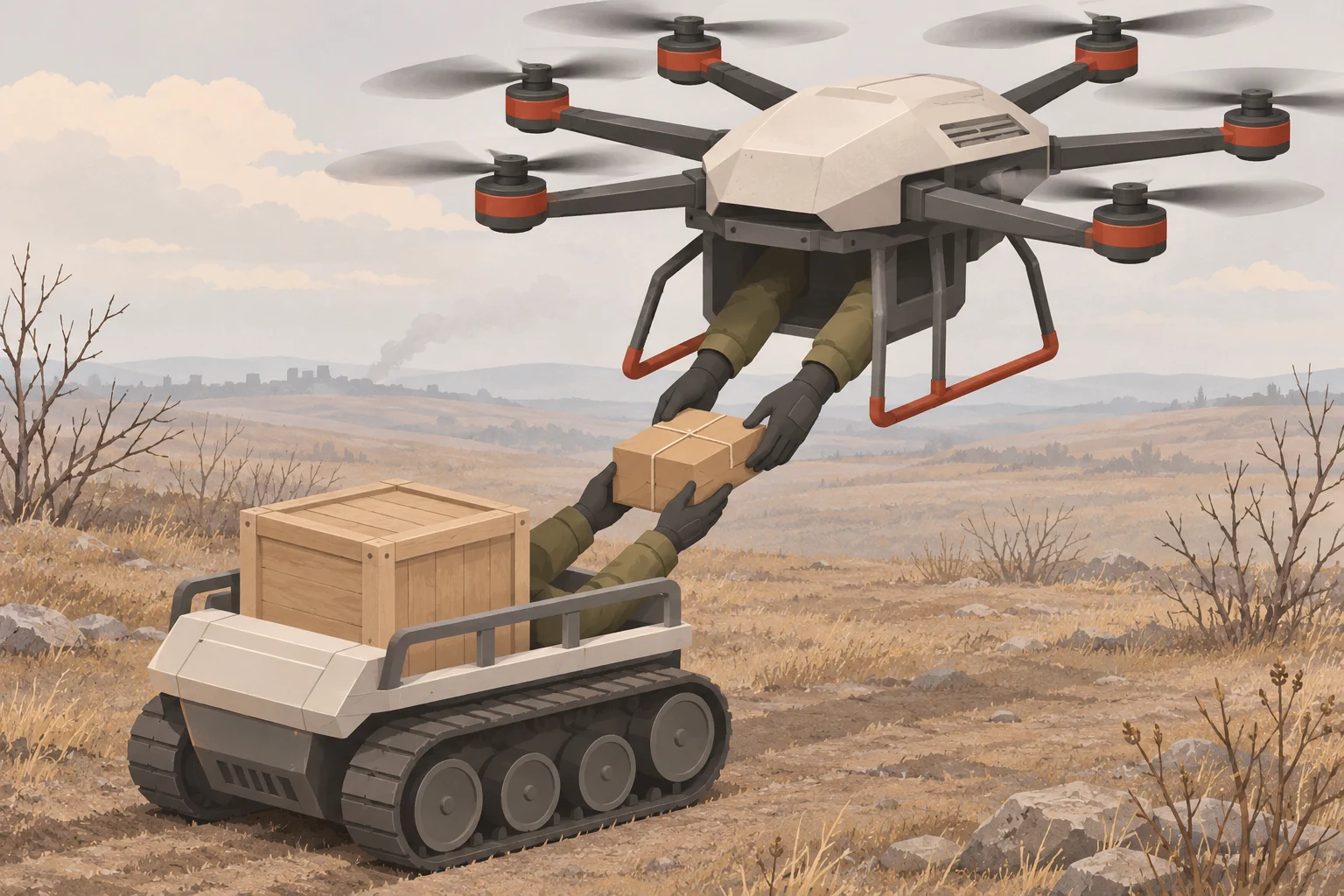
The 93rd Separate Mechanized Brigade reported a longer chain in October. Ground robots carried food and water to the operators of Vampire heavy drones. The operators broke the supplies into smaller packages and flew them on to another point. There the packages were divided again, and smaller drones, which the enemy finds harder to spot, flew them the last few hundred meters to the troops.
The cargo shrinks as it gets closer to the enemy. A big load is a big target, so the bread is cut down until it can travel on something too small to be worth shooting at. Every stage exists so that a large supply vehicle or a medical evacuation team does not become what the enemy is looking for. The 93rd has been working this way for some time. In May, CNN described the brigade’s soldiers around the town of Druzhivka hurrying ammunition, food and water to robot resupply units sheltering under trees.
Carrying the wounded
Moving the wounded is harder, and the chain changes shape. Ground robots now go more and more often to positions that medical crews cannot reach. Their range is limited, though, and Yabchanka said they “cannot reach every location along the front line.” So the first stage of a rescue may still be on foot. Comrades carry the injured soldier to a spot the robot can get to, or, if he can walk, he gets there himself.
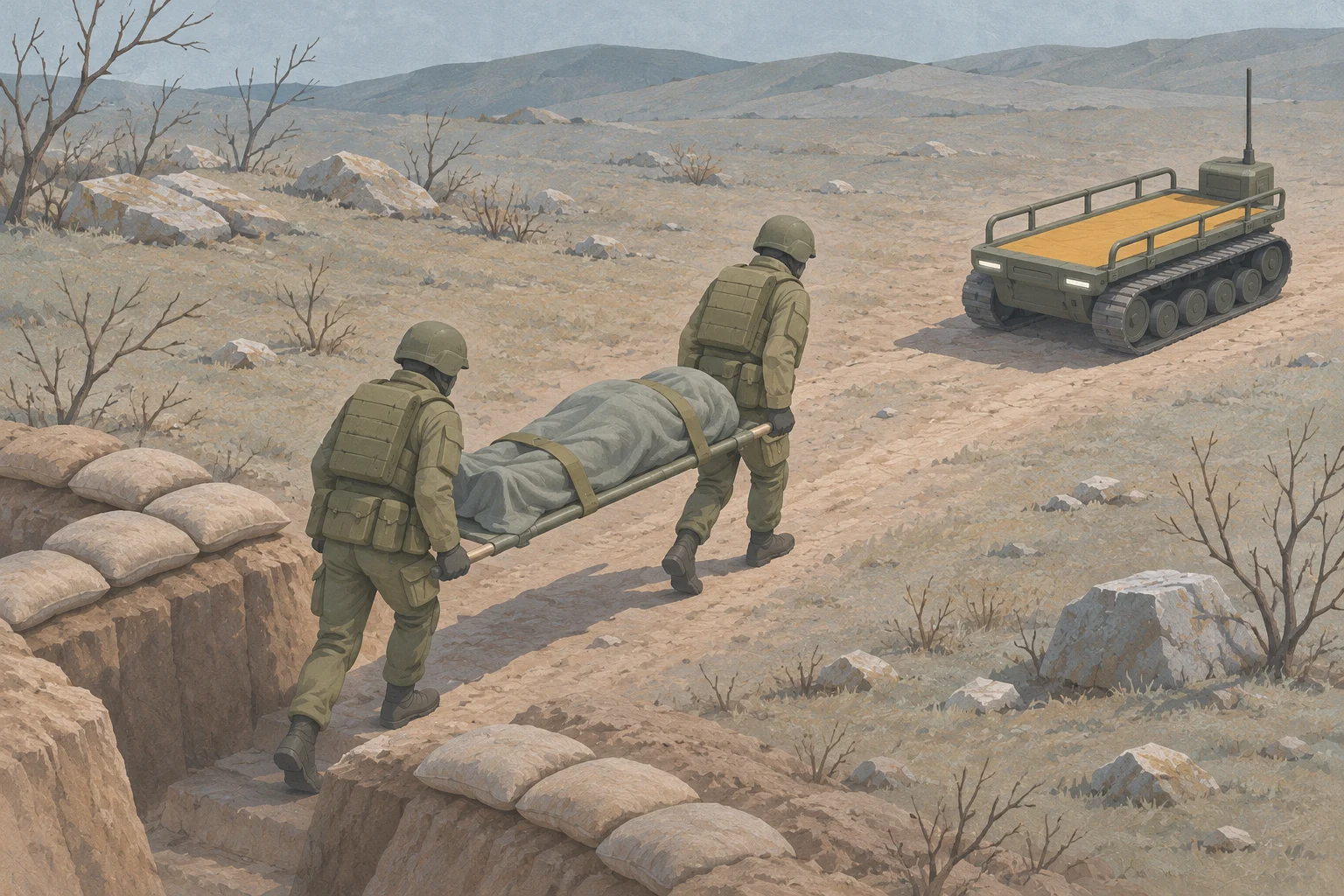
From there, the wounded individual is placed onto a ground-based robotic system and transported to a point where an armored vehicle can take over.
Each leg is a gamble. Yabchanka has told Business Insider before that his unit turns to robotic evacuation mainly when there is no other option, because a robot can take a wounded man out of cover and into open ground. A drone can do the same at the other end of the war: rews has followed one that flew a wounded soldier forty miles in seventy-five minutes.
Machines handing off to machines
Some chains have no person in the field at all. Naval drones have carried ground drones that went on to strike Russian targets. Aerial drones have dropped ground drones behind Russian lines, as in the operation Ukraine called Vivaldi. Robots and drones also scout for each other and guard each other against Russian attack.
Yabchanka draws a line between that kind of cooperation and the relay. In a relay the systems act in sequence, each taking over part of the mission from the one before. Part of the aim is distance. “For instance, if an operator previously worked five kilometers away, we aim to enable them to work from ten kilometers away,” he said, calling it a rough example. “The goal is to reduce the risk to personnel.”
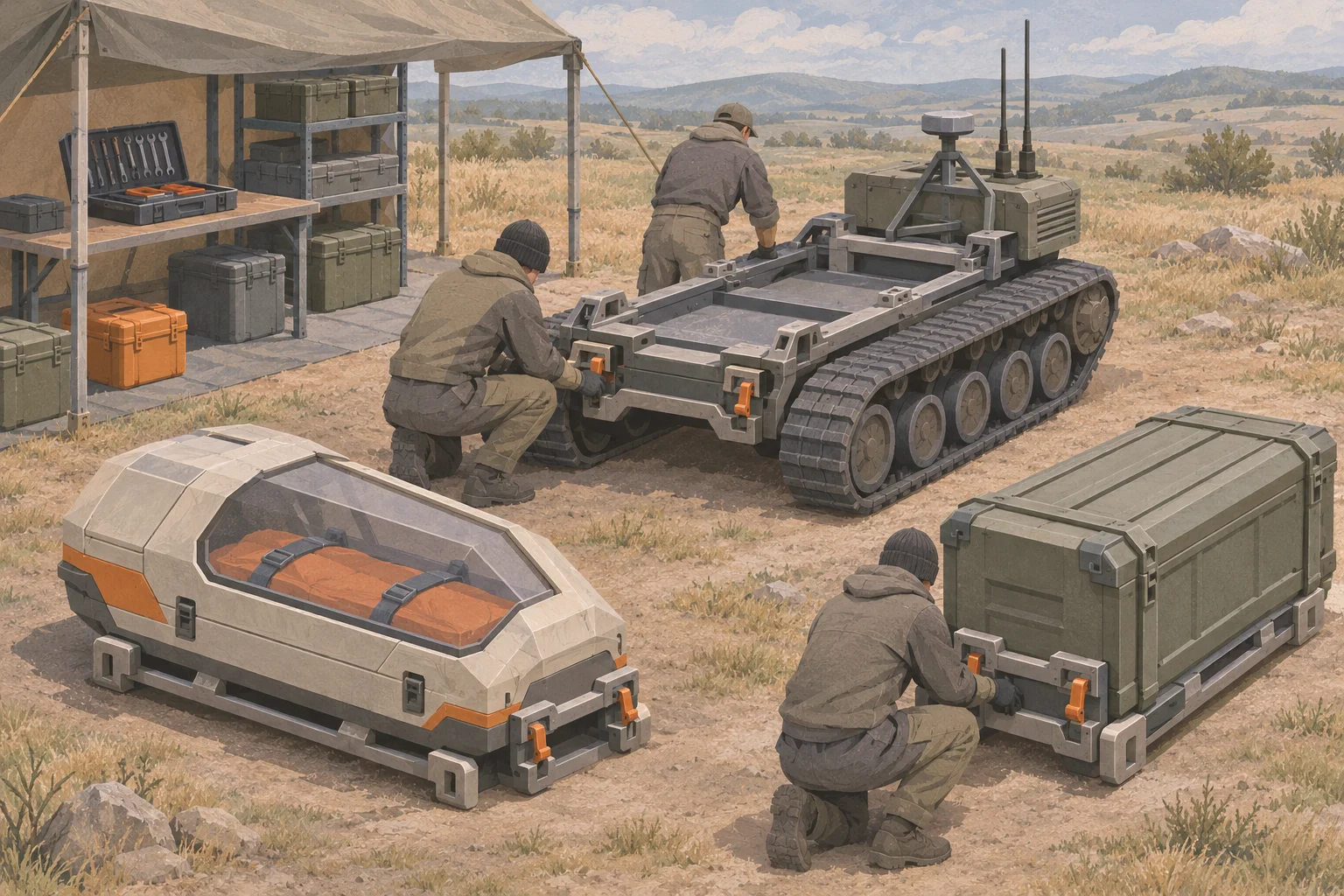
His unit treats the robots the same way, as parts to be put together. He has described fitting the same ground drone with a rigid capsule for a casualty one day and a bomb the next.
The arithmetic of people
“Our philosophy is, above all, to preserve our personnel,” Yabchanka said. “We strive to position our fighters as far as possible from the line of contact and the areas of highest risk—the so-called “kill zone.”” In that strip any movement can draw a drone’s attention.
The machines are attritable. They are built to be lost, and they are sent where a person is far less likely to come back. They have not removed the soldier from the front. They have reduced how many soldiers the most dangerous places need, and people are still part of the chain: they move a crate or a stretcher from one platform to the next.
One could read this as a parable about a country that has fewer people to spend than its enemy has, and so pays in metal and batteries. That is an interpretation, but the commander’s own words point the same way.
The arrangement never stays fixed for long. Units and manufacturers keep upgrading the robots’ communications and batteries, and the workshops treat no design as finished. “We are constantly adapting our tactics,” Yabchanka said.
In my observation, conditions shift noticeably about every six months. For instance, the adversary may introduce new attack drones, or their existing drones may gain greater range and power. Consequently, the way we employ our ground-based systems changes as well.
Six months is roughly a season and a half. On that schedule the chain that carried bread to the 93rd’s positions in October will need changing again by spring.