
For most of the history of armies, command has had an address. A headquarters was somewhere you could point to on a map. Orders went out from it and reports came back to it, and the importance of the place was plain to anyone who looked. That plainness is now the problem. A headquarters that can be found can be struck.
So in the first days of November, on the island of Oahu, United States Marines rehearsed doing without one. As Business Insider reported, Marines of the 3rd Marine Littoral Regiment, part of the 3rd Marine Division, spent five days in Hawaii testing how fast they could set up command and keep it running from scattered positions. According to the Marine Corps release, the exercise ended on Nov. 6.
The drills
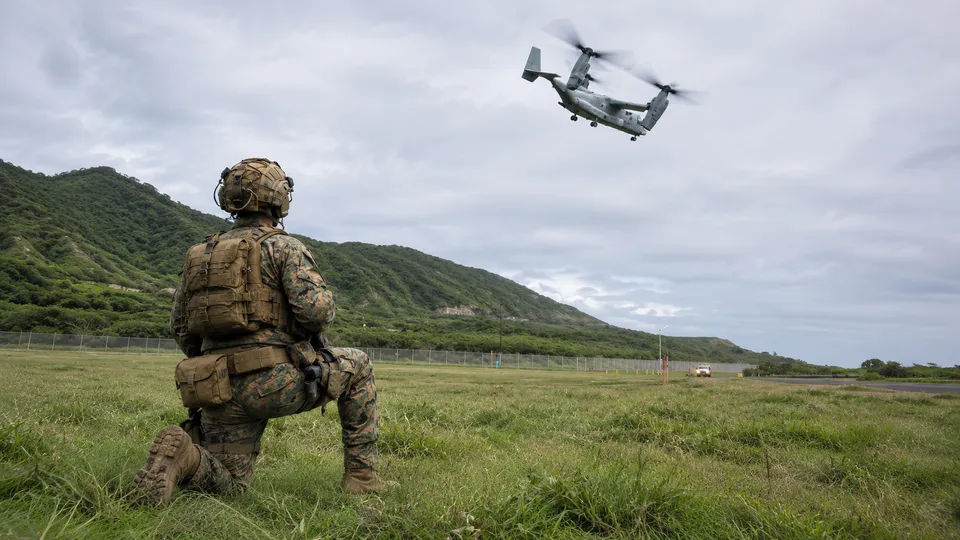
The regiment set up independent command nodes and then put them through what the Corps called “aggressive displacement drills”: pack up, move, start again, by ground vehicle and by MV-22B Osprey. In one of these drills, on Nov. 2 at Marine Corps Base Hawaii, an Osprey from Marine Medium Tiltrotor Squadron 363 lifted off a landing zone while a rifleman of the 3rd Littoral Combat Team watched, as the service’s photographs record.
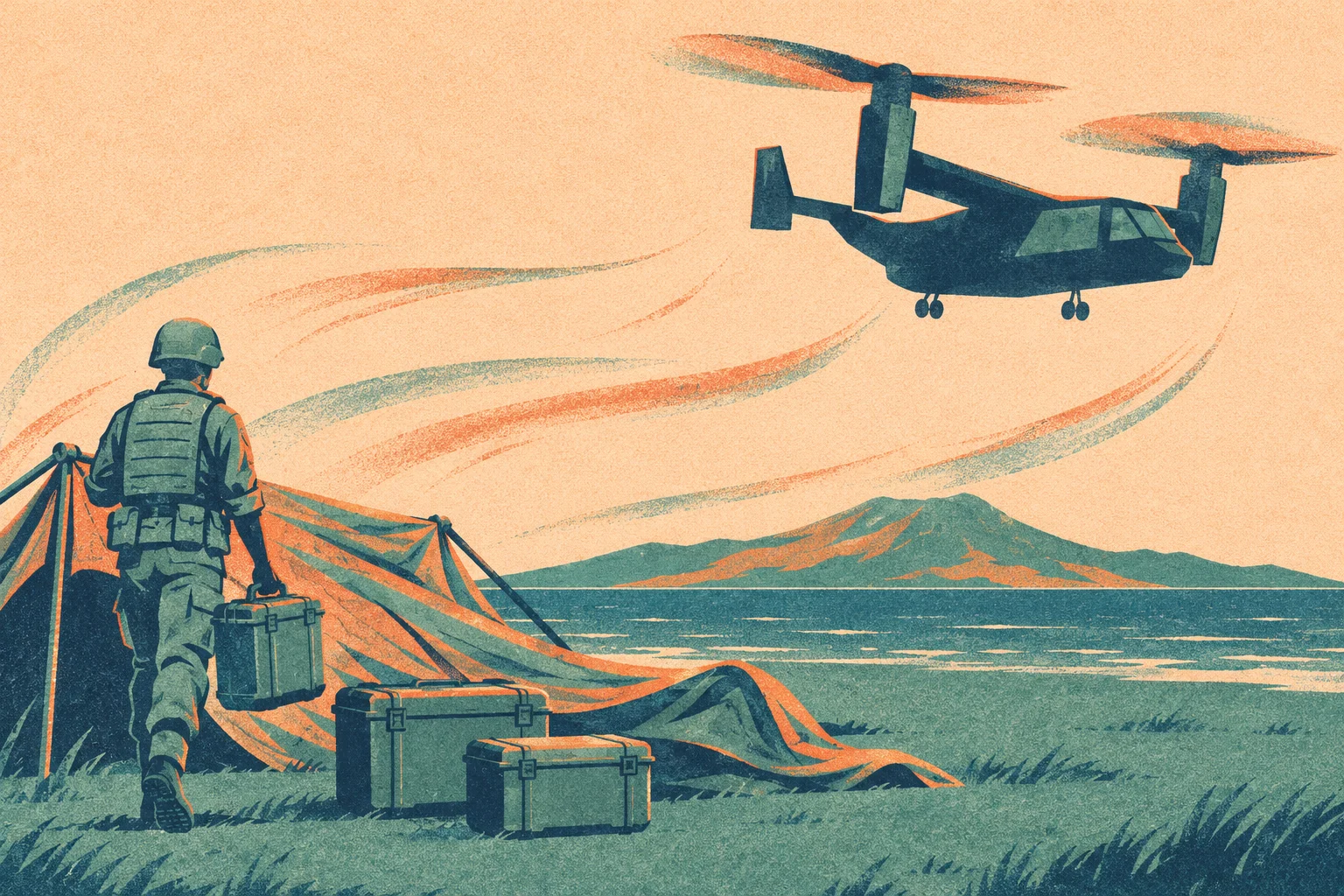
The nodes were not idle while they moved around. They ran littoral combat missions, reconnaissance and counter-reconnaissance, defence against air and surface threats, and coordination with partner forces. When one node had to stop work and relocate, the service said, it passed its tasks to another command post so that operations carried on without a pause. The Corps calls this goal Assured Command and Control: a commander’s ability to keep deciding, directing and synchronising across many distributed, expeditionary nodes.
Chief Warrant Officer 2 Cameron Carver, the senior watch officer during the exercise, judged it a success. “Between physically moving, managing rapid battle handovers, and coordinating simultaneous activities across our units, this was a great rep at validating our ability to disperse and still maintain the fight,” he said. He described the main change in more human terms:
“brought our staff out of predictable headquarters settings and required our planners to operate in distributed environments.”
Predictable headquarters settings. The phrase will mean something to anyone who has worked in an office, and it means a great deal more on a battlefield.
Why the tent must move
The thinking behind the drill is straightforward and grim. In a war across the vast distances of the Indo-Pacific, an adversary could use sensors and faster kill chains to find command posts and hit them with missiles and drones. If those posts are fixed and too centralised, such strikes could badly damage commanders’ ability to make battlefield decisions. The Marines and the other services have been practising a dispersed posture with exactly this kind of conflict in mind.

A reflection, offered as nothing more: power has always liked to sit still, in palaces, ministries and bunkers. Modern sensors punish anything that stays where it is, and armies are now teaching their generals’ staffs to keep moving.
The Army’s version
The Army has built its new Next Generation Command and Control system, known as NGC2, around the same fear. In tests, soldiers have tried command posts that can be loaded into vehicles and driven away in 30 minutes or less, hidden both in the terrain and in the electromagnetic spectrum. At Fort Carson, Maj. Dan Hickox told Business Insider: “I’d say at the most, like about 30 minutes for us to set up, tear down.” The camouflage netting, he said, takes the longest.
Soldiers at an exercise earlier this year told the magazine that the switch to dispersed nodes was jarring at first. The nodes were designed to stay connected over long distances and to keep collecting information and making decisions while being set up or on the move. Some had redundancy built in: if a node gathering targeting data on one location was discovered, another could take over where it stopped.

Not everyone believes half an hour is fast enough. In June, DefenseScoop reported the view of one critic, Lynch, that against an enemy able to fill the sky with drones that go from detection to strike in seconds, being able to move in 30 minutes is of limited help. The outlet also said it saw no counter-drone capabilities at the sites it visited. Even the system’s champions talk carefully about it. An Army leader, Ellis, told AFCEA’s Signal in August that NGC2 was “ready but not done, or I would say it’s functional but not optimized.”
Beyond the command post
The move away from fixed positions goes beyond headquarters. US officials have said in recent years that large air bases are easy targets for drones and missiles and need to be dispersed and concealed. In the Indo-Pacific, American forces have practised flying aircraft from austere places such as rough fields. The Air Force trains like this regularly, and the Marines rehearse expeditionary basing.
In Ukraine the idea is already being tested in real combat. Ukrainian and NATO officials have said that mobility, redundancy and survivability in command and control are becoming essential as Russian forces go after high-value command centres. American units have been drawing on that war in their training for some time. On Oahu the stakes are still only exercises: a staff packs up its screens, an Osprey takes off, another post picks up the work. At Fort Carson, the slowest part of disappearing is still taking down the netting.