
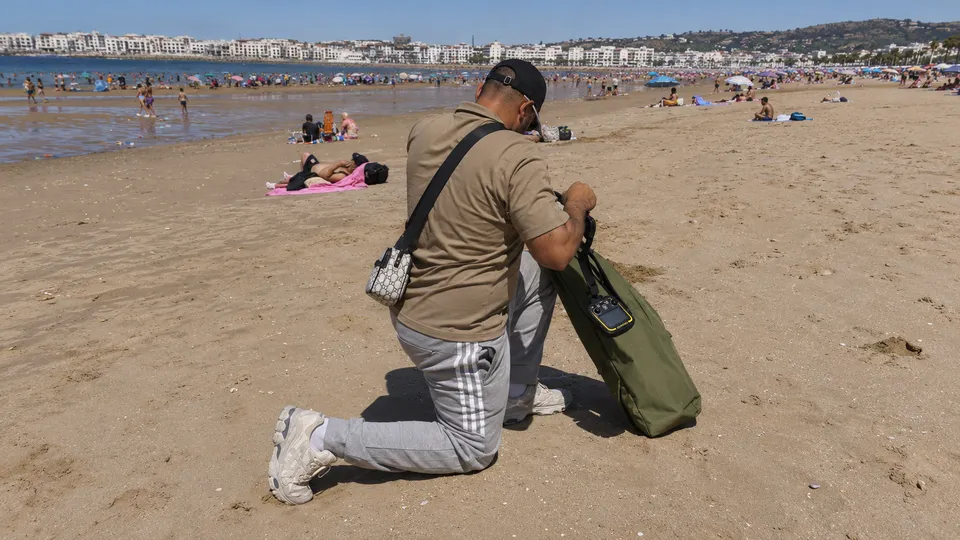
On the Corniche at Agadir, where Morocco’s Atlantic coast bends south, Mustapha Harmouch walks the sand slowly, swinging a metal detector in low, even arcs. Surfers paddle out past the break, children scream in the waves, families talk. He ignores all of it. He is waiting for one sound, the beep that tells him the coil has passed over something buried.
The machine has no opinions. A coin, a ring, a scrap of aluminium, a lost piece of fishing tackle: it gives each of them the same signal. Harmouch, 33, says that blindness is what he likes about it. “The excitement comes partly from not knowing what lies beneath the sand,” he told Hajar Elkahlaoui of Al Jazeera English.
He makes content for a living. About four years ago he ordered a Tianxun TX 850 detector online, and what started as a pastime now turns up from time to time in the videos on Stofishing, his YouTube channel about travel and spearfishing, which has roughly 123,000 subscribers. “It’s a nice hobby because it’s the kind of exploration where I find something and learn something new,” he said. “Each outing is a chance to encounter something I would otherwise never have known about.”
Fourteen coins at Sidi Ouassay
Some of what he has learned is history. He has found old coins tied to particular periods and places, among them the Al Haouz region and Fez. His rarest haul, he says, came from Sidi Ouassay, a coastal town about 65km south of Agadir: 14 Moroccan falus, the old bronze or copper small change, lying together in one spot. Salt and time had worn some of them so badly that their markings were hard to read. The oldest, by his account, is dated 1289 on the Hijri calendar.
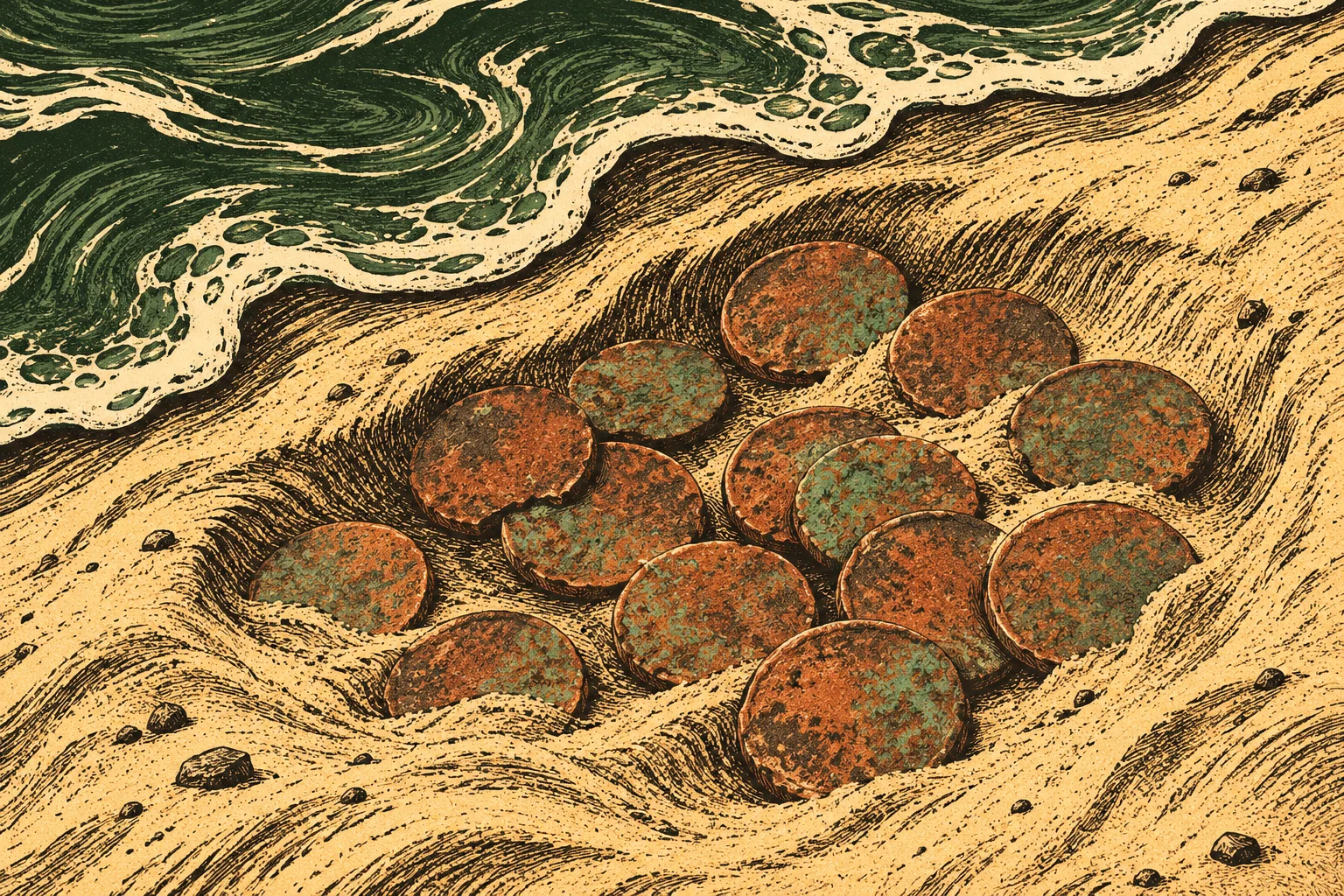
That year began in 1872 and ended in 1873. Coin dealers catalogue falus of that date, cast in bronze at the Fez mint, under Sultan Sidi Mohammed IV, who ruled from 1859 to 1873. Falus were the copper denomination of a monetary order that, according to histories of the dirham, gave way to modern coinage in 1882.
One could reflect that this is how sovereignty tends to end up. A sultan strikes his name and his year into metal so that his authority will pass from hand to hand through the markets of his kingdom. A century and a half later the sea gives a few pieces back, too corroded to read, to a man with a YouTube channel.
Harmouch has no plans to sell them. “I just collect them as a memory,” he said. Near the same spot he once dug up what he took for a meteorite. It turned out to be a common, cheap mineral. “Before asking, I thought I had found the best discovery,” he said, laughing.
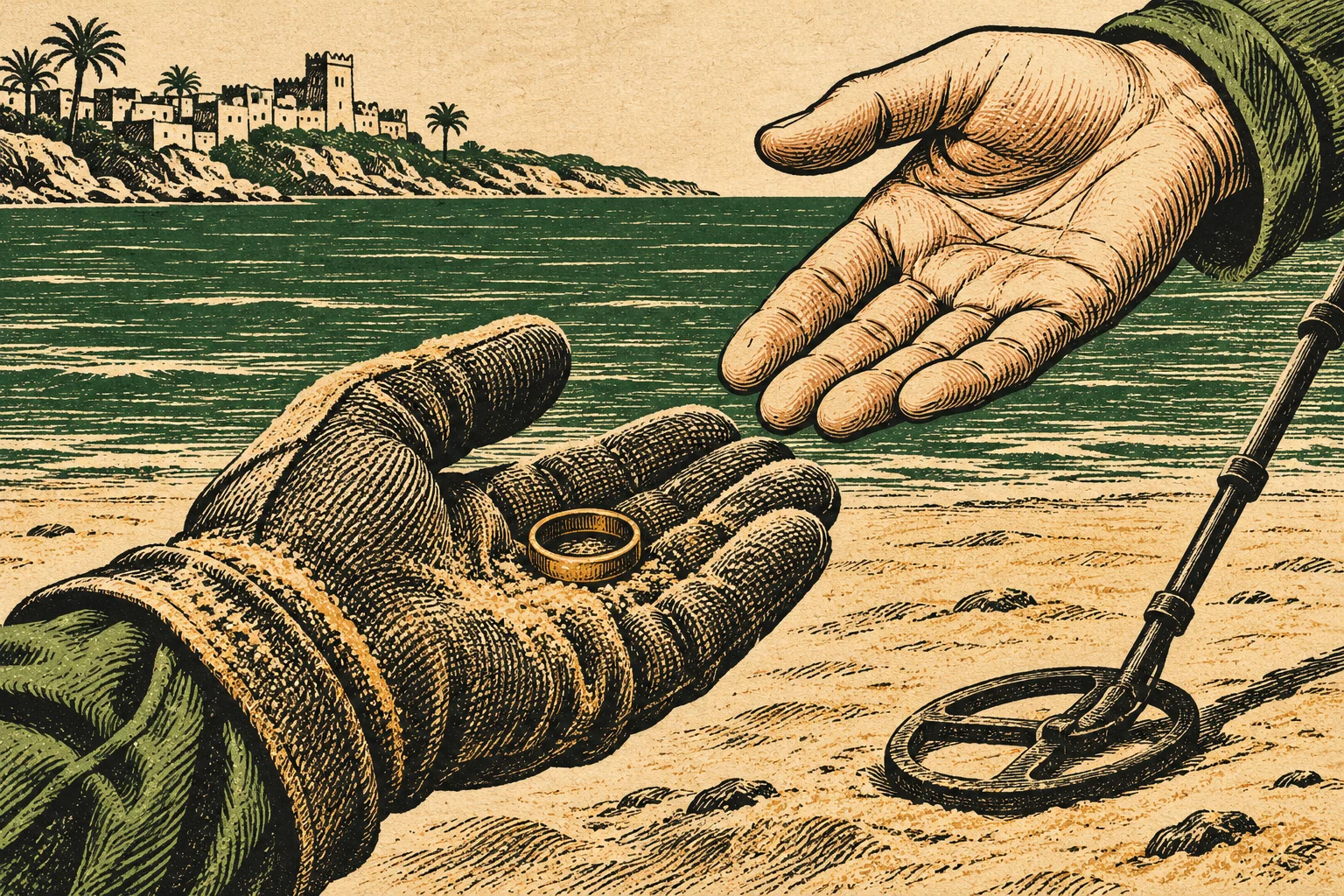
He goes out about four times a month, often with other members of the Moroccan Association for Research and Exploration Enthusiasts. He prefers Taghazout and the Agadir Corniche because they hold less rubbish to confuse the detector. Those beaches have given him jewellery, Moroccan coins and foreign money, including a French 20-franc silver piece. In Taghazout he once found a small gold ring. “I always try to identify and return valuable lost items to their rightful owners,” he says.
The law of 1980
The state keeps its own account of what lies under the sand. Morocco protects its monuments, archaeological sites, works of art and antiquities chiefly through Law 22-80, which dates to 1980 and was amended in 2006 by Law 22-05. It governs archaeological prospecting and what happens to historical finds. Any search meant to uncover monuments or movable objects of historic, archaeological or anthropological importance needs authorisation. Accidental finds must be reported. If work that has nothing to do with archaeology turns up monuments, coins, art or antiquities, the authorities must be told, and the objects must not be damaged or moved unless that is needed to protect them. The government has said again that unauthorised archaeological searches, on land or at sea, are banned.
The law draws a line between a holidaymaker’s lost coin and a deliberate search for the past. The machine in the detectorist’s hand does not, and neither, apparently, does the law. In testimony to a US advisory committee in January 2025, the Committee for Cultural Policy and the Global Heritage Alliance, two groups opposed to US import restrictions on Moroccan antiquities, argued that regulating metal detectors would be the most effective way to stop coins being looted for sale, and said Morocco had not taken that step. Their position is an advocacy one, but it points at a real gap: the law covers the act of searching, not the tool.
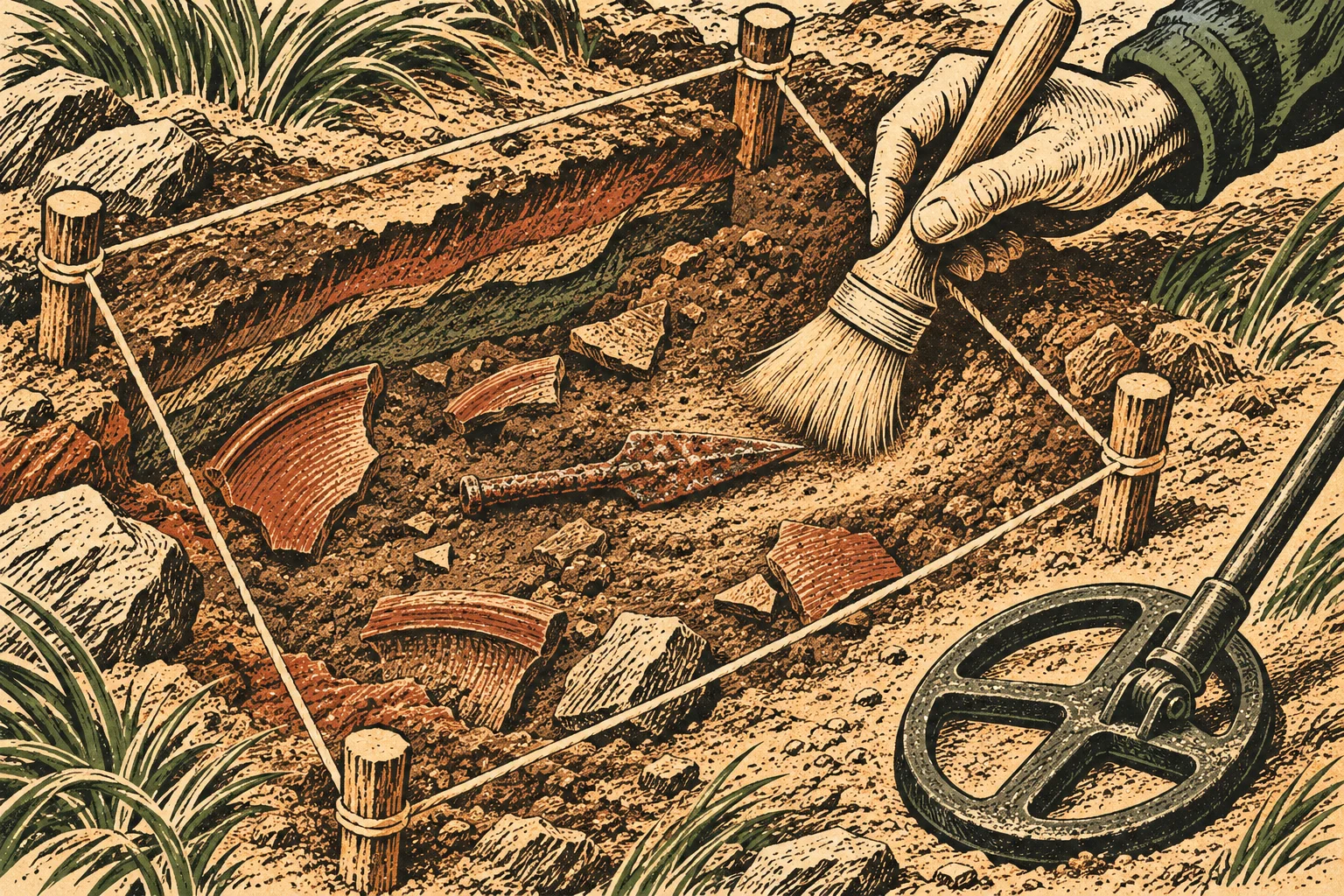
Archaeologists working on the coast care most about context. “Sometimes something as simple as a fragment of metal, a coin, or a small tool can become important because of where it was found and what was found around it,” said Basma Oumaima, an underwater archaeologist. She does not want curiosity punished. “Metal detectors themselves can actually be useful tools in archaeology when they are used as part of a proper archaeological survey, where every find is located, recorded and studied within its context.” In Hungary, volunteers with detectors working that way turned up a Celtic spear and a whole shield set.
Harmouch says he respects the law. Members of his association carry identification, keep off private land and heritage sites, and treat the detecting as a hobby, not a job. His money, he says, comes mostly from his videos and a shop that sells fishing gear.
Every person has their luck
Detecting has never paid Mohamed Botaib’s bills either. He used to coach sport and is now looking for work, and he takes his detector to beaches, forests and mountains. He has found ordinary coins, Moroccan dirhams and rings. “Every person has their luck,” he said.
Jalal Zegnoune works full-time as a maintenance technician in Casablanca and detects when he has time off, or for a few hours in the evening. His finds include coins, jewellery, glasses and watches, along with rusted bits of sardine can, nails and lost fishing gear. He sees taking the junk away as part of the work. “I remove such objects from the beaches because some can be dangerous to beachgoers,” he said. He also likes the company: “I also enjoy meeting other people who practise the hobby and sharing the objects they find.”
So for every Hijri-dated coin there are many nails. Botaib does not seem to mind. “When we look at the beach, it’s not to find treasure,” he says. “It’s also our way of contributing to keeping our beaches clean. We collect pieces of metal and aluminium that we find and throw them away.”