
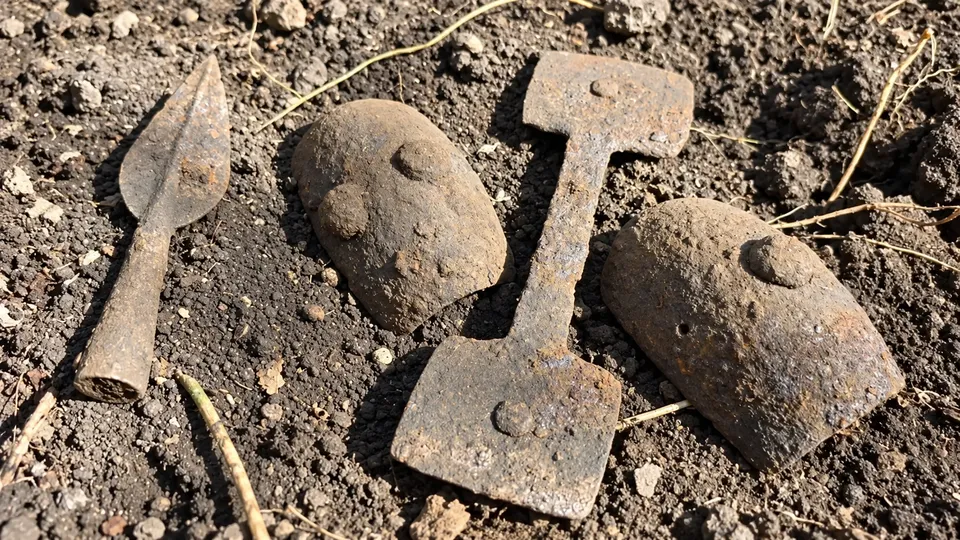
The polite way to find Iron Age weapons is to dig a large, expensive trench and hope. The Erdőbénye way is to walk up and down the hills of northeastern Hungary for two years with metal detectors and a group of volunteers, and then, one September day, notice a Celtic spear and an entire set of shield fittings lying together in the ground. Archaeologists surveying the area around the village announced the find this month, and other outlets have picked it up since. According to the Hungarian National Museum, nothing comparable has previously been documented in the immediate area.
The museum is calling the assemblage the first of its kind known from Erdőbénye: a spear plus what researchers describe as a complete set of shield fittings, recovered together during the September campaign of a survey that has been systematically mapping the district since 2024. The Hungarian outlet Múlt-kor reports that the weapons were lying close to one another alongside additional metal objects and fragments of pottery. Nobody has yet said what the grouping means — whether it was a burial, a deliberate deposit, a loss, or something else entirely — and the museum has notably declined to guess. Fair enough. The whole value of the find is that the objects were found where they were left, by people who wrote down where that was.
That deserves a small amount of unpacking, because context is the entire difference between an archaeological find and a very old piece of scrap. A spearhead that turns up on its own — in a field, in a market, in someone’s grandfather’s barn — tells you that Iron Age material exists in the world. A spearhead found next to shield fittings, next to other metalwork, next to pottery, in a documented location, can tell you something about what people were doing in that particular place: how the objects were deposited, what happened there, maybe why. Archaeologists can learn considerably more from associated objects in a recorded context than from isolated finds whose original positions are gone forever. Which is why the profession has such strong feelings about looting, and such warm feelings about patient, methodical fieldwalking.
The patient, methodical part is the actual story here. The Erdőbénye project was not launched to chase spectacular objects; it began in 2024 with the goal of building a systematic archaeological map of the region — revisiting known sites, finding undocumented ones, and working out how communities occupied and moved through the landscape over time. The tools are conventional fieldwalking and metal-detector survey, repeated over large areas, and the workforce includes volunteers working alongside professionals under a community archaeology programme. The spear and shield set were not found because anyone knew a weapon deposit was there. They were found because a lot of people walked a lot of hills.
What the weapons do is give Celts a local address. Groups belonging to the La Tène cultural world — the material culture archaeologists associate with the Celts — established themselves in parts of the Carpathian Basin during the later Iron Age, and Celtic-linked cemeteries and artefacts are already known elsewhere in northeastern Hungary. Erdőbénye itself was a blanker spot on that map. A single stray artefact might hint that Iron Age people passed through; a group of weapons found together starts to fill the gap with something usable, once further study of the pottery, the metal and the surrounding ground settles where the deposit belongs in the area’s chronology.
The project is jointly led by Vera Majerik of the Hungarian National Museum’s National Institute of Archaeology and Borbála Nyíri, with Gábor Bakos coordinating the community archaeology programme, assisted by archaeologist Máté Piros-Pozdora. The wider collaboration takes in Gábor V. Szabó of the Institute of Archaeological Sciences at Eötvös Loránd University and geographer András Gömöri of the University of Miskolc. Fieldwork continues through the autumn, with researchers and volunteers back out on the hills.
What is left is the question the museum is politely not answering: why a Celtic spear and an entire shield — or at least all its metal parts — came to rest together in this particular corner of Hungary. Someone, at some point in the Iron Age, put those things in the ground or dropped them there, and the reason has been sitting with them ever since. The survey will keep walking. That is, increasingly, how the good finds happen.