
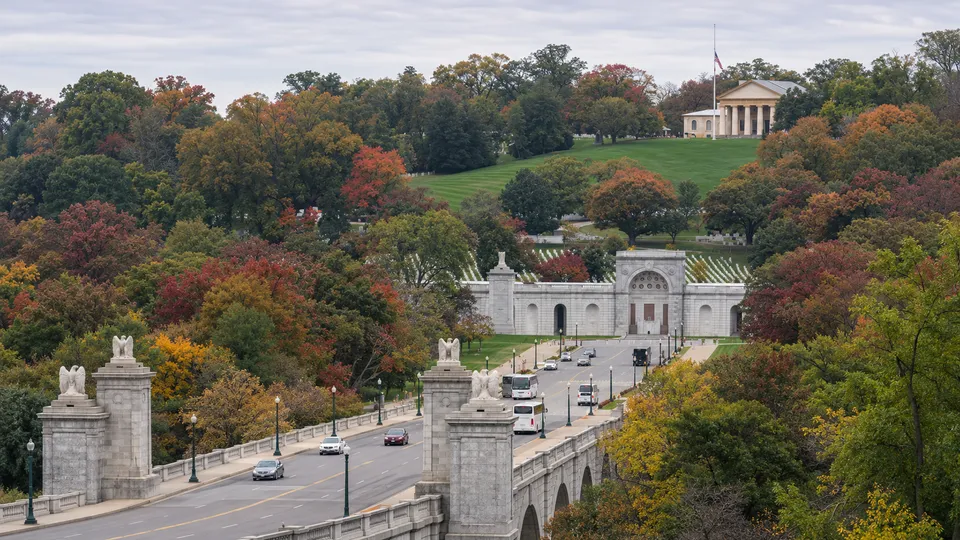
The arch the Trump administration wants to put at Memorial Circle, the traffic island on Arlington Memorial Bridge between the Lincoln Memorial and Arlington National Cemetery, would stand 76 metres (250 feet) tall. That is two and a half times the 99-foot height of the Lincoln Memorial itself, per the National Park Service’s own measurements, and about 86 feet taller than the Arc de Triomphe. On Tuesday, nine children and grandchildren of Robert F. Kennedy and Edward M. Kennedy filed a motion to intervene in the federal lawsuits already trying to stop it, as the Associated Press reported. Their complaint adds a third legal track to a case that, as of this week, has already produced a federal judge’s temporary freeze on construction and an unresolved fight over which century-old statute, if any, lets a president build a monument this size without asking Congress.
The mechanism at issue is the Commemorative Works Act, a 1986 law written specifically to stop presidents from erecting large memorials in the capital’s core on their own authority. It requires congressional authorization, a designated sponsor and review by the National Capital Memorial Advisory Commission for any new monument on National Park Service land in Washington. The administration’s answer, laid out in court filings reviewed in NPR’s coverage of the case, is that it does not need any of that: a 1925 act of Congress authorizing the Arlington Memorial Bridge and its approach columns, the administration argues, already gives the Interior Department standing authority to redesign that approach as it sees fit, a century later. U.S. District Judge Tanya Chutkan was unpersuaded in a 33-page opinion, writing that “the sheer improbability that a 100-year-old statute would contain authority, unknown to every previous administration, to erect a 250-foot arch at a principal location in the Nation’s capital indicates how far defendants must stretch to justify this project.”
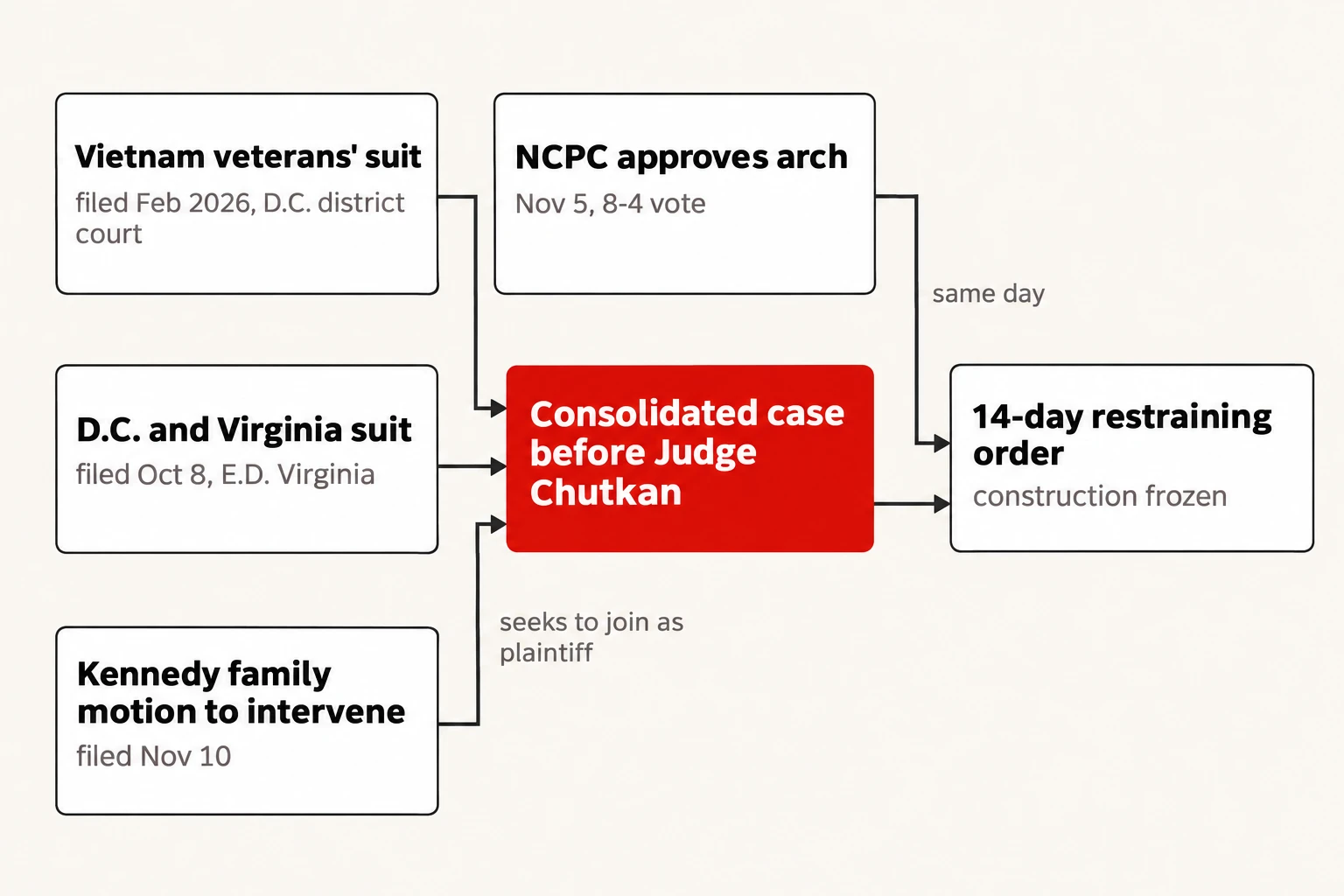
The timing is what forced Chutkan’s hand. The National Capital Planning Commission, the federal body with final sign-off on the design, voted 8-4 to approve the arch on November 5 after a 9½-hour hearing in which more than 120 members of the public testified, most of them opposed, according to NBC News’s account of the vote. Within hours, Chutkan issued a 14-day temporary restraining order barring the government from “initiating, making, or otherwise effectuating any construction, excavation, demolition, land-disturbance, utility-installation, or roadway-closure activity” tied to the project. That order runs out around November 19; she has ordered the parties to file a joint briefing schedule and a status report before then.
| From | To | How |
|---|---|---|
| Vietnam veterans' suit (filed Feb 2026, D.C. district court) | Consolidated case before Judge Chutkan | |
| D.C. and Virginia suit (filed Oct 8, E.D. Virginia) | Consolidated case before Judge Chutkan | |
| NCPC approves arch (Nov 5, 8-4 vote) | 14-day restraining order (construction frozen) | same day |
| Consolidated case before Judge Chutkan | 14-day restraining order (construction frozen) | |
| Kennedy family motion to intervene (filed Nov 10) | Consolidated case before Judge Chutkan | seeks to join as plaintiff |
Based on Court filings; NPR, AP
A justification that keeps changing
The national-security argument the administration leaned on through the fall has not survived contact with its own paperwork. Trump wrote on Truth Social that he had agreed, at the military’s “strong request,” to convert the project into a “top grade Military Complex/Triumphal Arch,” and Defense Secretary Pete Hegseth told the court the structure represented “a generational national defense opportunity,” per Yahoo News’s reporting on the filing. An Interior Department deputy chief of staff later conceded under questioning that “specific national security functions have been filed under seal” in the case, while acknowledging the National Park Service itself “has not been privy to any national defense preparations.” The final design plans submitted to the planning commission, though, drop every mention of the drone launch pads, sniper nests and ammunition storage the administration had floated earlier in the year, a reversal rews reported in October and which NBC Washington also documented. A monument that was a military installation in April is, on paper, a ceremonial gateway by November, and the justification that would have made the project easier to defend in court is the one the administration quietly abandoned.

What the Kennedy filing adds
The nine plaintiffs, Rory Kennedy, Maxwell Kennedy, Christopher G. Kennedy, Kerry Kennedy, Courtney Kennedy, Kathleen Kennedy Townsend, Joseph P. Kennedy II, Joseph P. Kennedy III and Edward M. Kennedy Jr., are children and grandchildren of the two Kennedy brothers buried near President John F. Kennedy and his Eternal Flame at Arlington. Their complaint, filed with lawyers Norman Eisen and Steve Jonas of the Democracy Defenders Fund, argues the arch would sit directly in the sightline from Arlington Memorial Bridge to the Kennedy gravesites, a view the family says was deliberately preserved when JFK was buried there in 1963. It cites a forensic shadow study to argue the structure would darken the graves during the early-morning hours when visitors most often come, the basis for reporting by Yahoo News that put the figure at roughly 50 days a year, a number from the family’s own study rather than from any court finding. “Only Congress has the constitutional power to authorize an intrusion of this magnitude,” the attorneys said in a statement from the Democracy Defenders Fund. Robert F. Kennedy Jr., the president’s health secretary and the most politically prominent member of the family, did not join; asked about family opposition to a separate push to rename the Kennedy Center after Trump, he said he had “bigger fish to fry.” In their own statement, carried by CBS News, relatives Rory and Maxwell Kennedy said a towering arch casting shadows over the graves would also “cast a shadow over our democratic principles.”
The money nobody will confirm
The White House has never given an official total cost for the arch. Axios’s early reporting put it near $100 million, paid mostly by private donors; the government’s own paper trail is narrower. An Office of Management and Budget-approved spending plan from September reserves $2 million in special initiative funds and $13 million in matching funds specifically for the arch, according to documents reviewed by Yahoo News, with the rest expected to come from the same donor pool funding the president’s White House ballroom, a project whose own budget has already grown from $200 million to a projected $300 million. White House spokesperson Davis Ingle said the administration expects to be “fully vindicated as this litigation proceeds,” calling the arch “a tribute to 250 years of American greatness”; a separate White House statement called it unfortunate that Kennedy relatives had joined litigation against a project “intended to honor our heroes who rest in Arlington Cemetery.”
None of the three pending questions, whether the 1925 bridge statute substitutes for the Commemorative Works Act, whether the Kennedy family has standing to sue over a sightline, and what the sealed national-security filings actually say, has been decided. Chutkan’s 14-day order buys the court time, not a ruling; a status conference and briefing schedule are due before it lapses. The number to watch is not 250 feet but the date the temporary order expires without a longer injunction behind it.