
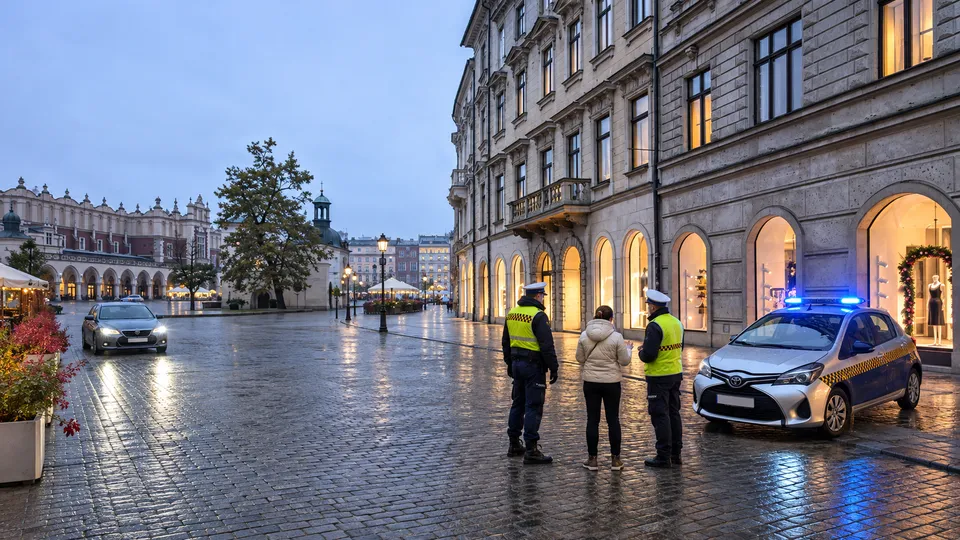
Nine people are dead. Six of them died in Kraków’s Main Market Square on Saturday afternoon, shot from a moving car by a man armed with a rifle he was legally entitled to own. Three more were his parents and sister, found dead in the family home in Ostrowiec Świętokrzyski, 150km east, hours after the attack. Polish police said he held a valid permit for two firearms; his 52-year-old father, in whose name the car was registered, legally owned 11, according to Onet’s reporting, relayed by The Week. Neither man had a criminal record.
The weapon was an AR-15-style rifle, confirmed by Krakow police spokesperson Katarzyna Cisło to broadcaster TVN24 and reported by Al Jazeera. The suspect, named by police only as Michał O. in line with Polish privacy practice for unconvicted suspects (some Polish outlets, unconfirmed by police, give the surname Oksiński), was wearing military-style fatigues and a bulletproof vest. He was not a soldier, Poland’s defence ministry said, pushing back on speculation the gear meant military ties. His age has been given as 25 in the initial wire reporting from Reuters, AP and AFP carried by RTÉ and in CBS News’s account; later Polish reporting, including the one cited above, gives 24.
The three minutes
The attack’s geography, reported by defence24, runs a specific route through the old town. The suspect drove his father’s black Subaru into the Main Market Square from Sławkowska Street around 3pm local time (14:00 GMT), stopping at several points to fire at pedestrians with what Cisło described as a military-type long gun. Witness Jonathan Balshaw, sheltering with his girlfriend in St Mary’s Basilica, told the BBC’s reporting carried by Yahoo News he counted “more than 20” shots from what sounded like “two distinctly different” firearms. The car continued through the centre and fired on a passing tram at Wszystkich Świętych Square, shattering the driver’s cab window without injuring anyone aboard. The gunman then fled roughly 1km south along Grodzka Street before police intercepted him at the junction of Dietla and Stradomska streets.
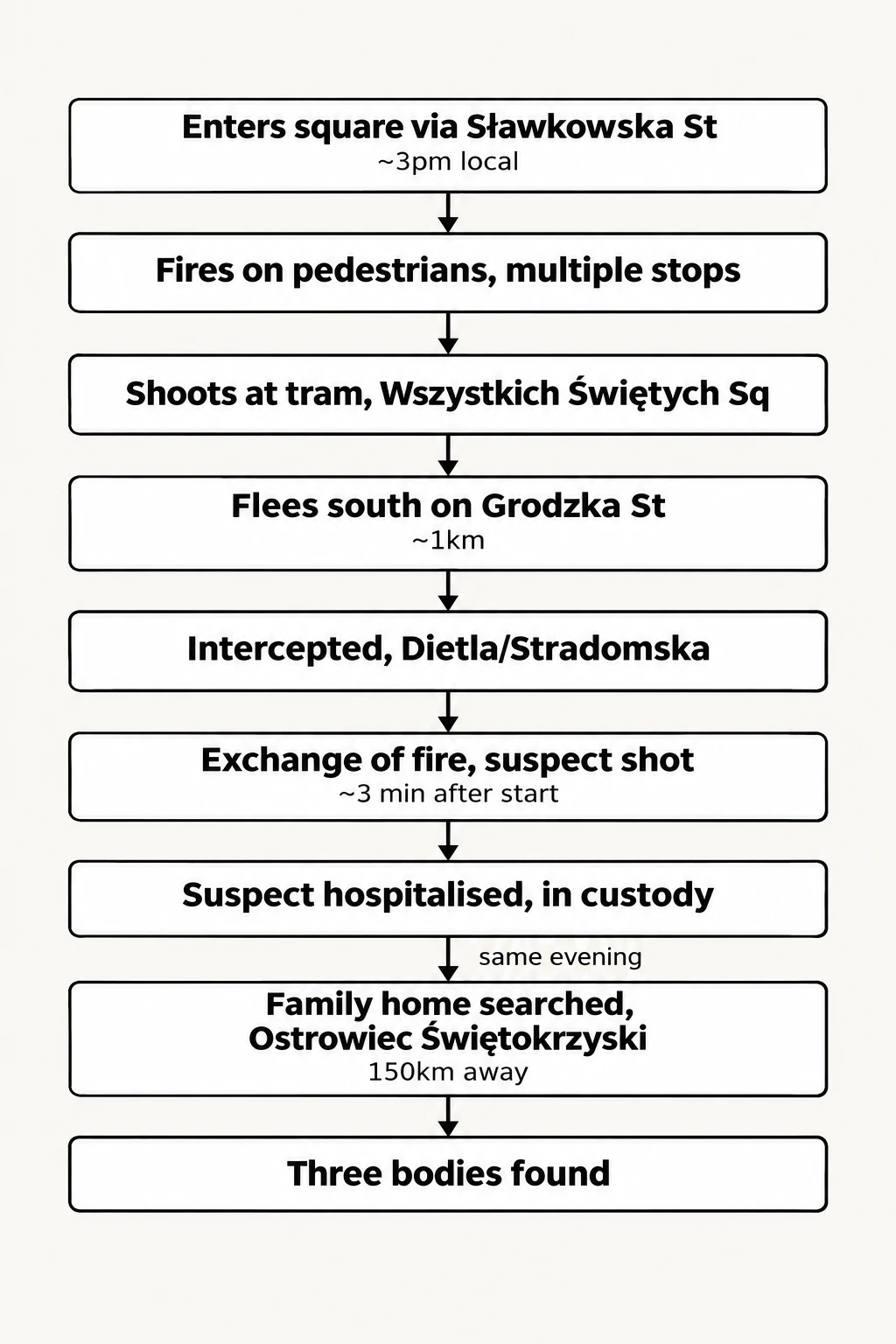
| From | To | How |
|---|---|---|
| Enters square via Sławkowska St (~3pm local) | Fires on pedestrians, multiple stops | |
| Fires on pedestrians, multiple stops | Shoots at tram, Wszystkich Świętych Sq | |
| Shoots at tram, Wszystkich Świętych Sq | Flees south on Grodzka St (~1km) | |
| Flees south on Grodzka St (~1km) | Intercepted, Dietla/Stradomska | |
| Intercepted, Dietla/Stradomska | Exchange of fire, suspect shot (~3 min after start) | |
| Exchange of fire, suspect shot (~3 min after start) | Suspect hospitalised, in custody | |
| Suspect hospitalised, in custody | Family home searched, Ostrowiec Świętokrzyski (150km away) | same evening |
| Family home searched, Ostrowiec Świętokrzyski (150km away) | Three bodies found |
Two officers were shot during the arrest. Yahoo News’s account, drawing on BBC reporting, says the suspect was shot within three minutes of the first shots being fired. One officer took a single gunshot wound; the other, hit three times, was described by Interior Minister Marcin Kierwiński as in “very critical condition” and underwent surgery. Prime Minister Donald Tusk credited the pair with having “likely saved many lives, without regard for the risk of losing their own.”

Of the six killed in the square, four were women and two men; three victims were Polish, one a British citizen, and two were not immediately identified, Al Jazeera reported from the police statement. Among roughly 15 wounded in the square were two police officers and several foreign nationals — Austrian, German, Portuguese, Russian and British, per reporting gathered by the ABC. A US State Department spokesperson told CBS News it was not aware of any American citizens harmed.
Legal, and unchecked
The AR-15-style rifle fits a pattern this masthead has covered before: Poland’s gun-permit system has been growing fast and checking little. Police issued 50,709 new firearms licences in 2025, a record, up 10.6% on 2024’s roughly 46,000, according to Notes from Poland’s reporting of the police data. That is more than five times the 9,783 issued in 2015. Civilian-owned firearms nationally have passed 1,037,778, up more than 107,000 in a single year and nearly three times the 380,000 recorded in 2014. Sporting and collector permits, the categories that cover semi-automatic rifles like the one used Saturday, account for 76% of last year’s grants.
| New licences (licences) | |
|---|---|
| 2015 | 9,783 |
| 2021 | 19,939 |
| 2022 | 37,402 |
| 2024 | 46,000 |
| 2025 | 50,709 |
Source: Polish Police statistics, via Notes from Poland. 2024 figure reported as 'nearly 46,000'; other years not published in the same release
Poland’s Supreme Audit Office, NIK, had already measured how little checking follows the initial grant. Its audit of seven regional police offices, published before this attack, found that sport-shooters, hunters and collectors — the suspect’s category — are vetted once, at the application stage, with no recurring psychological or medical review required afterward. Where police did later appeal a medical clearance they suspected was wrong, the original all-clear was overturned in 32% to 100% of reviewed cases, depending on the region. Five of the seven offices had let medical certificates expire on file, in one case by three years. An EU-mandated national weapons registry meant to track who owns what launched five years late, in 2024 instead of 2019, and NIK says it still lacks complete data on firearms and their components. None of that machinery was triggered to re-examine a 24- or 25-year-old sport-shooting permit holder before Saturday; the audit’s point was precisely that nothing is.

Mourning, twice, and a word not yet used
Two different mourning periods are running in parallel, declared by two different officials for different reasons. Kraków’s mayor, Łukasz Gibała, ordered municipal mourning through Wednesday, November 11, and told residents the square “will belong to us again,” per CBS News. Separately, Tusk declared national mourning for November 8 and 9. Poland’s defence minister called the attack “an act of terror,” and some wire accounts describe Tusk as classifying it as terrorism, but as of November 8 the attack had not been formally designated under Poland’s anti-terrorism statute, according to defence24’s reporting. The gap between the rhetoric and the legal classification matters in Poland, where a formal terrorism designation carries specific prosecutorial and sentencing consequences the looser phrase does not.
That gap sits inside a second tension. Within hours of the shooting, Interior Minister Kierwiński told reporters “everything indicates” the suspect was “fascinated by far-right ideologies” and held “very radical” and “ultranationalistic” views — a characterisation cited across the US wire coverage. Tusk, en route to Kraków, made what the ABC reported as “a heartfelt appeal to politicians of all stripes: do not exploit this tragedy.” Poland’s cybercrime bureau has joined the investigation to check whether the suspect was active in radical online communities, per The Week’s reporting cited above; no findings from that review have been published.

Kraków drew 16.2 million visitors in 2025, according to city data reported by RTÉ, and the Main Market Square — a UNESCO World Heritage site and one of the largest medieval squares in Europe — is the city’s principal tourist draw. The attack lands five weeks after a wave of stabbings elsewhere in Poland that Tusk at the time called a “cult of violence,” and amid persistent Polish warnings about Russian hybrid sabotage, which Moscow denies and which investigators have so far attached no evidence to in this case.
The open questions are procedural, not rhetorical: whether the formal terrorism designation follows, what the cybercrime unit finds in the suspect’s online history, and whether NIK’s audit findings, written before anyone outside Poland’s police bureaucracy had reason to read them, produce a change to a permit system that added 50,709 new gun owners last year and re-examines almost none of them afterward.