
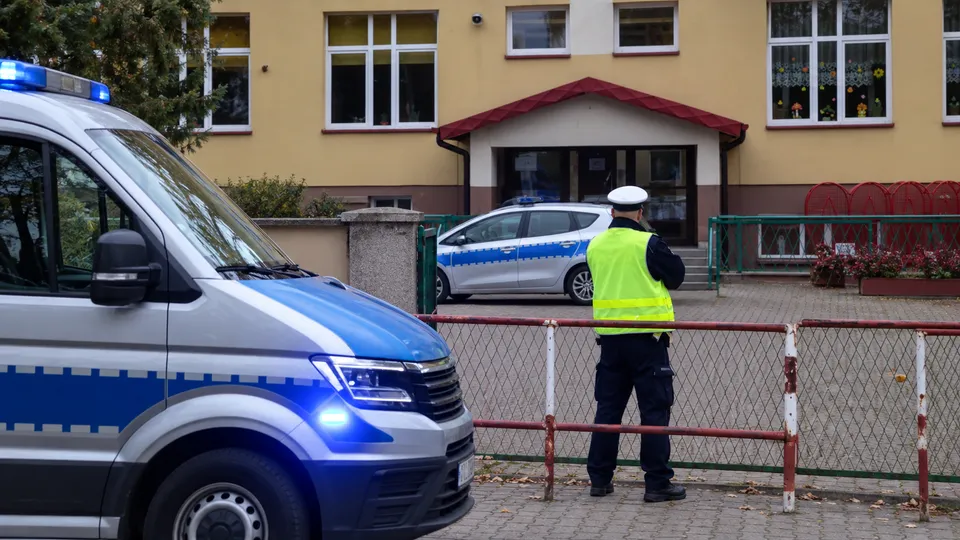
Seventy-six people are in detention across Poland and police have checked nearly 50,000 schools nationwide, authorities said Saturday — the visible accounting of a week in which two knife attacks, three days of online rumour and one nonexistent “bloody Friday” disrupted an entire country’s school system, the Associated Press reported in a dispatch carried by CNN. The 50,000 figure is the police’s own count, and it is worth holding next to the actual violence: two attackers, both in custody.
The first attack came Wednesday, when a 19-year-old student at a vocational school in the Mazovian province of central Poland attacked fellow students, teachers and passersby with a sharp object, injuring nine people before fleeing; he was arrested nearby. The second came Thursday, when a 15-year-old entered his former school in the same province, killed a school custodian and wounded two others — elsewhere the dispatch describes three adults wounded in that attack, and the discrepancy is not explained. Both perpetrators are Polish nationals, and both are in custody. School violence by minors is a new phenomenon in Poland, which is part of why the week landed the way it did.
How a rumour outran the attacks
By Thursday night, claims that the attacks were coordinated and that more would come on a culmination day dubbed “bloody Friday” were circulating in parents’ online groups and in mainstream media. On Friday, 59 schools across the country suspended classes — most of them in the Mazovian district, which contains Warsaw — while school directors stationed extra staff at entrances, introduced voluntary backpack checks and brought in police patrols. Many parents simply kept their children home. No further attack took place.
Saturday’s detention count gives a sense of what the response actually caught. Among those held: a 14-year-old boy from a central Warsaw district found with a knife with a concealed blade and 11 firecrackers, and a 16-year-old from another Warsaw district who arrived at school with a butterfly knife in his backpack. Others had posted photos of knives online, threatened peers, or threatened attacks on schools. “There will be no compromise here. The safety of the youth is the most important thing,” Interior Minister Marcin Kierwiński said.
The government said it has so far found no evidence that an internet challenge promoting school attacks is ongoing, and there is no official confirmation the two attacks were linked. Extra security at schools will continue, and crisis training will be organized. The liberal government also promised to renew efforts to pass a bill blocking harmful online content. Prime Minister Donald Tusk pointed to the gap in the law: “If that juvenile attacker had streamed the crime online today, we would have been unable to block that content because we have not been given that legal tool.” The 15-year-old in Thursday’s attack was wearing a camera to record what he did.
That attack ended when school director Krzysztof Ochmański overpowered the boy. Ochmański told reporters there was a moment when the teenager seemed to grasp the scale of what he had done and said he did not want to do it any more. “Once I had established contact, he asked me for help,” Ochmański recounted. “It got to the point where he wanted a hug.” The questions the government cannot yet answer are whether the two attackers knew of each other, and what share of the 76 detained had any intent to hurt anyone. Both numbers will matter to the bill Tusk wants to pass.