
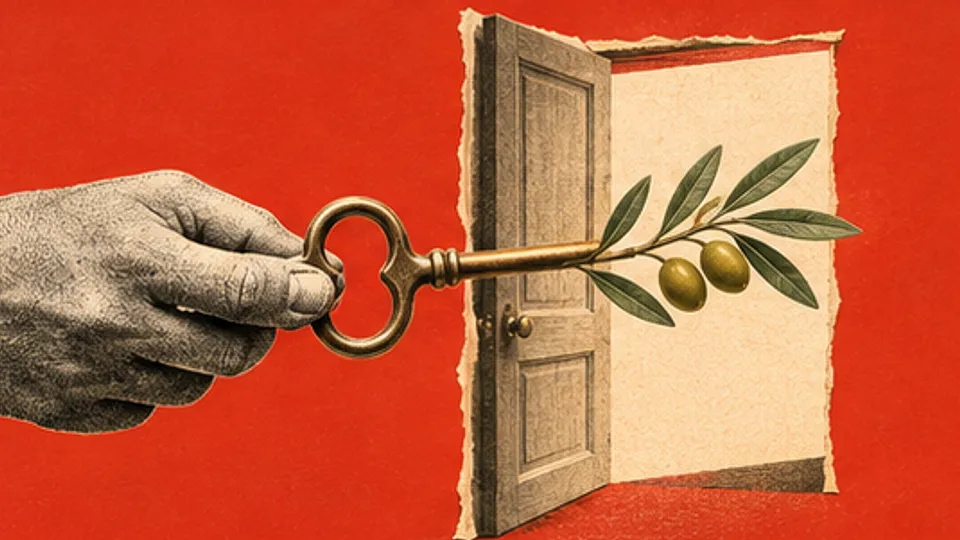
On Saturday, 14 November, Benjamin Netanyahu spoke to Israel the way a man speaks once the house is no longer his but he still has the keys: by video, calling for unity. The caretaker prime minister said that his meeting with Gadi Eisenkot two days earlier, on Thursday, had “only strengthened the conviction that it is essential to form a national unity government”, and that only such a government could guarantee the country’s security, as Al Jazeera reported.
Eisenkot answered within minutes. Netanyahu, he said, “knows he lost the election.”
The arithmetic of 27 October
The appeal and the dismissal make sense only next to the numbers. The 27 October election gave nobody a majority in the 120-seat Knesset. Netanyahu’s right-wing and religious bloc won 53 seats. Eisenkot’s four-party bloc won 48. Arab-led parties took a record 19. When President Isaac Herzog asked who should try to govern, 67 lawmakers, the Arab-led parties among them, named Eisenkot and 46 named Netanyahu. Last Sunday the former army chief received the mandate and 28 days, which can be stretched by another 14.
Netanyahu has stayed on in the meantime, a premier without a majority who still holds the instruments of state. That is the position he spoke from on Saturday.

An invitation with conditions
His language was generous. “Instead of trying to form a weak and dangerous government,” he said, according to a Reuters report carried by Yahoo News, “let’s meet in one room, without preconditions, put aside all our disagreements and all the boycotts, and reach agreements for the security and the future of the state”.
The room he described did have a condition. The government he proposes would be made up of parties that recognise Israel “as a state for the Jewish people”, which in practice means centrist and right-wing Jewish parties, with the Arab parties left outside. He and his allies have claimed, without evidence, that Arab-led parties “stole” the election. Saturday’s call for unity came from the same camp that ran that campaign.
His argument was security, and the security he meant was Iran. A unity government, Netanyahu said, could “eliminate the Iranian threat once and for all”, and he claimed Tehran would “not hesitate to use nuclear weapons against us.” Two days before the video, his caretaker cabinet had ordered the military to prepare for a possible attack on Iran. The man offering to share power is also the man holding the threat that, on his account, makes sharing power necessary.

A reflection, offered only as one: rulers who lose a vote often find that the nation’s danger has grown at the same moment, and that the danger requires them in particular.
“These tricks don’t work on me”
Eisenkot did not take the bait. “Netanyahu is calling for negotiations while they are already underway; he claims to want unity but... sows division and stokes tensions as if there were no tomorrow,” the former chief of staff said, adding that “these tricks don’t work on me”. He also called the statement “yet another spin move.”
The day before, Eisenkot had described Netanyahu’s campaign against the Arab parties as “racist”. He has not shut every door to the right. He has said he could work with members of Likud and with outgoing Finance Minister Bezalel Smotrich’s Religious Zionism if their commitment to unity is “sincere”, and he has demanded a “break with the extremists”, meaning above all the supporters of the far-right minister Itamar Ben-Gvir. He would take Netanyahu’s party without Netanyahu. He has also kept the Arab-led parties out of his own coalition, though their recommendations helped win him the mandate.

A government that does not need a majority
Netanyahu’s real target on Saturday was Eisenkot’s plan for a minority cabinet, presented as a “national emergency government”. The arithmetic is simple. Eisenkot’s 48 lawmakers vote in favour and Netanyahu’s 46 vote against. The 26 lawmakers of the Arab and ultra-Orthodox parties abstain. The government is approved without an absolute majority of the Knesset behind it. Netanyahu warned that this would lead to Israel’s “collapse”.
In this design, the people Netanyahu’s camp accused of stealing the election would decide the outcome by sitting still, and ultra-Orthodox members of his own bloc might do the same beside them.
Tuesday
The next test comes earlier than the 28-day deadline. On Tuesday the Knesset votes for its speaker. Amir Ohana, a Netanyahu ally, holds the chair now. The opposition has nominated Matan Kahana, a former military officer, to replace him.
On 10 November, after the new members were sworn in at the Knesset in Jerusalem, Netanyahu and Eisenkot posed for a photograph together. Five days later they were talking about unity through video statements and rebuttals issued minutes apart. The speaker vote will show which of them can actually count to a majority on the Knesset floor.