
The US Navy has 286 ships. Its 2016 force-structure goal, still the official target, calls for 355. Acting Navy Secretary Hung Cao told the Senate Armed Services Committee on Tuesday that this gap, not any single decision by him or by Defense Secretary Pete Hegseth, is why carrier crews are spending close to a year at sea: “The reason why we had to have these extended deployments is really because we only have 286 ships today.” The hearing, on his nomination to hold the job permanently, ran nearly two and a half hours and covered the US-Israel war on Iran, now in its ninth month, from the angle lawmakers care about when they’re not on camera: what it costs, in ships, missiles, dollars and sailors, as Al Jazeera reported.
Fewer hulls, longer deployments
The arithmetic behind Cao’s claim is simple fleet-management math: if the Navy has committed to keeping a given number of carrier strike groups on station in a theatre, and it has fewer total hulls to rotate through that commitment, each hull stays out longer before a relief ship arrives. The USS Abraham Lincoln left San Diego on November 21, 2025 and didn’t return until October 8, 2026 — a 321-to-322-day deployment, with the ship going 286 days without a port call by most counts, though some outlets put the uninterrupted stretch at 265 days depending on how a port call is defined, as NPR reported. That’s the second-longest carrier deployment since the Cold War ended, behind only the USS Gerald R. Ford’s 326 days earlier this year, the longest since Vietnam. The pre-war standard was six to eight months, roughly 180 to 240 days. Three carrier strike groups — the George H.W. Bush, George Washington and Theodore Roosevelt — are now massed in the region to relieve the pressure, a stopgap, not a fix, since it still draws down ships the Navy would otherwise have free for the Pacific, where Cao argued the joint war effort has nonetheless “set China back on their heels.”
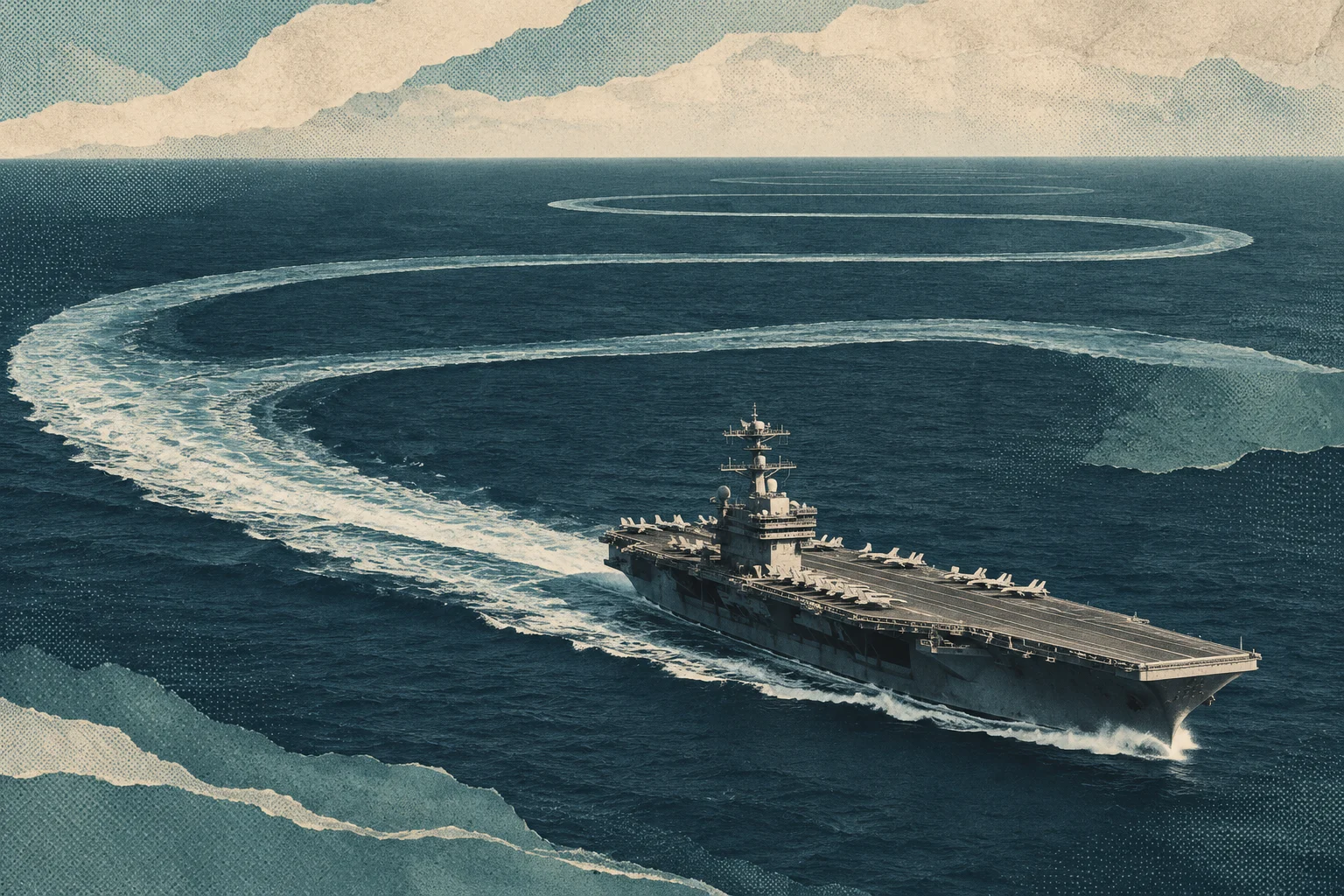
The crew cost of that math showed up in the numbers lawmakers put to Cao directly. Eight sailors attempted suicide during the Lincoln’s deployment, a figure the Navy disclosed to Congress only in September, after Sen. Kirsten Gillibrand requested it, and only after the Navy had publicly denied reports of mental-health problems in August before reversing itself two days later and sending more counselors aboard, as Military.com reported. Cao told the committee he preferred to call the eight episodes “eight suicide mitigations,” crediting the chaplains and counselors who intervened, and noted that a typical carrier strike group sees “one or two suicides” per deployment — a claim that, if the eight attempts are compared against that one-or-two baseline rather than redefined as successful interventions, describes a crew in far worse shape than normal, not better. Sen. Richard Blumenthal told him: “you’re failing these sailors and their families... you simply don’t care.” Sen. Mark Kelly cited a parent’s account of a sailor who lost more than 45 pounds in six months to food shortages; Cao compared the complaints to his own kids finding an empty refrigerator and insisted the ship never ran out of food entirely.

The money and the metal
Sen. Elizabeth Warren put a number on the war that Cao did not dispute: the naval blockade on Iranian shipping costs about $32.5 million a day. If that rate held for the roughly 274 days between the war’s start in February and the November 17 hearing, the blockade alone would have cost close to $8.9 billion — an estimate nobody at the hearing offered, since no one stated when the blockade itself began, so treat it as an upper bound, not a reported total. Warren also cited estimates that Iranian strikes on the Navy’s regional headquarters in Bahrain caused at least $400 million in damage. Cao confirmed the blockade figure but said he couldn’t give a full damage assessment in Bahrain because “it’s a nonpermissive area for us to go” — notable from an official who told a reporter months earlier, on the record, that Iran “blew the hell out of Bahrain.” Ranking Democrat Jack Reed said the munitions spent and the damage sustained in Operation Epic Fury, the US-Israel campaign’s official name, “will take years to recover” from.

On munitions, Cao gave the committee a figure that is useful precisely because he volunteered it himself: during his active-duty years the Navy produced about 125 Tomahawk cruise missiles a year; production is now, in his words, “well above 60 every month.” Annualized, that’s upward of 720 missiles a year, roughly six times the historical rate — though Cao’s figure is a monthly rate he cited in testimony, not an audited annual total, so the comparison is illustrative rather than exact. Sen. Deb Fischer pressed him on dwindling stockpiles of air-defense interceptors and other missiles regardless; Cao said production of Tomahawks and interceptors has ramped up, but also conceded the Navy has resorted to firing expired munitions, a practice he likened to reviving stale bread with water and a microwave.
A nominee who needs a waiver
Cao was confirmed as Navy undersecretary in October 2025 with no Democratic votes, and became acting secretary in April after his predecessor, John Phelan, was pushed out following friction with Hegseth, as Stars and Stripes reported. Trump formally nominated him for the permanent job in September. The complication is procedural but not trivial: federal law requires a service secretary to have been off active duty for seven years, and Cao retired as a Navy captain in 2021, four years short. He needs a waiver from both the Senate and House, and in the Senate that takes 60 votes to clear a filibuster. Congress has granted this specific waiver only twice before, for defense secretaries Jim Mattis and Lloyd Austin; Cao would be the third. No Democrat on the committee voiced support for him at the hearing.
The vote, if it happens, will happen in a lame-duck session: Republicans lost control of both the House and Senate in the November midterms, with the war cited as a factor, and the new Democratic majority is sworn in on January 3, 2027. A House effort to impeach Hegseth over the war’s conduct failed earlier this fall. Separately, Reed told Cao the committee got no advance notice when the Navy quietly relieved the entire leadership of the USS South Dakota — commanding officer, executive officer and command master chief — after the nuclear submarine’s October collision with the seabed; Cao said the squadron commodore judged they hadn’t lived up to the service’s “honor, courage and commitment” standard, which does not answer why Congress wasn’t told.
None of the specific figures Cao cited — the 286-ship count, the >60-Tomahawks-a-month rate, the one-or-two-suicides-per-deployment baseline — were independently verified at the hearing; they are his numbers, told to a committee that, as Al Jazeera reported, is about to be run by the party that didn’t vote for him. The war Trump calls “effectively over” is still drawing a daily blockade bill, still consuming Tomahawks faster than the old production line ever ran, and still deciding, one relief carrier at a time, how long the next crew stays out before anyone in Washington has to put a number on what it cost them.