
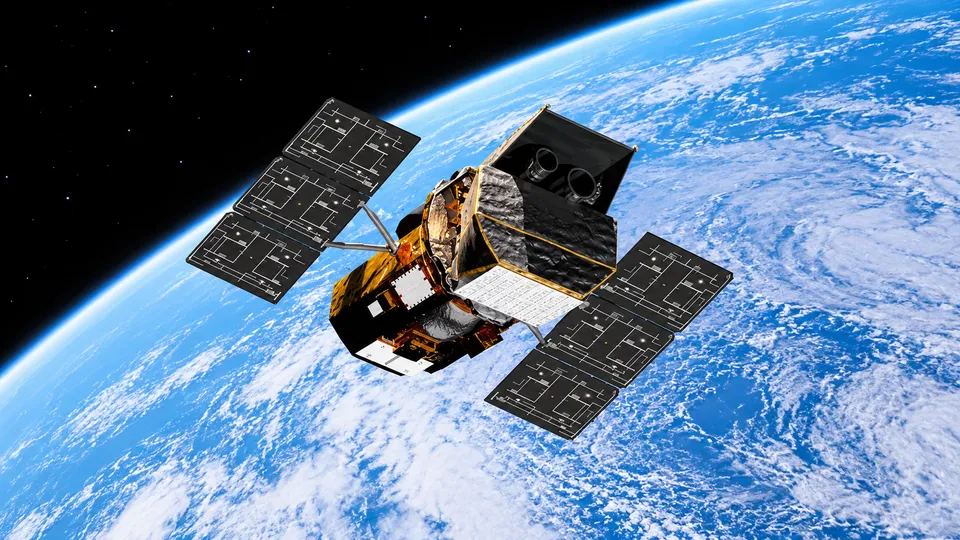
NASA’s Neil Gehrels Swift Observatory will end its science observations within weeks and fall from orbit, the space agency said on Wednesday, after a privately built rescue craft failed to boost the nearly 22-year-old telescope to a higher altitude.
The 3,200-pound observatory now circles about 200 miles above Earth. Once it slips below 185 miles, expected in early to mid-October, operating it will become difficult, according to NASA. The agency expects the telescope to reenter the atmosphere and burn up by early November, ABC News reported, closing a $30 million NASA-sponsored salvage effort.
LeoLabs, a space-tracking company, said the risk from falling debris is low. “While it’s possible some hardware from the Swift spacecraft may survive re-entry due to its size, the probability of debris causing significant property damage or physical harm to anyone is very small,” the company said in a statement shared with CNN by email, adding that surviving debris would most likely land in the ocean or on uninhabited ground. NASA did not respond to CNN’s request for comment on the reentry risks.
The rescue attempt was an unusual one. Katalyst Space Technologies, based in Arizona, developed, built and launched a satellite called LINK in nine months, sending it up on July 3 aboard an air-launched Northrop Grumman Pegasus XL rocket, according to Space.com. Weeks later LINK began spinning out of control, and on Aug. 19 NASA and Katalyst called off the capture plan.
Katalyst’s engineers slowed the spin with thrusters and uploaded new flight software, but the reorienting maneuver drained the satellite’s propellant. “As a result, Katalyst and NASA together determined that LINK no longer had sufficient fuel to safely execute the planned capture and orbit-raising phase of the mission,” the company said.
What was left became a demonstration. In the first week of September, LINK closed to within 7.5 to 9 miles of Swift, practicing how a future servicing craft might approach a satellite never designed to be serviced. It deployed the three robotic arms meant to grab the telescope and fired its three electric thrusters. After 85 days in orbit, LINK reentered the atmosphere on Friday, Sept. 25, Katalyst said.
Shawn Domagal-Goldman, director of NASA’s Astrophysics Division, defended the attempt in a statement. “From the beginning, this was a high-risk, high-reward mission,” he said. “Without intervention, Swift was going to re-enter the atmosphere by year’s end.” He said the agency was capturing lessons from the effort to be ready “to go even farther.” Ghonhee Lee, the C.E.O. of Katalyst Space, said the company would apply what it learned to a next generation of servicing spacecraft, a niche NASA has been cultivating with several companies, including an inspection craft that flew last week.
Swift had no guaranteed successor waiting. Since its launch in November 2004, the telescope, built to catch gamma-ray bursts, the most powerful explosions known, became an all-purpose instrument for flaring black holes, comets and asteroids, able to pivot toward fast-fading events in moments. No established observational replacement exists.
Its decline was hastened by the sun. Swift had been losing altitude to atmospheric drag for years, and solar activity at the peak of the sun’s 11-year cycle in 2024 expanded Earth’s atmosphere and increased that drag, according to NASA. Mission scientists had shut the instruments off for months to save power and slow the descent; with the end set, they have turned them back on to gather data until the last, which is accelerating the fall.
“When Neil Gehrels, Swift’s namesake, designed the observatory, nothing like it had ever launched,” said S. Bradley Cenko, Swift’s principal investigator at NASA’s Goddard Space Flight Center in Greenbelt, Md. “He would have celebrated that this boost effort was part of Swift’s legacy, that it allowed NASA to try something new and daring even though the outcome wasn’t guaranteed.”