
Three hundred and thirty degrees per second. That was the spin rate at which Otter Pup 1, Starfish Space’s first demonstration spacecraft, was flung off its orbital transfer vehicle in 2023 when the vehicle suffered a failure and ejected its passenger prematurely. Over the following weeks, the company’s engineers stabilized the little spacecraft and recovered it, though one of its thrusters eventually gave out. It was not the debut anyone had planned. It was, in hindsight, an oddly appropriate rehearsal for the work the company has now been hired to do — because the job, at its core, is measuring the spin of things in orbit.
Starfish Space is a seven-year-old company based in the Seattle area, founded in 2019 by Austin Link and Trevor Bennett, both former flight-sciences engineers at Blue Origin, according to NASASpaceFlight.com. It has stayed deliberately small — about 120 employees and roughly $150 million raised to date. Rather than build its own spacecraft bus, it buys that hardware from Astro Digital and concentrates its effort where it believes the difficulty actually lies: the software and maneuvering technology for precise rendezvous and docking, and the ability to live a long time on orbit and service multiple vehicles.
The SSPICY mission
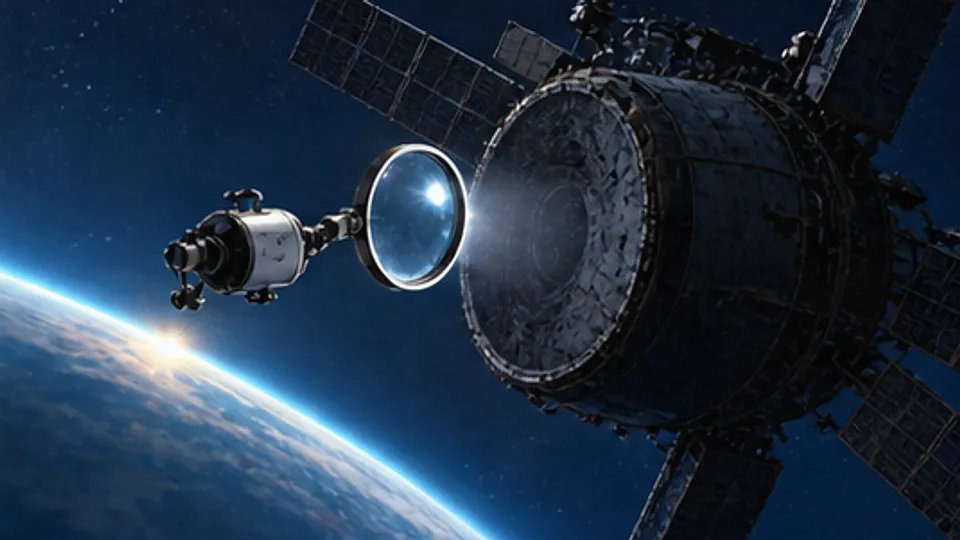
The spacecraft now bound for orbit is the first full-sized Otter, a 660-pound (300-kilogram) vehicle, per GeekWire, slated to fly on the Transporter-18 rideshare mission. Its customer is NASA, which is paying Starfish $15 million under a Phase III Small Business Innovation Research contract for the Small Spacecraft Propulsion and Inspection Capability mission — SSPICY. It is the first time NASA has funded a commercial debris inspection mission. The Otter will close to within hundreds of meters of multiple defunct American satellites in low-Earth orbit, according to KeepTrack, and measure each one’s spin rate, spin axis and surface condition — the particulars you would want in hand before ever trying to touch one.
Bennett is careful about the mission’s scope. “All of these will be inspections to start,” he said of SSPICY. “But then there will be an opportunity for us to use the remaining life of Otter to do something more.”
Rehearsals, some luckier than others
After Otter Pup 1’s tumbling start, the demonstrations improved. Otter Pup 2, launched in 2025, has been flying in close proximity to a target spacecraft in low-Earth orbit and has approached to within one kilometer; if all goes well, a docking will follow in the coming months. Last summer, Starfish partnered with Impulse Space and used its software to fly the Mira spacecraft after that vehicle had finished its primary mission — a test of whether a single lightweight camera, paired with Starfish’s closed-loop guidance, navigation and control software, could autonomously rendezvous with another spacecraft. It could. It did.
Five more Otters are already in production, bound for missions meant to showcase docking, de-orbit and life-extension capabilities. But the NASA flight is the first impression, and there is only one of those. Bennett said he is nervous and excited.
There is always a tension that comes with seeing the first of anything fly, right? The other part of this is huge amounts of excitement. I think the excitement comes because this is a new kind of capability that’s finding its way to orbit.
“This is a moment to celebrate getting here and affording us this opportunity to go do something big,” he added. Somewhere in flight heritage, the spacecraft that was once thrown into orbit spinning at 330 degrees per second has a successor whose paying work now begins with reading, calmly and at close range, exactly how fast the dead ones spin.