
A merger of SpaceX and Tesla would combine about $2.0 trillion of SpaceX’s market value with roughly $1.5 trillion of Tesla’s — together, close to $3.5 trillion at Tuesday’s closing prices, by Fortune’s count. On SpaceX’s third-quarter earnings call that same day, Elon Musk, chief executive of both companies, was asked directly whether combining them made sense. “Do I think it would be a good idea? Yes,” he said, as Ars Technica reported from the call. Then came the qualifier that matters more than the yes: “at the end of the day the shareholders have to be supportive of this.”
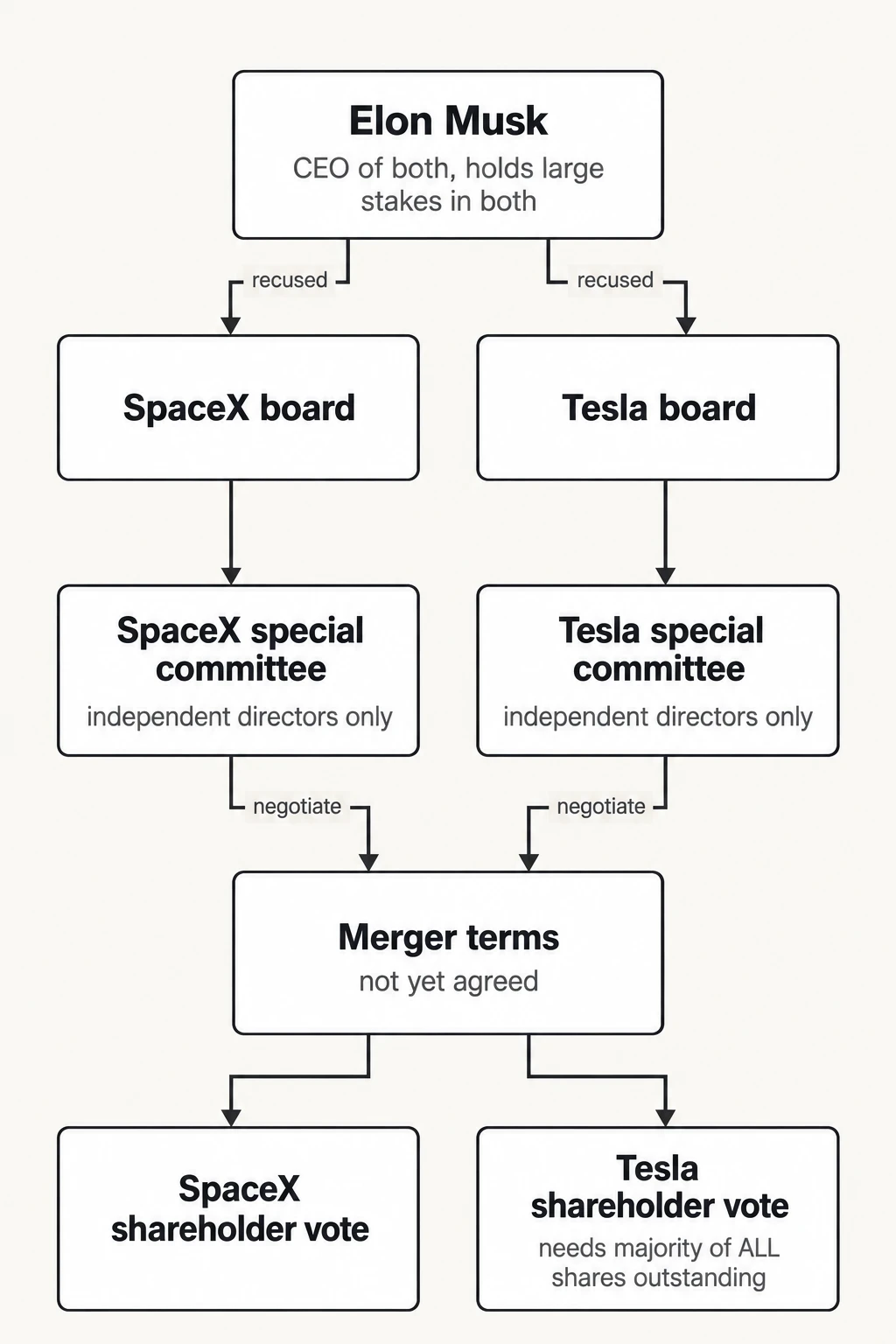
“Supportive” has a specific mechanism behind it. Each board has formed a special committee made up only of independent directors — board members with no executive role or controlling stake in either company — to negotiate and sign off on any deal terms. Musk, who runs both companies and holds large stakes in both, is excluded from those talks by design. SpaceX lists six independent directors; Tesla has seven, one of whom, Ira Ehrenpreis, sits on both boards and chairs committees at each, according to TechCrunch’s review of the companies’ filings. Musk called the arrangement “an odd kabuki dance where two groups of people are talking and I can’t be in the conversation.” The committees “have not reached agreement on the terms of any transaction,” he said, “and obviously there’s no guarantee that they will.”
| From | To | How |
|---|---|---|
| Elon Musk (CEO of both, holds large stakes in both) | SpaceX board | recused |
| Elon Musk (CEO of both, holds large stakes in both) | Tesla board | recused |
| SpaceX board | SpaceX special committee (independent directors only) | |
| Tesla board | Tesla special committee (independent directors only) | |
| SpaceX special committee (independent directors only) | Merger terms (not yet agreed) | negotiate |
| Tesla special committee (independent directors only) | Merger terms (not yet agreed) | negotiate |
| Merger terms (not yet agreed) | SpaceX shareholder vote | |
| Merger terms (not yet agreed) | Tesla shareholder vote (needs majority of ALL shares outstanding) |
Based on Musk's remarks on SpaceX's Q3 2026 earnings call and Tesla's October 19 proxy filing
This is Musk’s third move this year to fold pieces of his companies into each other. In February, SpaceX acquired his AI startup xAI in an all-stock deal that valued SpaceX at $1 trillion and xAI at $250 billion — a combined $1.25 trillion, with every xAI share converted into 0.1433 SpaceX shares. In June, SpaceX itself went public, raising $75 billion in what became the largest IPO on record, pricing the company at $1.77 trillion and closing its first trading day near $2.1 trillion — enough to make Musk, briefly and on paper, the world’s first trillionaire. This month came the pledge of one SpaceX share to every American child, which Musk has priced at $10.6 billion if the stock holds its value. And Starlink, the business that would anchor the “connectivity” piece of any merger, had its own quarter under scrutiny, as this week’s earnings showed.
The business Musk wants to combine
SpaceX’s own numbers explain some of the urgency behind the “good idea.” Third-quarter revenue reached $14.6 billion, up 161 percent from a year earlier; net income was $4.4 billion, a swing of $5.5 billion from the $1.1 billion net loss booked a year earlier, and adjusted EBITDA rose 306 percent to $8.8 billion, according to the company’s earnings call transcript. The unit Musk calls “Super Intelligence” — compute services and infrastructure, including the coding tool Cursor — generated $7.6 billion, against $813 million a year earlier, a 9.3-fold increase that pushed AI to 52 percent of total revenue. Launch revenue grew a comparatively modest 6 percent year-over-year, to $1.8 billion; Starlink-branded Connectivity revenue rose 69 percent, to $5.2 billion.
What a merger would actually add
Musk’s list of merger synergies on the call ran through “superintelligence software, chip design, the Terafab, ... robotics, mass to orbit with the Starmind constellation, and connectivity.” Several of those don’t need a corporate merger to happen, because they’re already happening: Tesla and SpaceX set up Terafab as a joint venture back in March, Musk told analysts on Tesla’s own July earnings call, the same call on which he said “we can’t talk about combining companies and that kind of thing on an earnings call.” Terafab is a chip-fabrication project planned for a former power-plant site in Grimes County, Texas, with spending across all its phases projected to reach $119 billion according to county filings, $16.8 billion of it committed to the first construction phase in August, per Wikipedia’s sourced account of the project. At full scale the plan calls for up to 100 million square feet of fab space, a million wafer starts a month, and more than a terawatt of AI compute capacity produced annually — “Terafab will ultimately,” Musk said on Tuesday, “make a terawatt of superintelligence chips per year.” Intel joined the project in April to contribute manufacturing expertise, and the site is slated to run on on-site natural gas and batteries rather than Tesla’s own solar panels. Musk put volume production at “around Q3 of ’28” — “insanely fast timeframes,” in his words, for a fab that breaks ground this winter.
Starmind, the satellite constellation meant to run AI workloads in orbit, is earlier-stage: SpaceX showed a first-generation design called AI1 in June and told analysts Tuesday to expect an on-orbit refueling test early next year, with the first Starmind satellites flying in 2027. None of that needs Tesla’s name on the certificate either. What a legal merger buys, that a joint venture doesn’t, is one cap table instead of two — and one set of financing decisions instead of two boards negotiating who pays for what.
The vote that actually decides it
That’s where the mechanics get harder for Musk, not easier. A merger needs Tesla shareholders to approve it with a majority of all outstanding shares, not simply a majority of votes cast — a bar Musk himself called “quite a high hurdle,” as Fortune reported. Tesla must hold its annual meeting by December 6 under SEC rules, and Barclays analyst Dan Levy has flagged that date as the natural venue for a shareholder vote, meaning an announcement would need to land by late October or early November to make the deadline, Barclays told clients. Musk’s own stake cuts unevenly across the two companies: he holds roughly 20 percent of Tesla’s equity but, thanks to SpaceX’s dual-class structure, somewhere between 82 and 85 percent of SpaceX’s voting power on about 48 percent of its economic value, per SpaceX’s own IPO disclosures. Levy estimates that in an all-stock deal, with SpaceX likely structured as the formal buyer, Musk would end up holding about 37 percent of the combined company’s economic value and 56 percent of its votes.
Levy’s note also points at the financing logic behind “a lot of merit”: Bloomberg’s consensus estimates, cited by Barclays, put Tesla’s 2030 free cash flow at a positive $12 billion and SpaceX’s at a negative $17 billion in the same year. Combining the two would let Tesla’s cash fund SpaceX’s chip and satellite buildout directly, instead of through separate capital raises — good news for SpaceX’s financing, an open question for what it leaves Tesla shareholders.
Not every analyst is convinced the market caps underpinning that $3.5 trillion figure are solid to begin with. CFRA Research’s Keith Snyder rated SpaceX a sell after the June IPO, with a 12-month price target of $115 a share — roughly a third below where the stock traded on Tuesday — telling CNBC he remained skeptical SpaceX was worth $1.77 trillion in the first place, before any merger premium gets layered on top.
Tesla reports its own third-quarter results Wednesday evening, hours after SpaceX’s call, with no SpaceX shareholders in the room to prompt an answer this time. Barclays’ timeline gives the two special committees until early November to agree on terms if a vote is to make Tesla’s December 6 annual meeting; miss it, and Levy’s note says the deal isn’t dead, just pushed six to twelve months out — roughly the same runway Terafab’s Grimes County site has left before its own 2028 completion target.