
On 12 and 13 November a large share of the world’s office work simply stopped. Teams, Outlook, Copilot and other Microsoft products were offline for about 24 hours, according to Reuters, which broke the story of the company’s internal response. Governments were hit, from Australia and Japan to the United States. Trading firms were delayed. Airline communications were disrupted. Nobody fired a shot and nobody broke in. Microsoft says no cyberattack or malicious activity was involved.
Big companies don’t usually narrate their own collapses, and this account did not come from a press release. It came from memos. Reuters reviewed them, and Nick Indge, writing for Ars Technica, set out what they show: a company that declared a Code Red, admitted it had lost sight of itself in the middle of the crisis, and then promised to do better within an hour.
Eleven rooms
The phrase belongs to Amanda Silver, the corporate vice president who oversees Microsoft 365 Core and Work IQ. She wrote that engineers had to contend with a “fog of war” while the outage was unfolding. Her memo, dated Monday 23 November, puts numbers on that fog. The people responding sent more than 11,000 messages across 11 separate Teams chats. Diagnostic data ended up scattered among them, and no single place held a full view of the incident.

Eleven thousand messages. Eleven rooms. No map.
The irony needs no help. Teams was one of the products customers lost, and Teams is where, according to the memo, the responders split into separate camps. A failure inside a system tends to repeat itself inside the organisation that runs it. When the machine fragments, the people tending it fragment too, each group holding its own piece of the evidence, each chat its own small republic of theories.
A decade of tolerance
The most revealing line in the memos is not Silver’s own. She quotes Charles Lamanna, executive vice president of Copilot, Agents and Platform, telling a Code Red review that the affected component had accumulated “roughly ten years’ worth of acceptable failures.”
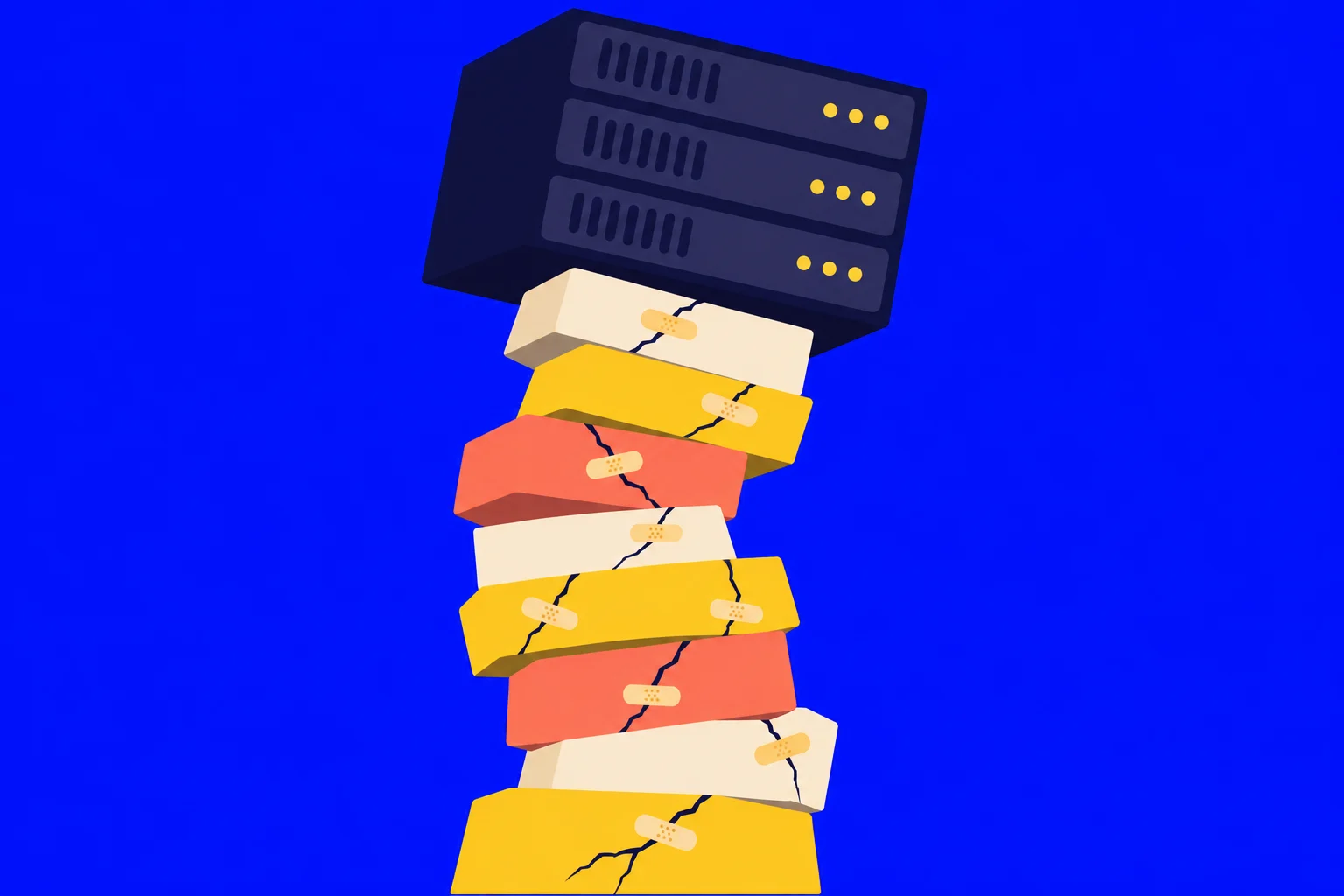
It is worth slowing down over that sentence. Every institution keeps a category of breakage it has agreed to live with: the small fault that gets logged, the outage short enough to forget. Each one on its own is reasonable. Ten years of them make a history, and that history comes due without warning on an ordinary Thursday in November. What makes a failure “acceptable” is rarely the failure. It is the calculation of the people deciding whether to pay for a fix.
Microsoft’s official explanation is more specific. The company has blamed a scalability bug in Windows, introduced in July, that went undetected for months. That followed earlier attention on how automated health checks deepened the damage. The company says the defects were not caused by AI tooling. According to The Next Web’s summary of the Reuters report, the memos also describe a separate recent incident in which an urgent production fix took five to six days to reach every part of the world.
The decree
The response came from the top of the hierarchy, in the form such responses usually take. In a Friday memo to staff, Jason Henderson, president of M365 Core, called the event the most customer-impacting incident in the history of Exchange Online, Reuters reported, and said the Code Red designation made fixing the problems the team’s highest priority. Henderson said he would hold daily meetings with the Substrate leadership team, the group that oversees the engineering teams responsible for Microsoft 365 services, along with weekly reviews.
Silver’s memo sets out five workstreams. They cover load shedding, which means deliberately dropping some traffic so the whole system doesn’t fall over, along with partitioning traffic by geography and building faster recovery mechanisms. Reuters reported that Microsoft also plans to deploy its own AI agents to help engineers read system health data more quickly, so that incidents are diagnosed and patches shipped sooner.

There is a certain symmetry here. The company insists AI did not cause the defects, and it is offering AI as part of the cure. The scattered data that 11 chats couldn’t assemble is to be handed to agents that, presumably, will not need to argue in 11 rooms. Whether that works is a question for the next outage. The memos can’t answer it.
One hour
Then come the targets. Microsoft has set a goal of resolving major incidents worldwide within one hour, and a one-hour deployment window for urgent security fixes.
Set those numbers against the record. The outage lasted roughly 24 hours. A recent urgent fix took five to six days to roll out globally. The new standard asks for a speed-up of about twenty-four times in the first case, and more than a hundred times in the second.
The company hasn’t said when it expects to meet either target. Nor has it explained how the next response will avoid splitting across 11 Teams chats, or how its engineers will see through the next fog of war. The memos put the clock at one hour. They don’t say when it starts running.