

At the worst point of last week’s Microsoft 365 outage, more than 80% of the servers in Microsoft’s networking gateway stopped responding. The gateway is the front door for Exchange Online, Teams, SharePoint, Copilot and most of the rest of Microsoft 365: every login, every mail fetch, every chat message passes through it before it reaches the service that actually does the work. Microsoft’s own preliminary post-incident report (PIR), published November 15 and covered by Ars Technica, says the trigger was a defect that had been sitting in that gateway’s code since July — invisible for roughly four months, or 104 to 134 days depending on exactly when in July the change shipped, according to FourWeekMBA’s reading of Microsoft’s timeline.
Microsoft runs two independent, differently-built gateway systems in parallel for exactly this reason: if one has trouble, traffic fails over to the other rather than queuing behind a dead front door. The bug lived in a fix that had been prepared specifically for the gateway’s Windows-based connection handling. Under certain load patterns, the fix caused lock contention — multiple processes fighting over the same resource and blocking each other — which could exhaust a server’s CPU and memory and leave it unable to accept new connections. Microsoft’s pre-release testing never caught it because that testing ran on hardware with fewer CPU cores than much of what was already in production; the contention problem gets worse, not better, as core counts rise, so the newer, more powerful machines in the live fleet were the ones that broke.

Three failures, stacked
A single latent bug rarely takes down a system this size on its own; it needs something to wake it up. Microsoft’s report, reproduced in full by Office Watch after the company put it behind an admin-only login, lists two more factors that converged with the code defect. First, roughly 14% of the networking gateway’s server capacity was already out of service on November 12, for an unrelated problem dating to the previous day. Second, at 01:07 UTC that same morning — about fifteen hours before the outage began — Teams traffic was automatically failed over from its alternate gateway onto the primary gateway that also carries Exchange Online, as part of routine maintenance. That shift changed both the volume and the mix of requests hitting the primary gateway, and gave the dormant bug the load pattern it needed to trigger.
The anomaly first showed up in Microsoft’s monitoring at 4:03pm UTC on November 12; a high-priority alert followed seventeen minutes later, opening the incident under case number EX1550543 and, two hours later, the broader MO1550821 for every service downstream of the gateway. Microsoft paused all deployments at 7:00pm and spent the next five and a half hours trying to isolate the failure by region. It didn’t work.
Microsoft’s gateway fleet is organized into thousands of capacity units grouped by region, with isolation boundaries — bulkheads, in the report’s language — meant to stop a failure in one partition from spreading to the rest. In this incident, a separate problem meant those bulkheads didn’t hold. As the overloaded servers in the shared gateway started failing, their traffic shifted onto the servers that remained, raising those servers’ load in turn and spreading the same CPU-and-memory exhaustion across the fleet. Microsoft 365 engineering chief Charles Lamanna, posting an abridged version of the PIR on X, put the arithmetic simply: the same total load, spread across fewer and fewer healthy servers, pushed more than 80% of the fleet into an unresponsive state in under two hours.
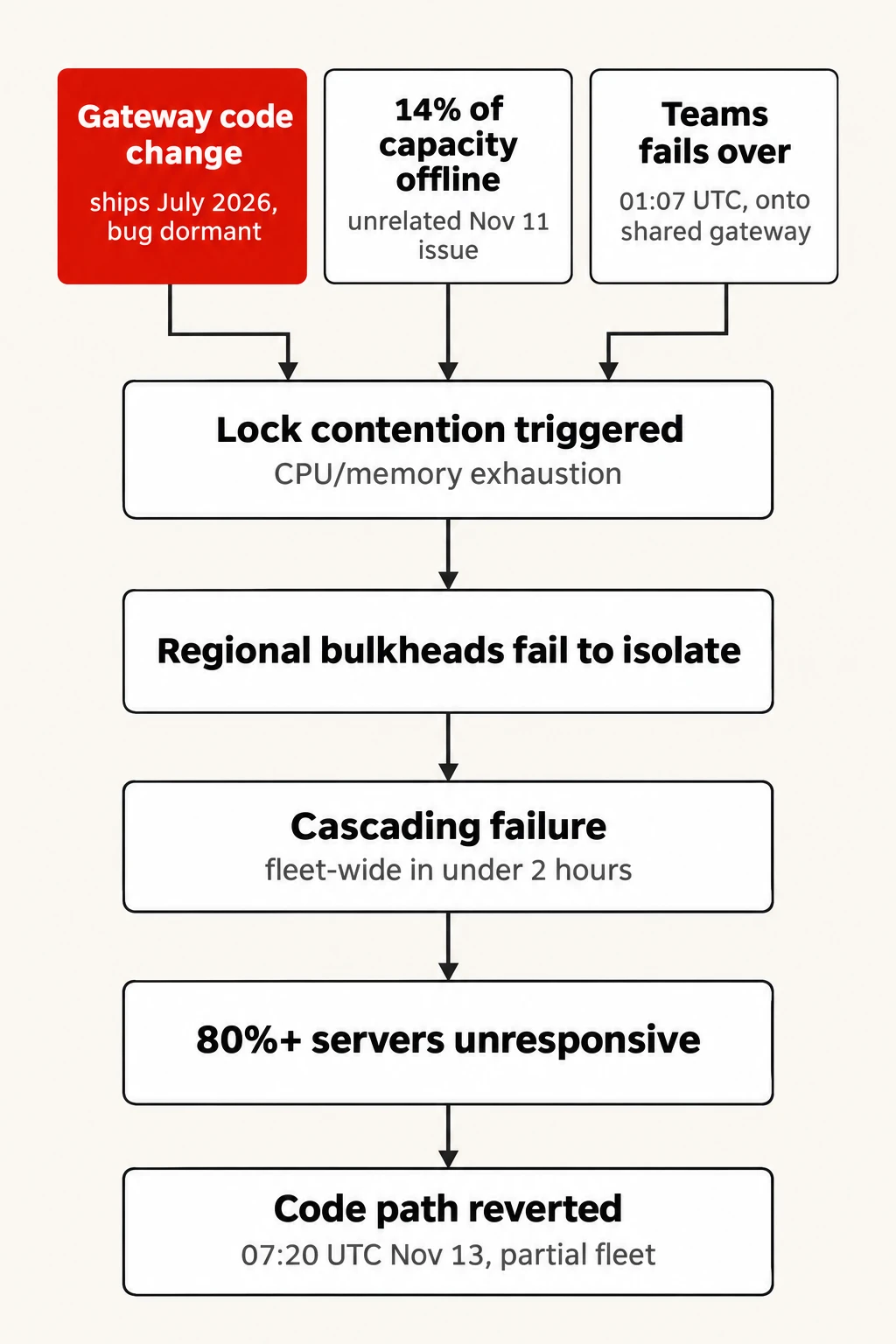
| From | To | How |
|---|---|---|
| Gateway code change (ships July 2026, bug dormant) | Lock contention triggered (CPU/memory exhaustion) | |
| 14% of capacity offline (unrelated Nov 11 issue) | Lock contention triggered (CPU/memory exhaustion) | |
| Teams fails over (01:07 UTC, onto shared gateway) | Lock contention triggered (CPU/memory exhaustion) | |
| Lock contention triggered (CPU/memory exhaustion) | Regional bulkheads fail to isolate | |
| Regional bulkheads fail to isolate | Cascading failure (fleet-wide in under 2 hours) | |
| Cascading failure (fleet-wide in under 2 hours) | 80%+ servers unresponsive | |
| 80%+ servers unresponsive | Code path reverted (07:20 UTC Nov 13, partial fleet) |
Based on Microsoft preliminary PIR, via Office Watch and Ars Technica
Microsoft identified “connection negotiation” as the specific failure point at 12:30am UTC on November 13, and deployed a fix seven hours later, at 7:20am, that reverted the connection-handling code path to its prior known-good state — on part of the fleet first, then progressively wider. Asia-Pacific recovered by 11:00am; Europe reported healthy by 11:35am; global webmail availability returned to expected levels by 2:17pm. Microsoft’s report puts the formal end of customer impact at 4:10pm UTC on November 13, with final status updates issued after extended monitoring at 4:15am on November 14. Lamanna’s thread explains why the fix took as long as it did: because the defect had been live for months rather than hours, “our normal rollback, flighting, and feature flags were unable to quickly revert the change” — the standard tools for undoing a bad deployment assume the deployment is recent.
A different outage, a day earlier
The explanation Microsoft settled on is not the one that circulated while the outage was still live. Status-dashboard entries examined by outlets reporting in real time, including an earlier account of this same incident, put the start of impact at 10:05am UTC on November 12 rather than the 4:20pm the final PIR uses, and described the mechanism as a feedback loop in Microsoft’s automated server health checks: servers failing those checks were pulled from rotation, their traffic shifted to the survivors, those survivors then failed the same checks under the added load, and so on. That reading produced a headline duration near 30 hours. The PIR’s own window — 16:20 UTC November 12 to 16:10 UTC November 13 — is 23 hours and 50 minutes, measured from the first high-priority alert rather than from whenever customers first noticed something was wrong. Health checks removing overloaded servers from service is consistent with, and probably a symptom of, the cascading failure the PIR describes; it was a mechanism inside the collapse, not its cause. The root cause Microsoft now points to — a four-month-old lock-contention bug exposed by a routine Teams failover — never appeared in the outage’s first 72 hours of public reporting, because it was sitting in a dashboard behind admin-only credentials that most people covering the story in real time did not have.

The practical cost of the gap between the live narrative and the engineered one showed up away from any dashboard. At the Ling Bao hotel inside the Phantasialand theme park in Brühl, Germany, an automated pool-chemical monitor is designed to email staff when chlorine levels drift outside a safe range; with the email system down, no one saw the alert. Guests started reporting respiratory irritation, and German emergency services sent 40 first responders; 15 people were ultimately affected and four were taken to hospital, according to TechRadar’s report of Phantasialand’s statement to German broadcaster WDR. A cybersecurity architect quoted in that reporting, Stephan Skrobisch, argued the fault there sits with the park’s design, not with Microsoft: a safety system with no local fallback when its single notification channel is a cloud email account.
Microsoft’s report classifies the incident, finally, as “a technical issue not related to cyber or AI/agents” — a line that reads less like analysis and more like a company anticipating where blame would otherwise land. The fixes listed as already completed are generic for this class of failure: added gateway capacity, new monitoring for traffic-redirection patterns, and unspecified “guardrails for traffic distribution to avoid cascading impact.” None of them says how Microsoft will keep its regional bulkheads from failing the next time a routine failover meets a bug that pre-release testing was built to miss. The comprehensive repair-item list, and whatever Microsoft says about the bulkhead design specifically, is due in the final PIR on November 20.