
Mexico’s federal attorney general’s office, the Fiscalía General de la República (FGR), charged former Chihuahua state prosecutor César Jáuregui Moreno with treason on October 21. He is the first person in living memory to face trial on the charge, traición a la patria: Mexican officials and legal scholars trace the last widely recognized conviction to 1867, when Benito Juárez’s government executed the Habsburg emperor Maximilian for ruling the country under French backing. The treason charge against Jáuregui carries a sentence of 5 to 40 years under Article 123 of the Federal Penal Code, plus a fine of up to 50,000 pesos (about $2,600), as the Código Penal Federal text sets out.
The case, first reported as a state-level arrest, turns on a single question of jurisdiction: who gets to authorize foreign agents operating on Mexican soil. Mexico’s National Security Law reserves that power to the federal executive. Jáuregui, the FGR alleges, let two US agents take part in a Mexican law-enforcement operation without clearing it with Mexico City, then told federal authorities about it late and incompletely.
The crash that exposed the raid
The operation itself happened on April 19, 2026, against a clandestine drug lab at El Pinal, in the municipality of Morelos, in Chihuahua’s Sierra Tarahumara. On the way down from the mountains, a vehicle in the convoy went off the road and into a ravine. Four people died: Pedro Oseguera Cervantes, director of Chihuahua’s state investigation agency, his bodyguard Manuel Genaro Méndez Montes, and two US nationals. Washington confirmed in April that two employees of its Mexico City embassy had died, without naming their agency; anonymous sources told reporters the two, identified as John Dudley Black and Richard Leiter Johnston, were CIA officers. The US government has not confirmed that identification on the record.
Jáuregui resigned on April 27, eight days after the crash, acknowledging what he called “omissions” in how the operation’s communication and institutional oversight had been handled, as CNN en Español reported. He stayed free for nearly six months after that. Infobae has reported that, according to the FGR’s investigation, US personnel had been involved in the activities of Chihuahua’s state investigation agency since October 2025, which would put the unauthorized cooperation at six months rather than a single raid.
The federal case moved in stages once it moved. A federal judge issued an arrest warrant on October 17 after what attorney general Ernestina Godoy described as more than 100 separate investigative acts, desk and field combined. Chihuahua’s own state prosecutors opened a parallel case the same weekend, detaining Jáuregui on local charges of unlawful exercise of public office and collusion. He was transferred to the federal Altiplano prison on October 19. On October 21, after a closed hearing lasting more than ten hours, a judge ordered him held in pretrial detention on the federal treason count, Infobae reported. The next hearing is set for October 24.
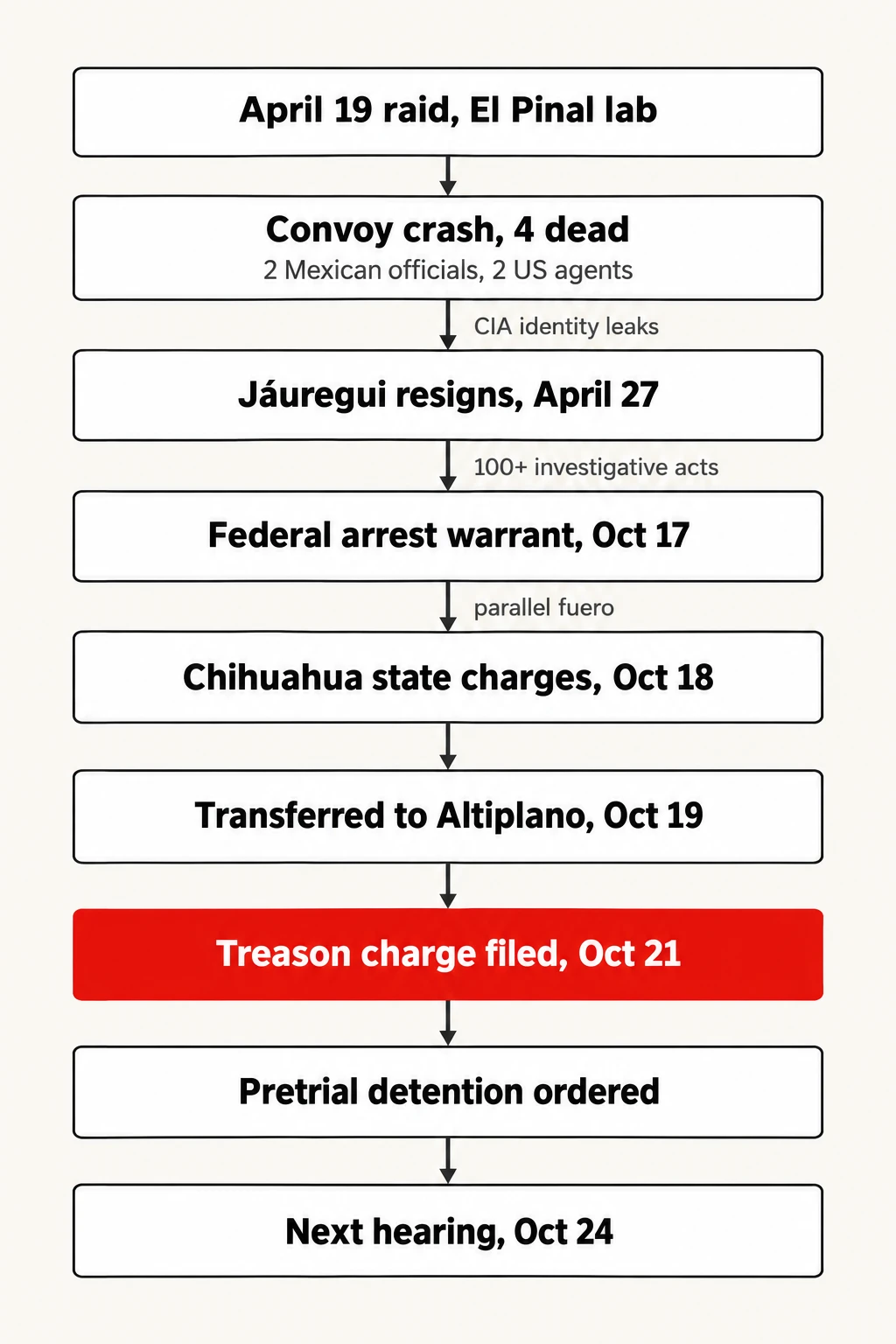
| From | To | How |
|---|---|---|
| April 19 raid, El Pinal lab | Convoy crash, 4 dead (2 Mexican officials, 2 US agents) | |
| Convoy crash, 4 dead (2 Mexican officials, 2 US agents) | Jáuregui resigns, April 27 | CIA identity leaks |
| Jáuregui resigns, April 27 | Federal arrest warrant, Oct 17 | 100+ investigative acts |
| Federal arrest warrant, Oct 17 | Chihuahua state charges, Oct 18 | parallel fuero |
| Chihuahua state charges, Oct 18 | Transferred to Altiplano, Oct 19 | |
| Transferred to Altiplano, Oct 19 | Treason charge filed, Oct 21 | |
| Treason charge filed, Oct 21 | Pretrial detention ordered | |
| Pretrial detention ordered | Next hearing, Oct 24 |
Based on FGR, Fiscalía de Chihuahua, CNN en Español, Infobae

What the statute actually requires
Article 123 of the Federal Penal Code does not define treason as a single act. It lists discrete conducts, each with its own penalty, under the chapter heading “crimes against the security of the nation.” The core clause, fracción I, covers acts against Mexico’s independence, sovereignty or territorial integrity undertaken with the aim of subjecting the country to a foreign person, group or government. Other clauses in the same article cover taking up arms for a foreign power, handing a person over to foreign authorities without legal process, or supplying a foreign government with the means to invade Mexican territory. Godoy’s office has placed Jáuregui’s conduct under the sovereignty clause, framing his alleged failure to clear the operation with federal authorities, and his decision to inform foreign personnel instead, as acts that “atentan contra la soberanía y la integridad de la nación” — attack the sovereignty and integrity of the nation, as Godoy said in a statement circulated by López-Dóriga’s outlet.
That is a stretch from the clause’s plain text, according to legal scholars interviewed about the case. Baldomero Mendoza, a criminal-law professor affiliated with UNAM and the Inacipe, the public prosecutors’ training institute, told El Universal that permitting foreign agents onto Mexican territory without authorization does not by itself meet the standard: prosecutors would need to show the agents’ structural ties to a foreign armed force and an intent to wage war on Mexico or subject it to foreign rule, as El Imparcial reported. Nothing in the public record of the case describes the CIA officers as part of a military unit or alleges any plan to invade or subordinate Mexican territory. Mendoza’s reading, if a court adopts it, would make the treason count hard to sustain on the facts as the FGR has stated them so far.
Jáuregui’s lawyer, Héctor Villasana, went further at an October 21 press conference in Chihuahua’s state capital, arguing that no single video, log or piece of physical evidence establishes that CIA personnel operated on Mexican soil at all, according to El Universal. That claim sits awkwardly next to the FGR’s own account of the April crash, in which two of the four dead have been identified by name as US nationals, and next to the more than 100 investigative acts Godoy says her office conducted before seeking the arrest warrant. Neither side has released the underlying evidence; the October 21 hearing was closed on national-security grounds.
A charge aimed past one prosecutor
Reuters reported that Matias Gomez Leautaud, an analyst at Eurasia Group, reads the charge as aimed at a broader audience than Jáuregui: it seeks to set a precedent and prevent cooperation between Mexican states and the US government without the federal government’s coordination and approval. The target isn’t limited to the man standing in for it. Under President Claudia Sheinbaum, whose government has otherwise kept up security cooperation with Washington, the message to state and local officials is that bypassing federal clearance for US operations now carries criminal exposure measured in decades, not just a resignation.
Sheinbaum has also declined to treat Jáuregui’s arrest as the end of the matter. Asked whether the investigation reaches Chihuahua’s governor, Maru Campos, a member of the opposition PAN party as Jáuregui is, Sheinbaum said it is not her place to exonerate anyone, leaving open whether the FGR’s inquiry extends up the state’s chain of command. Campos has publicly backed her former prosecutor’s detention.
Two unresolved facts will decide whether the treason count survives arraignment rather than being reduced to the lesser state charges Jáuregui already faces. One is whether the FGR can tie the two dead Americans to a US government agency on the record, something Washington has not confirmed and Jáuregui’s own lawyer now disputes outright. The other is whether a Mexican court accepts Godoy’s reading of fracción I as covering an unauthorized but apparently cooperative drone-training exercise, rather than the war-making or invasion scenarios the clause was written for in 1970. A ruling either way will tell state prosecutors across Mexico, not just in Chihuahua, how far federal law actually reaches into their dealings with American counterparts.