
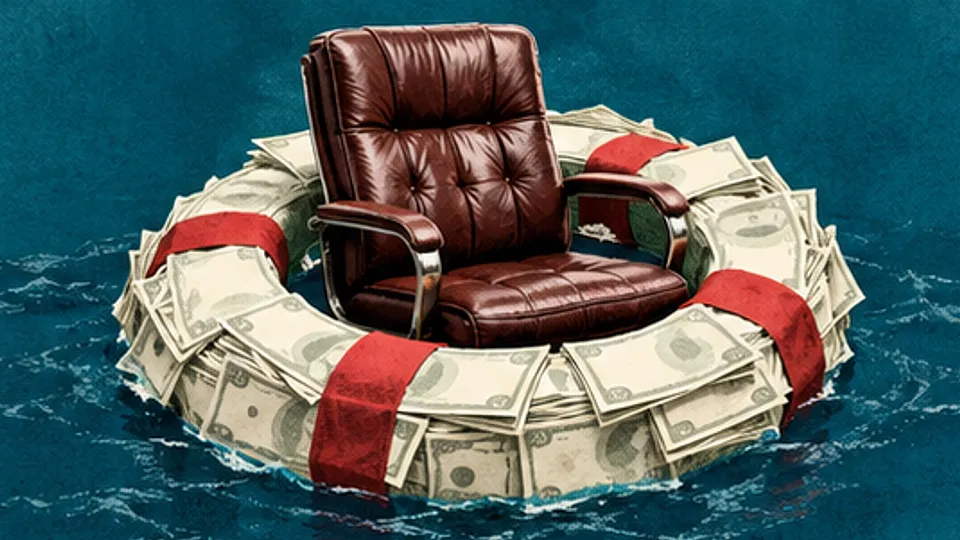
When a billionaire buys a big news organization, there are two basic ways to signal that you intend to leave it alone. The expensive way is to actually leave it alone, forever, even when it publishes things that annoy you or annoy the president you had dinner with. The cheap way is to keep the editor. Keeping the editor costs roughly nothing, and it lets everyone involved say, look, the editor is still there. If we were going to ruin the place, would the editor still be there?
David Ellison has kept the editor. Business Insider’s James Faris reports that Mark Thompson is staying on at CNN — now with the title chairman and editor-in-chief — as Paramount Skydance’s roughly $110 billion takeover of Warner Bros. Discovery, CNN’s parent, closed on Tuesday. The combined company is called Skydance, and it now holds two movie studios, HBO, HBO Max, Paramount+, Pluto TV, CBS, CNN and a long list of cable channels. Thompson, who has run CNN since October 2023 after earlier stints running the BBC and The New York Times Co., sent staffers a memo that is a small masterpiece of the genre. “I’m convinced that from David Ellison on down, Paramount Skydance leadership really does believe in news alongside entertainment as a top strategic opportunity for our new company,” he wrote, adding that he has “real confidence” the new owners “will fully support the principle and practice of the kind of independent news that CNN has always stood for.”
The key phrase in the memo is quieter. Thompson wrote that he will lead CNN “as an independent Editor-in-Chief with the same responsibilities and prerogatives that I have now.” That is the entire negotiation in one line: he stays, but only as a going concern, not as a figurehead on someone else’s news. He also conceded the obvious — “I’ve had the odd moment or two myself!” — which is as close as a chairman’s memo gets to saying yes, I also read the newspapers.
The newspapers, it must be said, gave people reasons. As Brian Stelter laid it out for CNN, Donald Trump said last December that “it’s imperative that CNN be sold,” and his allies cheerfully treated the ownership change as a tuning fork for coverage; Defense Secretary Pete Hegseth said last March that “the sooner David Ellison takes over that network, the better.” Trump, Hegseth and other officials dined off the record with David Ellison and Paramount leadership in April, and the Justice Department green-lit the merger in June despite misgivings from career staffers, according to the Journal. Larry Ellison, David’s father and one of the richest men alive, is a longtime Trump ally. Meanwhile the actual on-the-ground precedent is CBS News, where Ellison bought The Free Press for about $150 million and installed co-founder Bari Weiss — who had never worked in TV news — as editor-in-chief last October. Several ousted correspondents accused Weiss of interfering with their work, which she denied; key newscasts have struggled in the ratings, though CNN notes Weiss’s shop has also notched reporting wins, including hard-hitting stories about the Trump administration. Weiss stays in her job too, and CNN and CBS News will operate separately, at least for now. Thompson had already told staffers at a September town hall not to “jump to conclusions that we become one with CBS News,” and he’d also said he wanted to stay “if the circumstances are right” — hedging that, in retrospect, was doing a lot of work.
Then there is the part where independence is not a vibe but a legal document, which is my favorite part. Twelve states sued to block the deal, and in July, as Ars Technica’s Jon Brodkin recounts, US District Judge Araceli Martínez-Olguín ruled that the combination would likely substantially reduce competition. California settled anyway, and on September 30 the judge approved the settlement as “a reasonable factual and legal resolution,” while conceding it may “leave some dissatisfaction for both sides and the public.” A coalition of free-speech and media advocacy groups had urged her to reject it, saying it gave the states’ residents “virtually nothing.” A last-ditch effort to stop the deal failed when Supreme Court Justice Elena Kagan declined to block it, and the merger closed.
What the states did get, editorially speaking, is a board. The September 21 settlement creates a five-member editorial independence board covering both CNN and CBS News, meant to uphold editorial standards and resolve disputes; Paramount says it will report to the corporate board through the chief compliance officer. Skydance has not appointed the members yet and has six months to do so. You can read this two ways. The cynical reading is that an editorial board routed through a compliance department is an unusual amount of plumbing to protect a thing the owner keeps insisting he was never going to touch. The generous reading is that the whole point of constraining a private company that bought its way past antitrust review is to make the promise legible and enforceable rather than vibes-based. A plaintiff’s lawyer gets a hook if the promises turn out to be decorative. Which reading is right depends on who the five members are, and on whether anyone ever hears from the board when nobody’s watching.
The rest of the org chart, per CNBC’s Maggie Roth, is a genuine two-company merger: HBO’s Casey Bloys runs content for streaming, former Paramount co-CEO George Cheeks runs content for TV, WBD’s JB Perrette co-chairs both on the business side, and Paramount pair Dana Goldberg and Josh Greenstein oversee film, with James Gunn and Peter Safran keeping DC Studios. Thompson reports to Ellison and to co-CEO Ynon Kreiz, the former Mattel boss brought in to run integration and day-to-day operations — a man with a reputation, as we’ve noted before, for finding the savings.
And savings will be found, because the arithmetic insists. In his own memo to staff, again obtained by Business Insider, Ellison wrote “we did it!” and laid out the numbers: close to $70 billion in revenue, $6 billion in merger savings, and about $80 billion in debt. Eighty billion of debt is a strong argument for cost cuts, and also, interestingly, a strong argument for not wrecking CNN. The combined company needs the cash flow from profitable channels like CNN to fund the restructuring, and a news network’s cash flow rests substantially on the thing everyone spent the last year worrying about. Meanwhile the hole Skydance is digging out of is real: Nielsen put Paramount and WBD’s combined share of US TV streaming at 3.6% in July, against 4.7% for Disney, 7.8% for Netflix and 14.2% for YouTube. Among Ellison’s four stated priorities is “Earn Trust Every Day,” capital letters in the original, which is a fine slogan and also a fair description of the deal he has made: the trust is not banked, it is rented, and the rent comes due daily.
Anyway
The last time this deal cleared a courtroom, we noted the judge called it a compromise that saves everyone a trial. The newsroom version of that compromise is now in place: the editor keeps his prerogatives, the owner keeps his deniability, and five people yet to be named get to referee the difference. Everyone involved has agreed not to find out what happens next until it happens.