
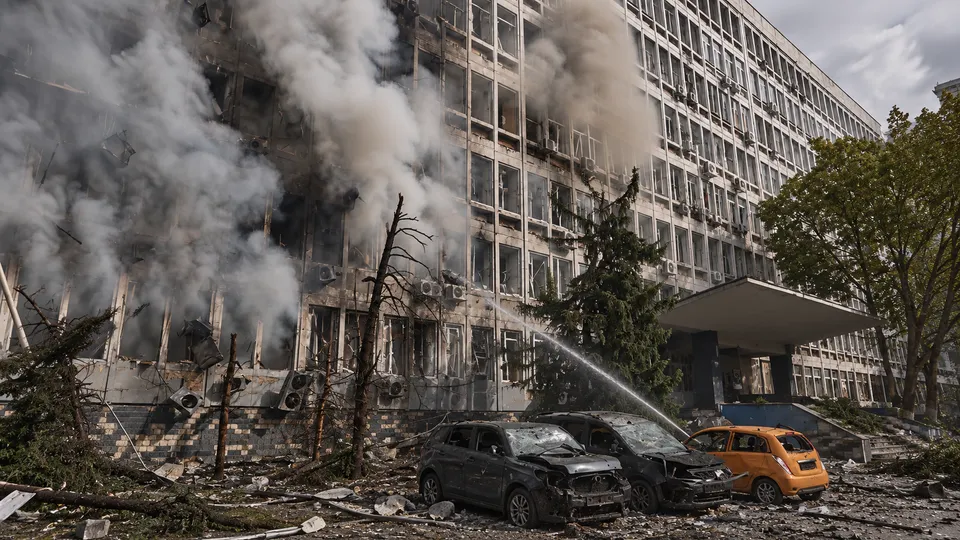
For most of its history this war has been fought over things a person can stand on: a bridge, a village, a ridge above a river. Since 23 September it has also been fought over buildings that most people in Kyiv never enter and rarely think about, the data centres through which their bank transfers, their news and their telephone calls pass every minute of the day.
Writing in Ars Technica, Jeremy Hsu describes a surge in Russian strikes on these facilities by jet-powered drones, strikes that have increasingly cut mobile and internet service for thousands of people. President Volodymyr Zelenskyy and other officials are now warning that Ukraine needs more air defence. Their fear is that the outages could threaten the country’s digital economy and weaken its resistance to the invasion.
The campaign has centred on the capital since 23 September, according to Reporters Without Borders. Ukraine’s digital transformation ministry said the first strikes left 100,000 households in the Kyiv region temporarily without internet. Since then Russia has only widened its attacks on the large data centres and the mobile networks.
The press-freedom group has documented one case closely. According to RSF, the facility of COSMONOVA|NET, a Kyiv telecom and IT provider, was hit on 25 September, attacked again the following day, and then declared itself “offline”. The public broadcaster Suspilne reported that several video players on its website were “temporarily unavailable”, and later told RSF that “most of the resources and functions affected by the strike have already been restored”. RSF called the repeated attacks on civilian infrastructure war crimes that endanger the public’s access to reliable information. The Kyiv Independent reported that the strikes disrupted the work of several Ukrainian media outlets.
Many providers in a few days
Russia has hit Ukrainian communications before. Tetiana Gaviuk, ACLED’s analyst for Europe, put the difference this way in a post on 1 October:
“However, the recent concentrated attacks on Kyiv’s data centers and telecom networks stand out because multiple providers and facilities were hit within days, indicating Russia’s increased pressure on Ukraine’s digital infrastructure.”
Before that, she noted, strikes and shelling had damaged fibre-optic lines, cell towers and the facilities of mobile operators. Now the attacks are concentrated in one city and over a few days. Officials and industry figures quoted by The Guardian have warned that repeated hits could undermine the networks that banks, payment systems and public services depend on.
One reflection seems fair. A modern state no longer lives only in its ministries and barracks. It also runs through cables and server rooms, and an enemy who cannot take a city may try to make it go quiet.
The arithmetic of interception
The method has a history. Since the first year of the full-scale invasion in 2022, Russia has sent missiles and drones in large numbers against the power grid, railway stations, ports and apartment blocks. This year those strikes have done more damage, for two reasons. Ukraine’s stock of missile interceptors has run down, and Russia has turned many of its one-way attack drones into faster, jet-powered machines that are harder to bring down.
On 4 October Zelenskyy gave the figures. Ukrainian air defences stop more than 85 percent of the conventional Shahed-type drones, the Iranian design supplied to Russia. Against the newer jet-powered Shaheds the rate falls to 50 or 60 percent. Put another way, four or five of every ten get through. Those are the gaps in the sky that, as rews reported, the drones have been finding over Kyiv.
The other capital
The strikes now go both ways. On the night before 6 October Ukraine launched a large drone attack on Moscow, killing two people and setting a warehouse in the city on fire, Russian officials said, as Al Jazeera reported citing AFP and Reuters. Moscow’s mayor, Sergei Sobyanin, said 650 drones had been heading towards the city and that most were shot down. The same report also gave a different Russian figure: 290 drones aimed at Moscow and the surrounding regions. The two numbers do not agree, and no explanation for the gap was given. Both sides are stepping up long-range strikes on infrastructure before winter.
Darnytskyi, before dawn
The answer came the next night. Russia’s Defence Ministry said its forces had carried out a “massive strike” on Kyiv and other regions of Ukraine. Al Jazeera reported that at least two people were killed in the capital. Mayor Vitali Klitschko said they died in the densely populated Darnytskyi district, in a fire started by the overnight attack.
The Kyiv Independent reported that its journalists first heard several explosions at around 3:15 a.m. The city was hit by ballistic missiles and reportedly by Zircon missiles. Klitschko said missiles struck the Podilskyi, Obolonskyi, Darnytskyi and Shevchenkivskyi districts, and in Darnytskyi crews worked to make an unexploded ballistic missile safe. The attack fell on Vladimir Putin’s 74th birthday. Ukraine’s air defences were reported to have shot down 117 drones, five ballistic missiles and 39 cruise missiles.
The Oleksandr Dovzhenko National Film Studio was damaged again, Ukrinform reported. Outside the capital, the Kyiv Post counted 11 people killed by the overnight missile strikes across Ukraine, among them people in an apartment building that collapsed in Pryluky. These are early figures and may rise.
The day before, a Russian drone had killed a soldier’s wife at her Kyiv office. Data centres can switch to backup sites and broadcasters can bring their video players back online. The dead of Darnytskyi cannot be brought back.