
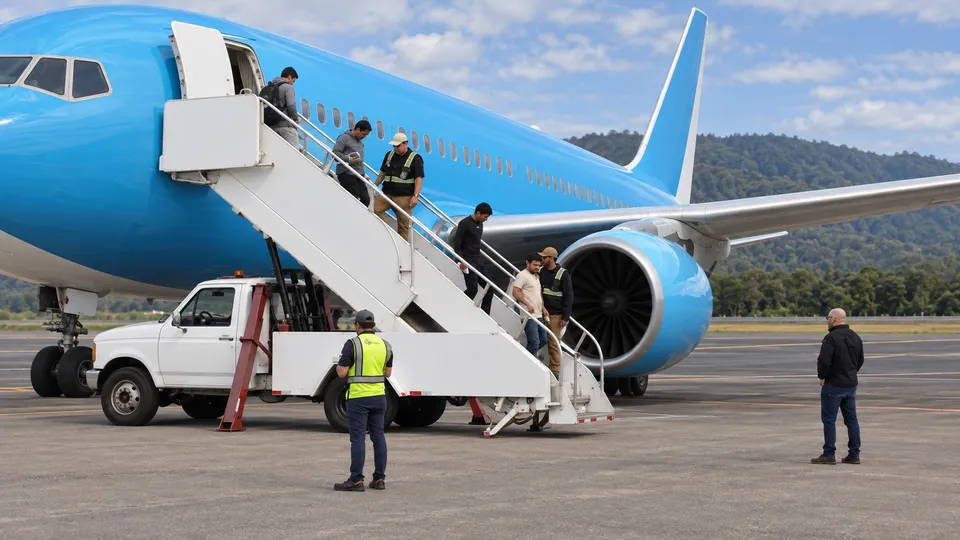
Jamaica took in its first flight of non-Jamaican deportees from the United States on Tuesday, when 22 people landed at Norman Manley International Airport in Kingston under a transit agreement the government has not made public.
The passengers were all adults, and seven of them were women. They were processed quickly and then driven by bus, with a police escort, to a location officials would not disclose, The Associated Press reported. Journalists were kept away. Officials also kept the passenger manifests and the arrival time confidential, though local sources told the AP that most of the group came from South America, according to the agency’s fuller account.
The group is expected to get 90-day landing status. The International Organization for Migration, a UN agency, will house them and is responsible for their care and their onward travel to their home countries or somewhere else, The Gleaner reported. The government had said on Monday that arrivals were close, once operating procedures were settled and the agency agreed to help.
The two countries signed the memorandum of understanding in June. It caps arrivals at 25 people every two weeks, and the program is to be suspended if 10 of them try to stay in Jamaica through asylum or other humanitarian claims. Jamaica won’t pay for it.
In a joint statement, the Ministry of National Security and Peace and the Ministry of Foreign Affairs and Foreign Trade called the deal “a transit arrangement intended to facilitate the return of Third Country Nationals” and said “no third-country national with criminal antecedents will be permitted to transit through Jamaica.”
Kamina Johnson Smith, the foreign minister, wrote on X that the agreement was negotiated “with protection of Jamaica and the Jamaican people in mind” and contains nothing “prejudicial.” She has said it can’t be released because the United States has not agreed to publish it.
That answer hasn’t satisfied the opposition People’s National Party, which called the government’s handling “unacceptable” and renewed its demand that the full text be tabled in Parliament. Fitz Jackson, the party’s spokesman on national security, said Jamaicans “are being asked to trust a secret document,” and he has called the failure to table it a “blatant contempt to the people of Jamaica.”
Mr. Jackson wants lawmakers told where the deportees will be housed, what security arrangements apply and who will monitor them. The party also wants to know what legal liability Jamaica could face and what happens when a receiving country refuses to take someone back. The opposition leader, Mark Golding, has asked repeatedly what Jamaica actually gets out of the deal.

Donna Scott-Mottley, the party’s spokeswoman on foreign affairs, said the public deserved full transparency. The party says it supports safe migration and values the partnership with Washington. It objects to putting the plan into effect without scrutiny from Parliament.
Housing has been a sore point before. In June, the security ministry dismissed as “false and misleading” claims that the migrants would be put up in St. Mary parish, saying housing was the migration agency’s job.
Jamaica is one of a growing list of countries to sign such deals with the Trump administration, which has sent migrants to Liberia, Eswatini and Paraguay, among others. The Supreme Court allowed the administration to resume third-country deportations last month, and the AP reported that the court is set to hear a challenge to the agreements.
Doubts reach past Parliament. Bishop Alvin Bailey, who leads a local evangelical alliance, asked why the United States can’t fly the migrants straight home. “We just don’t trust what the government is saying,” he said.