
Two unarmed watchmen died Friday night at a Médecins Sans Frontières clinic in Gaza City, killed by a strike the Israeli military says it carried out on purpose, against men it calls Hamas fighters. MSF says they were simply watchmen: no weapons, no uniforms but the charity’s own, at a building marked with MSF’s logo whose coordinates had already been shared with the Israeli military under the standard humanitarian deconfliction process. Those are the two accounts on the record, and neither is independently verified.
MSF said in a statement on X that it was “devastated and outraged by the killing of two of our colleagues, both watchmen,” calling the strike “a direct hit on MSF” and demanding accountability. The charity named the premises as clearly marked and its location as known to the Israeli military in advance, the baseline condition of the deconfliction system every aid group in Gaza is supposed to rely on.
The Israeli military named the dead as Ahmed Sufyan Muhammad Ali Abu Hasira and Moaz Yousef Alitsbach (the second name appears in other reporting, including the Times of Israel, as Muath Yousef Ali Subh), and said in a statement that “while also serving as terrorists, the two worked as security guards at a clinic operated by Doctors Without Borders (MSF),” describing one as a Hamas artillery-cell commander. The IDF did not publish ballistics, intercepted communications, detention records or any of the documentation it has sometimes released after contested strikes. One journalist cited by the Times of Israel pointed to a 2022 Al Jazeera photograph allegedly showing one man standing in front of a Qassam Brigades poster — third-party inference, not military evidence, and four years old.
A relative of one of the men, Ahmad Abu Haseira, said the two were unarmed and in MSF uniform at the time of the attack. A local MSF employee, Ahmad Shehada, said they were making a routine check of the clinic’s facilities when a missile struck. A Palestinian acquaintance of Abu Hasira described him to the BBC, in reporting picked up by the National, as “a peaceful, kind-hearted man” with no record of involvement in any armed group. Witnesses told the same outlet the strike came from a drone that opened fire on the men in a rear courtyard of the clinic, next to al-Shifa hospital, at around 9:10 p.m.

What deconfliction is supposed to do
Deconfliction is the mechanism by which aid groups tell a warring party where their people and buildings are, so the military can route strikes around them. MSF says it did exactly that: logo on the roof, coordinates filed with the Israeli military, as a matter of routine. If the location was known and marked, hitting it anyway is either a mistake in a system meant to prevent mistakes, or a decision to strike a known humanitarian site regardless. Israel’s own statement discloses which: it says it used precision munitions and aerial surveillance to minimize harm to civilians, and separately says it was deliberately killing two named individuals it had identified as combatants — not describing an error at all. A strike aimed precisely at men known to be inside a marked, coordinated MSF facility is not the same claim as a stray munition; the IDF’s own language rules out the second explanation.
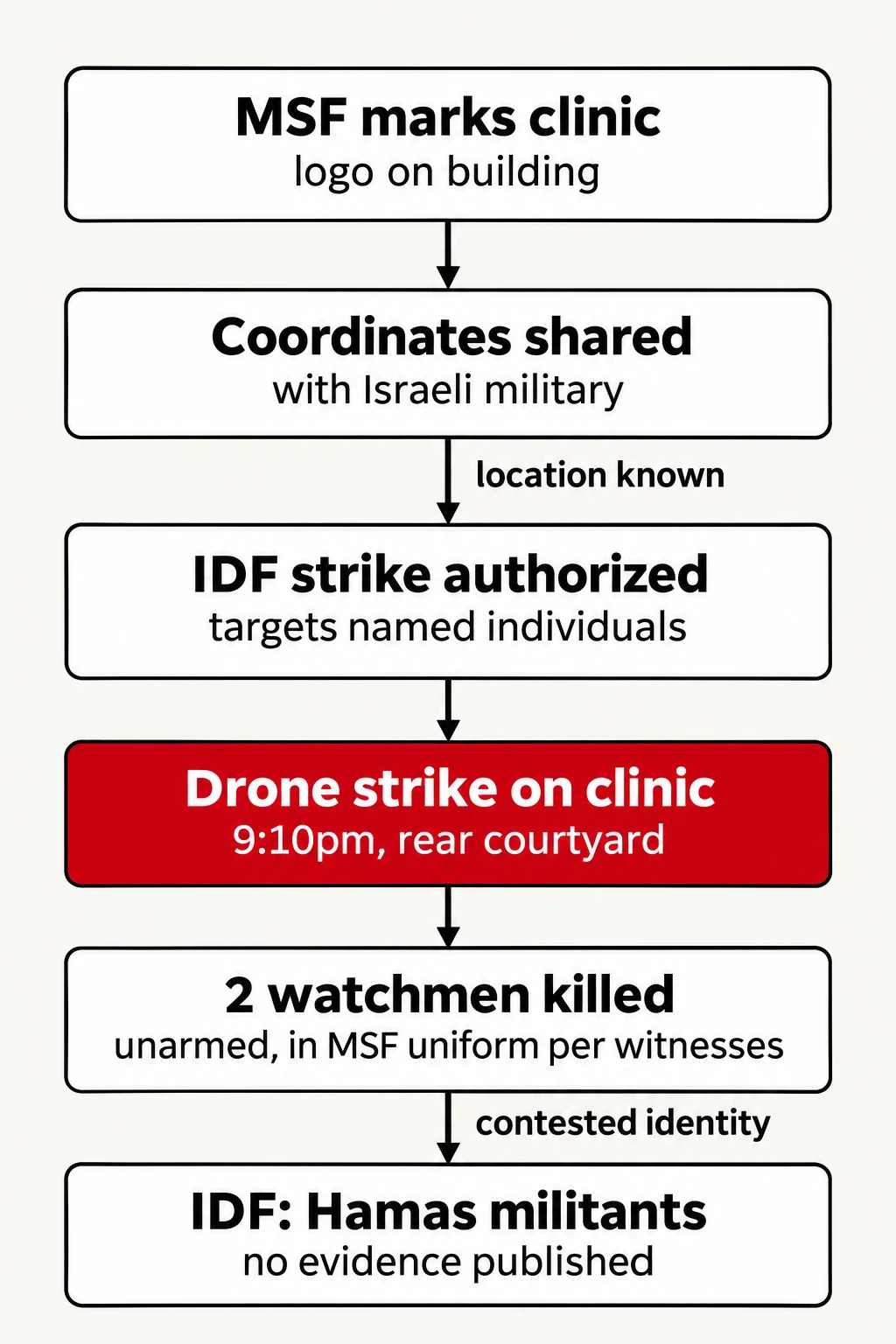
| From | To | How |
|---|---|---|
| MSF marks clinic (logo on building) | Coordinates shared (with Israeli military) | |
| Coordinates shared (with Israeli military) | IDF strike authorized (targets named individuals) | location known |
| IDF strike authorized (targets named individuals) | Drone strike on clinic (9:10pm, rear courtyard) | |
| Drone strike on clinic (9:10pm, rear courtyard) | 2 watchmen killed (unarmed, in MSF uniform per witnesses) | |
| 2 watchmen killed (unarmed, in MSF uniform per witnesses) | IDF: Hamas militants (no evidence published) | contested identity |
Based on MSF statement; IDF statement
Friday’s deaths bring MSF’s toll in Gaza to 17 staff killed since the war began on October 7, 2023 — a toll the charity itself maintains and updates with each death, which is as close to a primary count as exists for one organization’s losses. MSF has lost roughly one staff member for every 76 days of the 38-month war, a crude average that understates how front-loaded or clustered the killings have actually been; MSF has not published the full date list needed to check that.
A pattern larger than one clinic
MSF’s 17 sit inside a much larger count. The World Health Organization put the number of health workers killed in Gaza since October 2023 at more than 1,700 as of its September 2026 reporting, a figure built from the territory’s health authorities and cross-checked by WHO rather than from any single charity’s internal ledger — a different method from MSF’s own count, and one with a wider and less precise margin given the difficulty of verifying identity and cause of death at scale in an active war zone. WHO Director-General Tedros Adhanom Ghebreyesus called Friday’s strike “outrageous and unacceptable,” adding on X that “those who risk their lives to save others must be protected, not targeted.” The rights group Euro-Med Monitor went further, calling the strike part of Israel’s “systematic targeting of humanitarian personnel and facilities.”
The strike also falls inside a ceasefire that took effect in October 2025 and has not stopped Israeli strikes since. The tallies of how many Palestinians have died in that period vary by who is counting and over what window, and the gaps are wide enough to matter. The UN Human Rights Office, which verifies deaths individually before counting them, documented 1,076 Palestinian deaths in Gaza between the ceasefire’s announcement and the end of July 2026 — nine and a half months. The Palestinian Ministry of Health, which records deaths reported through the territory’s hospital system without the same individual verification step, put the figure at more than 1,400 over roughly the same period. Gaza’s Government Media Office, a Hamas-run body counting ceasefire violations rather than verified fatalities, said Israel had killed 1,690 Palestinians and injured 6,120 others in 6,405 recorded violations over 410 days — a span running into late November 2026, three and a half months longer than the UN’s window.
The chart’s three bars are not measuring the same thing precisely, which is the point: the lowest number is the only one independently verified case-by-case, and even it covers a shorter window than the two higher figures, so the true gap between methods is probably smaller than the raw numbers suggest, not larger. All three bars still land north of a thousand deaths inside a period formally labelled a ceasefire. Separately, the UN’s verified count found that of 331 people killed near the so-called yellow line through July 2026, 66 were children and 27 were women, and that in most of those verified cases there was no information indicating the victims posed a threat to Israeli forces — many were carrying out ordinary civilian activity or were killed inside tents, according to OHCHR’s findings.
Friday’s strike arrived four days after another attack on an aid worker: an Israeli strike killed Adel al-Helou, a 35-year veteran UNRWA employee, while he was distributing water in Jabalia refugee camp, according to the National’s reporting. Both episodes sit on top of the broader erosion of medical access documented in Gaza’s hospitals and the sniper positions Israeli forces have posted around a medical complex in the West Bank, and on the broader record of ceasefire violations tracked in Gaza’s week under truce.
Israel’s claim rests entirely on its own naming of the two men and the single unsourced attribution of an artillery-command role to one of them. MSF’s claim rests on a deconfliction record it says it filed and the testimony of a relative and a colleague, neither disinterested. What’s missing from the public record on either side is the kind of documentation — detention files, intercepted communications, or an independent post-strike investigation — that would let anyone outside the two institutions check which account survives contact with evidence.